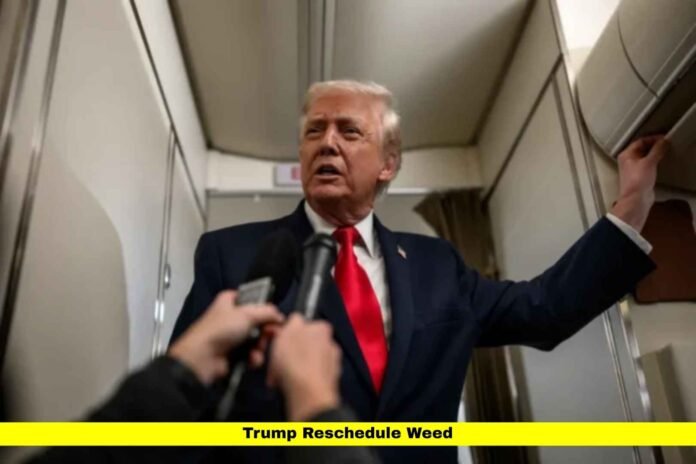

Trump reschedule weed remains one of the most closely watched federal policy developments in the United States as of today, with confirmed actions and official statements indicating renewed movement toward changing marijuana’s federal classification. The issue has returned to the national spotlight following direct signals from the Trump administration that cannabis rescheduling is being actively pursued through executive and regulatory channels.
Current Status of Trump Reschedule Weed
The Trump administration has confirmed that marijuana rescheduling is under active consideration at the federal level. Marijuana is still classified as a Schedule I controlled substance, a category reserved for drugs deemed to have no accepted medical use and a high potential for abuse. This classification has remained unchanged for decades.
Recent administrative actions have focused on accelerating the federal review process rather than introducing new legislation. The goal is to move marijuana out of Schedule I and into Schedule III, a category that recognizes medical use and allows broader research and regulatory flexibility. This process is being handled through existing federal authority rather than congressional action.
Why the Trump Administration Is Revisiting Marijuana Scheduling
The push behind trump reschedule weed centers on the growing gap between federal policy and state-level marijuana laws. A majority of U.S. states now allow medical marijuana, and many permit recreational use. Federal classification has not kept pace with these changes, creating legal and regulatory conflicts.
The administration has publicly emphasized the need for expanded scientific research. Schedule I status places heavy restrictions on clinical studies, limiting the federal government’s ability to fully evaluate marijuana’s medical benefits and risks. By rescheduling marijuana, the administration aims to remove barriers that researchers and medical institutions have faced for years.
How Rescheduling Works at the Federal Level
Rescheduling marijuana does not happen instantly. The process involves federal agencies reviewing scientific, medical, and safety data. The Department of Health and Human Services evaluates medical use and abuse potential, while the Drug Enforcement Administration oversees the final classification under the Controlled Substances Act.
Trump reschedule weed efforts rely on directing these agencies to move faster and complete stalled proceedings. An executive order can instruct agencies to prioritize the review, but the actual rescheduling must still follow established regulatory procedures. This distinction is important because it explains why the process has taken time despite public announcements.
What Would Change if Marijuana Moves to Schedule III
If marijuana is officially moved to Schedule III, several meaningful changes would follow at the federal level. Scientific research would become easier, as universities and laboratories would face fewer approval hurdles. This could lead to more comprehensive studies on medical applications, dosage standards, and long-term effects.
For cannabis-related businesses, rescheduling could significantly affect taxation. Under current law, marijuana companies are blocked from deducting normal business expenses because of Schedule I status. A move to Schedule III would remove this restriction, improving profitability and financial stability across the industry.
Banking access may also improve. Many financial institutions remain cautious due to federal restrictions. Rescheduling could reduce perceived legal risk, making it easier for cannabis businesses to access loans, payment processing, and insurance services.
What Rescheduling Does Not Do
It is important to clarify what trump reschedule weed does not accomplish. Rescheduling does not legalize recreational marijuana nationwide. Federal prohibition would remain in place, and states would continue to set their own marijuana laws.
Criminal penalties under federal law would still exist, although enforcement priorities could evolve. Rescheduling also does not automatically expunge past convictions or change sentencing guidelines. Those actions would require separate legislative or executive steps.
Political and Legal Considerations
Marijuana rescheduling remains politically sensitive. Some lawmakers argue that only Congress has the authority to fundamentally change federal drug policy. Others support executive action as a practical step forward when legislation stalls.
Legal experts note that while a president can influence the process, federal agencies must still follow administrative law. This means public comment periods, internal reviews, and formal rulemaking remain part of the timeline. These requirements explain why rescheduling cannot happen overnight, even with strong executive support.
Industry and Market Reaction
The cannabis industry has responded strongly to trump reschedule weed developments. Investors view rescheduling as a signal of long-term federal acceptance, even without full legalization. Market confidence tends to rise when federal barriers appear likely to ease.
Industry leaders have framed rescheduling as a foundational reform. While it does not resolve every legal challenge, it addresses some of the most pressing obstacles related to research, taxation, and financial access. Many see it as a necessary step toward broader reform in the future.
Public Opinion and State-Level Impact
Public support for marijuana reform continues to grow across political lines. Medical marijuana has broad acceptance, and federal rescheduling aligns more closely with public attitudes than the current Schedule I classification.
At the state level, rescheduling would not override local laws. States with legal marijuana would continue operating under their existing frameworks. States where marijuana remains illegal would retain the authority to enforce their own restrictions.
However, federal rescheduling could reduce conflicts between state and federal authorities. It may also encourage additional states to revisit their own marijuana policies with greater confidence in federal direction.
What Comes Next
The next phase of trump reschedule weed depends on administrative follow-through. Federal agencies must complete their reviews and issue formal decisions. While timelines can shift, the process is now clearly moving forward rather than remaining stalled.
Observers are watching for official announcements confirming agency action and regulatory milestones. These steps will determine how quickly rescheduling becomes a reality and how broadly its effects are felt across the country.
Why This Matters to Americans
Federal marijuana classification affects far more than cannabis users. It influences medical research, healthcare policy, small business growth, tax revenue, and law enforcement priorities. Rescheduling marijuana reflects a broader shift in how the federal government approaches drug policy in a changing legal and social landscape.
For many Americans, this issue represents a rare area of bipartisan interest and practical reform. While debates continue, the current movement signals that long-standing federal policies are no longer immune to reevaluation.
Trump reschedule weed is shaping up to be one of the most significant federal drug policy developments in years—share your thoughts below and stay connected as this story continues to evolve.