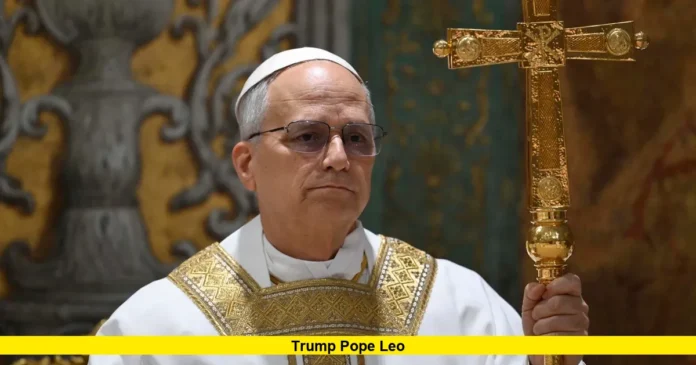

Trump Pope Leo has quickly become one of the most discussed phrases in both political and religious conversations across the United States. It represents a historic moment when Pope Leo XIV, the first American-born pontiff, openly addressed U.S. political discourse, military language, and immigration policy in ways that few of his predecessors dared. His recent statements signal a shift in the Vatican’s approach to global affairs and highlight his willingness to directly challenge rhetoric tied to Donald Trump’s influence and legacy.
At a time when American politics is sharply divided, Pope Leo’s words have resonated far beyond Catholic circles. They have sparked debate about morality in government, consistency in political values, and the role of the Church in shaping national conscience. The phrase Trump Pope Leo now encapsulates not just a headline, but a defining clash of ideals.
Why Pope Leo’s Comments Matter Now
Papal interventions in politics are not unheard of, but they are rare in American contexts. Traditionally, the Vatican emphasizes diplomacy and indirect guidance rather than explicit critiques of U.S. leaders. Pope Leo XIV has taken a different path.
His decision to directly comment on U.S. military and immigration rhetoric reflects the gravity of the current moment. With international conflicts intensifying and domestic debates over immigration and “pro-life” values growing sharper, the Pope evidently sees moral clarity as more important than political caution.
The phrase Trump Pope Leo underscores how his words directly intersect with Trump-era policies, reminding Americans that religious authority can still influence public debate in profound ways.
Military Language and the Rise of War Rhetoric
One of Pope Leo’s strongest warnings came in response to the use of aggressive military language in Washington. He expressed concern about calls to increase “lethality” in U.S. defense operations and the subtle shift from describing America’s military leadership as “defense” to framing it in terms of “war.”
This might sound like a small semantic detail, but to the Pope, words shape moral realities. When a nation begins speaking more casually about war, it risks normalizing violence. Pope Leo emphasized that leaders have a duty to choose words carefully, because rhetoric has consequences — not only for policy but also for the moral imagination of the people.
By speaking this plainly, he placed himself at the center of a conversation Americans often relegate to politicians and military experts. His stance insists that even in matters of national security, conscience and morality must remain guiding lights.
Immigration and the Meaning of Pro-Life
Another pillar of Pope Leo’s intervention came in his critique of immigration policies. He pointed out the inconsistency in claiming to uphold a “pro-life” ethic while simultaneously supporting harsh treatment of migrants and refugees.
In his words, protecting life cannot end at birth. True respect for life must extend to protecting the vulnerable, including those seeking safety at borders. His message challenges political leaders — many of whom appeal to Christian values — to reconsider whether their policies align with the principles they claim to defend.
The phrase Trump Pope Leo therefore does not only describe a political clash but also highlights a deeper moral question: can a society truly be “pro-life” if it neglects the dignity of immigrants and marginalized communities?
This point has stirred heated reactions within the United States. Some religious leaders welcomed the Pope’s honesty, saying it offers a fuller vision of life. Others criticized him, arguing that the Church should avoid blurring lines between abortion debates and immigration issues. Regardless of the pushback, his words have forced a conversation that will not fade quickly.
Trump, Gaza, and the Quest for Peace
Beyond domestic issues, Pope Leo also touched on international peace efforts, particularly Donald Trump’s proposed framework for resolving the Gaza crisis. He acknowledged that parts of the plan contained constructive elements and urged opposing parties to engage in dialogue.
While he stopped short of fully endorsing the proposal, his willingness to engage showed a pragmatic side to his leadership. The Pope’s approach reflects his vision that even imperfect political strategies can contain opportunities for peace. His hope, as he made clear, is that leaders across the Middle East would seize those opportunities before the conflict deepens further.
The use of Trump Pope Leo in this context reflects a broader truth: the Pope is unafraid to evaluate Trump’s influence on global affairs, praising where he sees constructive efforts while sharply criticizing language or policies he views as morally harmful.
U.S. Reaction and Catholic Divisions
Reactions to Pope Leo’s remarks have been mixed and intense.
- White House officials defended their policies, rejecting claims of inhumanity and arguing that the administration acts within lawful and moral boundaries.
- Catholic bishops remain divided. Some publicly support the Pope’s call to view pro-life values as comprehensive and consistent across issues. Others worry that his approach could alienate Catholics who identify strongly with conservative political priorities.
- Everyday Catholics are equally split. Many praise Pope Leo for addressing what they see as moral contradictions. Others believe he risks politicizing the Church, potentially weakening its influence.
This tension illustrates the challenge of being both a global spiritual leader and a commentator on national politics. Yet it also shows why Trump Pope Leo has become a phrase of such weight: it captures the intersection of faith, power, and conscience in real time.
The Deeper Moral Questions at Stake
Beneath the headlines, Pope Leo’s intervention raises fundamental questions for both Americans and Catholics worldwide:
- Can political leaders claim moral consistency if they prioritize some aspects of life while neglecting others?
- How should military strength be balanced with the pursuit of peace?
- Is the Church’s role to stay neutral in politics, or to act as a moral compass even when it stirs controversy?
- What does it mean for American Catholics when their Pope critiques the very leaders many of them support?
The conversation sparked by Trump Pope Leo is not about partisanship alone. It is about the ongoing struggle to align political power with ethical responsibility.
Global Implications of the Trump Pope Leo Moment
The influence of this moment stretches beyond America. Around the world, leaders are watching how the U.S. responds to moral critique from the Vatican. Allies and adversaries alike may view the Pope’s words as a signal of how global institutions see U.S. policies.
For the Vatican, this could mark a shift toward a more outspoken papacy — one less afraid to confront power directly. For the U.S., it could open new debates about how faith and governance intersect in an era when both religion and politics remain deeply polarizing forces.
What Comes Next
Looking ahead, the Trump Pope Leo moment may unfold in several ways:
- The Vatican could issue more formal teachings expanding on Pope Leo’s remarks.
- U.S. Catholic leaders may clarify their own positions, either aligning more closely with the Pope or distancing themselves.
- Political debates in the 2028 election cycle may include stronger references to the Pope’s critiques, especially among Catholic candidates.
- Ordinary believers may grow more vocal about whether they want the Church to remain a guiding moral force in politics.
Whatever happens, it is clear that Pope Leo’s words have already changed the conversation.
Conclusion: The Legacy of Trump Pope Leo
Trump Pope Leo is more than a phrase — it symbolizes a moment when moral clarity collided with political power. Pope Leo XIV has shown that he is willing to speak boldly on issues of war, immigration, and peace, even if it unsettles leaders or divides the faithful.
His intervention reminds us that politics cannot be separated from conscience, and that words carry as much weight as policies themselves. Whether one agrees with him or not, his message challenges everyone to think more deeply about the kind of society we are building.
As the conversation around Trump Pope Leo continues, what do you think — should religious leaders step into politics this directly, or should they remain above the fray? Share your thoughts in the comments and keep the discussion going.