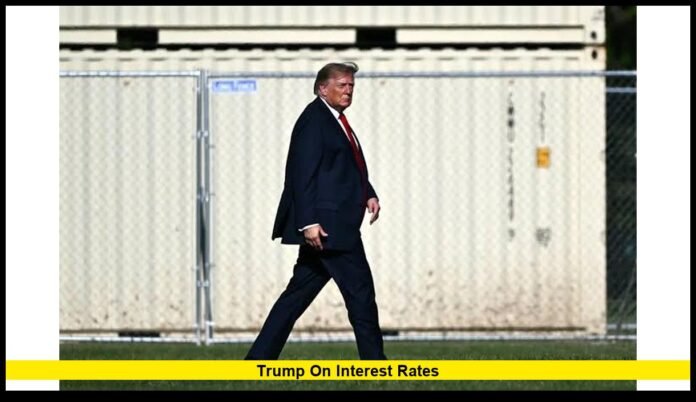

Trump on interest rates is back in focus after the Federal Reserve raised its benchmark rate on September 16, 2026, despite President Donald Trump’s repeated calls for much lower borrowing costs. The Fed increased the federal funds target range by a quarter percentage point to 3.75%–4%, marking its first rate increase since 2023.
The decision has created a sharp policy contrast between the White House and the central bank. Trump has argued that the United States should have substantially lower interest rates, while Federal Reserve Chair Kevin Warsh and other policymakers have emphasized the need to address inflation that remains above the Fed’s 2% objective.
The latest developments matter because the Fed is no longer signaling that lower rates are the immediate direction of policy. Instead, its September projections point toward another possible increase before the end of 2026.
Trump Calls for Interest Rates of 1% or Less
Following the Federal Reserve’s decision, Trump renewed his demand for significantly lower U.S. interest rates.
In a September 16 post on Truth Social, Trump said U.S. interest rates should be 1% or less. He argued that the country’s credit standing justified exceptionally low borrowing costs and called for rates to be reduced quickly.
The comments came only hours after the Fed delivered a quarter-point increase.
Trump’s position represents a substantial difference from the central bank’s latest policy decision. The Fed moved in the opposite direction, saying that inflation remains elevated and that the rate increase would help support a more timely return to its 2% inflation goal.
The president had also expressed his preference for low rates before the September meeting. Ahead of the decision, he said the United States should have the lowest interest rates in the world and questioned whether the Fed would raise borrowing costs.
The latest statement therefore continues a broader pattern of presidential pressure for lower rates rather than representing an entirely new position.
Federal Reserve Raises Rates for the First Time Since 2023
The Federal Reserve’s September decision was one of the most significant developments in U.S. monetary policy this year.
The Federal Open Market Committee voted 12–0 to increase the federal funds target range by 25 basis points, moving it from 3.50%–3.75% to 3.75%–4%.
The central bank said economic activity was expanding at a solid pace. It also pointed to resilient domestic spending, strong productivity growth and robust capital investment.
At the same time, inflation remained a major concern.
The Fed’s statement said inflation was still elevated. Officials said the latest policy move was intended to support a timelier return to the central bank’s 2% inflation objective.
The unanimous vote is also notable because Kevin Warsh, who became Federal Reserve chair earlier in 2026, participated in the decision.
The rate increase means the central bank is currently prioritizing inflation control even as political pressure for lower rates continues.
Why the Fed Is Moving Higher Instead of Cutting
The central issue behind the disagreement is inflation.
The Fed’s September economic projections show a median forecast of 3.7% for headline personal consumption expenditures inflation in 2026. That is substantially above the central bank’s 2% longer-term goal.
Officials expect inflation to ease gradually. The median projection puts PCE inflation at 2.3% in 2027, 2.1% in 2028 and 2% in 2029.
Core PCE inflation, which excludes food and energy prices, was projected at 3.4% for 2026 and 2.5% for 2027.
Those forecasts help explain why policymakers are not immediately following calls for aggressive rate cuts.
Higher interest rates can slow demand by increasing borrowing costs. The Fed uses monetary policy to balance price stability and maximum employment, and policymakers have indicated that inflation remains too high to ignore.
The September statement also said unemployment had changed little and that job gains had kept pace with the workforce. That gave policymakers additional room to focus on inflation rather than responding to a rapidly deteriorating labor market.
Fed Projections Point to Another Increase
The September projections provide another important detail.
The median Federal Reserve projection for the federal funds rate is 4.1% at the end of 2026. With the current target range centered around 3.875%, that projection is consistent with another quarter-point increase.
Reuters reported that 16 of 18 policymakers projected another rate increase during 2026, although individual views differed about the timing and longer-term path.
The Fed’s projections are not promises. They represent individual policymakers’ expectations about the appropriate policy path based on the economic information available at the September meeting.
That distinction is important because future decisions will depend on inflation, employment, economic growth, financial conditions and other developments.
The median projection also shows a gradual decline after the expected 2026 peak. The federal funds rate is projected at 4.1% for 2027, 3.9% for 2028 and 3.6% for 2029.
Kevin Warsh Takes a Different Approach From Trump’s Rate Demands
The relationship between Trump and Fed Chair Kevin Warsh is particularly significant.
Warsh was appointed by Trump and entered the chairmanship earlier this year. Yet the September decision shows that his leadership of the central bank does not automatically translate into the very low rates the president has publicly advocated.
Warsh joined the unanimous decision to raise rates.
Reuters reported that Warsh emphasized the need to respond to inflation and avoided committing the Fed to a predetermined path for future policy.
That approach is consistent with the Federal Reserve’s institutional role. Monetary policy decisions are made by the FOMC rather than by the president.
The September decision therefore demonstrates a clear distinction between presidential preferences and the central bank’s policy process.
Trump has continued to advocate lower rates, but the Fed’s latest action shows that policymakers are making their decisions based on their assessment of economic conditions.
White House Reacts to the Rate Increase
The White House also criticized the September rate increase.
The administration described the decision as unfortunate, reflecting the disagreement between the president’s preferred direction for borrowing costs and the Federal Reserve’s approach to inflation.
Trump’s latest comments were more direct than some of his earlier statements.
His argument centers on the view that lower interest rates could reduce borrowing costs and support economic activity. The president has repeatedly argued that the United States should benefit from much cheaper credit.
The Federal Reserve, however, is focused on maintaining price stability as part of its dual mandate.
The difference between the two positions is straightforward: the White House is pressing for substantially cheaper borrowing, while the Fed is currently concerned that inflation remains high enough to justify tighter monetary policy.
What the September Fed Decision Means for Borrowers
The federal funds rate does not directly determine every consumer interest rate.
However, changes in the Fed’s benchmark policy rate can influence borrowing conditions across the economy.
Credit cards, adjustable-rate loans and other forms of variable-rate borrowing can respond relatively quickly to changes in short-term interest rates.
Mortgage rates work differently. They are influenced heavily by longer-term Treasury yields and expectations about future monetary policy, inflation and economic growth.
Business borrowing costs can also change as financial markets respond to the Fed’s decisions.
The September increase therefore does not mean every household will immediately see its borrowing costs rise by exactly 0.25 percentage point. The effect varies depending on the type of financial product, its pricing structure and market conditions.
For savers, higher interest rates can also provide support for certain deposit and savings products, although the effect varies among banks and financial institutions.
Inflation Remains the Central Issue
The Fed’s latest projections make inflation the key issue behind the current policy debate.
The central bank’s 2026 median PCE inflation forecast increased to 3.7%, compared with the 3.6% projection issued in June. Core PCE inflation was also projected at 3.4% for 2026, up from 3.3% in the June projection.
The Fed still expects inflation to decline over time.
Its projections show headline PCE inflation reaching 2.3% in 2027 and 2.1% in 2028 before reaching 2% in 2029.
That timeline matters because it suggests policymakers do not expect inflation to return immediately to target.
The central bank therefore appears prepared to maintain a restrictive policy stance while it evaluates whether inflation is moving sustainably lower.
Economic Growth Remains Resilient
The latest projections do not show a U.S. economy in an immediate contraction.
The Fed’s median forecast puts real GDP growth at 2.3% for 2026 and 2.4% for 2027. Growth is projected at 2.2% in 2028 and 2.1% in 2029.
The unemployment rate is projected at 4.1% in each year from 2026 through 2029 under the median forecast.
Those figures provide important context for the rate decision.
The Fed is dealing with elevated inflation while economic activity remains relatively solid. Policymakers therefore have more flexibility to keep rates higher than they might if unemployment were rising sharply or economic output were falling.
What Comes Next for U.S. Interest Rates
The next policy decisions will depend heavily on incoming economic data.
The Fed has not committed to a specific date for another increase. Its projections point toward another hike during 2026, but the actual decision will depend on how inflation, employment and economic activity develop.
The September projections should therefore be viewed as a snapshot rather than a fixed schedule.
If inflation remains elevated, policymakers could maintain or increase restrictive policy. If inflation falls more quickly than expected, the policy discussion could change.
Financial markets will also continue to react to signals from Fed officials.
The key issue for the remainder of 2026 is whether inflation begins moving consistently toward 2% or remains high enough to require additional tightening.
The Growing Policy Gap Between Trump and the Fed
The latest developments have made the difference between Trump’s position and the Fed’s current policy direction particularly visible.
Trump is calling for rates at 1% or below. The Fed’s current target range is 3.75%–4%, following the September increase.
The gap is therefore substantial.
At the same time, the Fed’s projections show that policymakers expect rates to remain above 4% at the end of 2026 under the median forecast.
That does not mean the Fed will necessarily follow that exact path. Policymakers can change their projections as economic conditions change.
It does show, however, that the central bank’s current outlook is far removed from the president’s stated preference for rates of 1% or less.
What Readers Should Watch Now
Several indicators will be important in determining how the debate develops.
- Inflation data: Future readings will help show whether price pressures are easing.
- Employment data: Labor-market strength will influence how much room the Fed has to prioritize inflation.
- Consumer spending: Continued demand could affect inflation pressures.
- Energy prices: Changes in oil and other energy costs can influence headline inflation.
- Fed communications: Speeches and interviews from policymakers can provide clues about future decisions.
- Future FOMC meetings: The committee will reassess economic conditions before every policy decision.
The central question is whether inflation will cool enough to allow interest rates to move lower or whether policymakers will conclude that additional tightening is necessary.
For now, the September decision provides a clear answer about the Fed’s immediate direction: the central bank has moved rates higher rather than lower.
Latest Outlook
The most recent information shows a major difference between the president’s preferred interest-rate policy and the Federal Reserve’s current approach.
Trump has called for U.S. interest rates of 1% or less. The Federal Reserve has instead raised its benchmark range to 3.75%–4% and signaled that another increase could come before the end of 2026.
The Fed says elevated inflation remains a major concern. Its latest projections put 2026 PCE inflation at 3.7%, well above the central bank’s 2% target.
At the same time, economic activity remains solid, unemployment has changed little and policymakers expect continued economic growth.
That combination leaves the interest-rate debate centered on inflation rather than an immediate shift toward aggressive cuts.
As new inflation, employment and economic data arrive, investors, businesses and households will be watching closely for signs of whether the Federal Reserve continues tightening or eventually begins moving toward lower rates.
Frequently Asked Questions
1. What did Trump say about U.S. interest rates?
Trump said on September 16 that U.S. interest rates should be 1% or less and called for lower rates after the Federal Reserve raised its benchmark rate.
2. What is the current Federal Reserve interest-rate range?
Following the September 16 decision, the federal funds target range is 3.75% to 4%.
3. Could the Fed raise rates again in 2026?
Yes. The Federal Reserve’s September projections show a median federal funds rate of 4.1% at the end of 2026, consistent with another quarter-point increase, although projections are not guarantees.
Disclaimer: This article is provided for general news and informational purposes only. Interest-rate decisions, economic forecasts and policy expectations can change as new information becomes available. It should not be considered financial, investment, tax or economic advice.