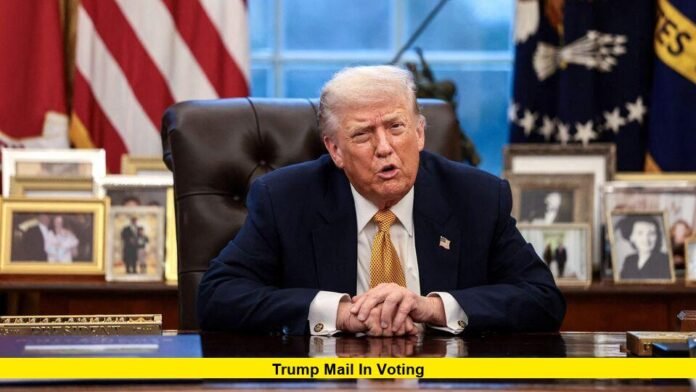

A federal appeals court has dealt another legal setback to President Donald Trump’s push to overhaul how mail-in ballots are handled ahead of the November 2026 midterm elections, ruling that his administration cannot enforce tighter voting rules in 23 states and the District of Columbia while litigation continues.
The decision, handed down on Saturday, July 25, 2026, by the 1st U.S. Circuit Court of Appeals in Boston, marks the latest chapter in a monthslong court battle over Executive Order 14399, the sweeping directive Trump signed in March 2026 that sought to give the federal government unprecedented influence over how states verify voter eligibility and process ballots sent through the mail.
NEED TO KNOW
🔲 A federal appeals court on July 25, 2026, refused to let the Trump administration enforce parts of Executive Order 14399 in 23 Democratic-led states and Washington, D.C.
🔲 The 1st Circuit’s 2-1 ruling upheld a June 25, 2026, injunction from U.S. District Judge Indira Talwani, who found key sections of the order unconstitutional.
🔲 The order had directed the Department of Homeland Security to compile “Confirmed Citizen Lists” of eligible voters and instructed the U.S. Postal Service to withhold delivery of ballots from voters not on state-approved rolls.
🔲 Judge Talwani ruled that the Constitution reserves the power to determine voter eligibility to the states, not the president, and that Congress never gave USPS authority to control mail-in voting.
🔲 The Department of Justice has warned it may now escalate the fight to the U.S. Supreme Court, setting up a possible high-stakes ruling just months before Election Day.
🔲 The case is playing out alongside a separate, parallel legal track in Washington, D.C., where a different appeals court has at times sided with the administration on narrower USPS-related questions.
What the Court Decided
In its 2-1 ruling issued Saturday, the 1st Circuit panel declined to lift the injunction that Talwani had issued a month earlier, finding that the Trump administration had not shown it would suffer irreparable harm by waiting for the appeal to play out in full. The majority opinion pointed to the compressed election calendar as a central reason for keeping the order on hold. A federal appeals court on Saturday declined to allow President Donald Trump’s administration to implement in 23 states his executive order that aims to tighten rules for mail-in voting ahead of November elections that will decide control of Congress.
The judges were direct about the practical pressure facing state election officials. The 1st U.S. Circuit of Appeals declined to lift a lower-court injunction from June that ruled parts of President Trump’s order was unconstitutional after Democratic-led states, including California, Massachusetts and Washington, sued the administration, and the appeals court rejected the administration’s appeal in a 2-1 decision. The majority reasoned that the order set rapidly approaching deadlines requiring states to coordinate with federal officials and adjust procedures while also keeping the public informed of shifting rules governing the September and November elections, and concluded the plaintiff states had no real choice but to respond immediately rather than wait for the case to fully resolve.
The ruling was not unanimous. One judge on the three-member panel dissented, reflecting the deeper partisan and legal divide over how much authority the executive branch has to intervene in what has traditionally been state-run election administration.
Notably, the appeals court fight over this executive order has not moved in a straight line. Just over a week before Saturday’s ruling, a separate panel — the D.C. Circuit Court of Appeals — had handed the administration a narrower, temporary win. A federal appeals court in Washington, D.C., handed the Trump administration a temporary win, putting on hold a lower court ruling which had blocked the U.S. Postal Service from attempting to restrict mail-in voting, though the Trump administration did not yet have a green light to move forward nationwide with the proposed rule. That D.C. Circuit decision, however, applied to a different, USPS-specific piece of litigation and did not disturb the broader injunction Talwani issued against the 23 states and D.C. — the injunction Saturday’s ruling just reaffirmed.
The Order at the Center of the Fight
Executive Order 14399, titled “Ensuring Citizenship Verification and Integrity in Federal Elections,” was signed by Trump in March 2026 after years of the president publicly calling for stricter mail voting rules and repeating unsubstantiated claims that his 2020 election loss resulted from widespread fraud. The order challenged Sections 2, 3, and 5. Section 2 directed federal agencies to compile “Confirmed Citizen Lists” for each state, derived from federal citizenship and naturalization records, Social Security Administration records, SAVE data, and other federal databases. Section 3 went further, directing the U.S. Postal Service to create rules for mail-in voting, under which states would give USPS lists of voters approved to receive mail-in ballots, and ballots from voters not enrolled with USPS would not be transmitted.
The order also instructed the Justice Department to prioritize investigating and prosecuting state and local election officials who issue federal ballots to people the administration deemed ineligible to vote — a provision voting rights advocates argued was designed to intimidate local officials into compliance regardless of the law’s actual requirements.
Twenty-three states and the District of Columbia — led by California, Massachusetts, Nevada, and Washington — filed suit shortly after the order was signed, arguing it violated the constitutional separation of powers and infringed on states’ exclusive authority to run their own elections. At least five separate lawsuits were ultimately filed challenging the order, including one brought by a coalition of voting rights groups led by the League of Women Voters.
Timeline: How the Legal Battle Unfolded
March 2026 — President Trump signs Executive Order 14399, directing DHS to compile citizen voter lists and USPS to restrict delivery of mail ballots from unverified voters, and instructing DOJ to prioritize prosecution of noncompliant election officials.
Spring 2026 — Twenty-three states, the District of Columbia, and voting rights organizations including the League of Women Voters file separate lawsuits challenging the order’s constitutionality.
June 2026 — USPS publishes a proposed rule detailing how it would decline to deliver mail ballots in states that had not turned over voter eligibility lists to the federal government, citing the executive order as its authority.
June 25, 2026 — U.S. District Judge Indira Talwani, ruling on the case brought by the 23 states and D.C., blocks the order’s key provisions, finding them unconstitutional. Talwani called Trump’s attempt to use federal oversight of the Postal Service to regulate mail voting “unlawful, null, and void,” writing that “the Constitution reserves the power to determine voter eligibility to the States alone,” and that “the President lacks any authority to compile voter lists for each State.”
Early June 2026 — During a related hearing, Talwani presses the administration on the real-world stakes of its position, asking pointedly, “What’s the harm if I say no one can use this list for the November election?”
July 2026 — The Trump administration appeals Talwani’s injunction to the 1st Circuit and separately pursues USPS-specific relief through the D.C. Circuit.
July 17, 2026 — The D.C. Circuit Court of Appeals pauses a separate district court order that had blocked USPS from advancing its proposed mail ballot rule, giving the administration a narrow, temporary procedural win on that specific front while Talwani’s broader injunction remains in place.
July 25, 2026 — The 1st Circuit rules 2-1 against the administration, declining to lift Talwani’s injunction and leaving the executive order blocked in the 23 states and D.C. through the November elections.
Ahead — The Justice Department has signaled it may ask the U.S. Supreme Court to intervene, setting up the possibility of an emergency high-court ruling in the weeks or months before Election Day.
Analysis: Why This Case Keeps Splitting Courts
What makes this legal fight unusual is how differently two separate appellate courts have approached closely related questions in the span of about a week. The D.C. Circuit’s July 17 ruling and the 1st Circuit’s July 25 ruling might look, at a glance, like contradictory outcomes on the same dispute. They are not. The D.C. Circuit case centers narrowly on whether USPS’s proposed mail-ballot rule violates a 2021 court-enforced settlement the Postal Service reached with the NAACP over election-mail delivery timelines — a dispute over agency procedure and ripeness. The panel found that USPS had made a strong showing that it is likely to succeed on the argument that the NAACP’s challenge to the proposed rule is not yet ripe for review, and that the rule likely would not violate the settlement even if finalized. The judges also ruled USPS demonstrated it would suffer “irreparable harm” if unable to finalize and implement the rule by the November midterms, writing that there “can be no do over.”
The 1st Circuit case, by contrast, goes to the heart of the executive order’s constitutionality — whether a president has any inherent authority to direct DHS to build citizen voter lists or direct USPS to police mail ballot delivery at all. That is a fundamentally larger question about separation of powers, and it is the one federal courts have consistently sided against the administration on so far. As one legal commentary piece on the broader fight put it, the narrower procedural win for USPS should not be read as validation of the executive order itself, since the Trump administration rule remains stalled under a separate court order, and the president’s executive order remains blocked in nearly two dozen states due to a Boston-based federal judge’s ruling that predates and outlasts the D.C. Circuit’s narrower procedural pause.
This is also why national outlets have covered the story with noticeably different emphases depending on when their piece published. Coverage from mid-July, following the D.C. Circuit’s USPS ruling, tended to frame the story as a “win” for Trump, with headlines describing a “legal victory” even as reporters acknowledged that the Trump administration does not yet have a green light to move forward nationwide with the proposed rule, and a separate judge in Massachusetts blocked the policy last month in the 23 states and the District of Columbia that brought the lawsuit, with that injunction still standing. Coverage from Saturday, July 25, tells a more consequential story: the core of the executive order itself — not just a procedural side issue — remains legally dead in the water for this election cycle, at least for now.
The Constitutional Question at the Core
Talwani’s original June 25 opinion, which the 1st Circuit just upheld, rests on a relatively narrow but consequential reading of the Constitution’s elections clauses. Her opinion emphasized that the Constitution lodges power over congressional elections in state legislatures primarily and in Congress ultimately, and that the president plays no role in the regulation of elections. She further found that Congress has not delegated authority to USPS to sort the mail, let alone to refuse to transmit mail ballots for certain voters, and that the executive order, in fact, directs the violation of several obligations imposed on USPS by Congress.
That reasoning tracks a broader legal consensus among the judges who have reviewed pieces of Trump’s election agenda so far. Judges have blocked an earlier executive order Trump signed requiring proof of citizenship to register to vote and restricting the counting of mail ballots, and under the Constitution, states are assigned the role of administering federal elections. The mail-in voting order is not an isolated legal effort, either — it sits alongside a divisive package of voting restrictions called the SAVE America Act that Trump has made a priority in Congress.
What Happens Next
With the 1st Circuit’s ruling now in place, the administration’s options narrow considerably heading into the fall campaign season. Before Talwani ruled, a federal judge in Washington, D.C., had rejected a related effort by Democrats to block Trump’s order on similar grounds, and the Justice Department has warned that absent a favorable ruling from the 1st Circuit, it may be forced to ask the U.S. Supreme Court to intervene.
Legal observers note that any Supreme Court intervention would likely come on an emergency, or “shadow docket,” basis given the tightening election calendar, rather than through the court’s normal, monthslong briefing and argument process. Whether the justices would even agree to take up the case before November — let alone how they might rule — remains an open question. Some commentary has pointed to the Supreme Court’s recent posture in a related case as a modest signal of caution about disrupting mail voting close to Election Day, though the court’s composition means the outcome is far from settled. Trump will almost certainly appeal Talwani’s ruling, and it may be affirmed if it reaches the Supreme Court, though the high court is closely divided, and it would take just one vote to flip and uphold Trump’s executive order.
For now, election officials in the 23 affected states and Washington, D.C. — a group that includes major battlegrounds where control of the House and Senate could be decided — can continue preparing for the November elections under existing state-level mail voting procedures, without the added burden of complying with a federal citizen-list mandate or a USPS ballot-delivery gatekeeping system. That certainty, however, remains conditional on how the appeals and any Supreme Court proceedings unfold over the coming months.
The legal fight over mail-in voting is far from over, but for now, the courts have kept the rules of the road unchanged for millions of voters heading into a pivotal November.