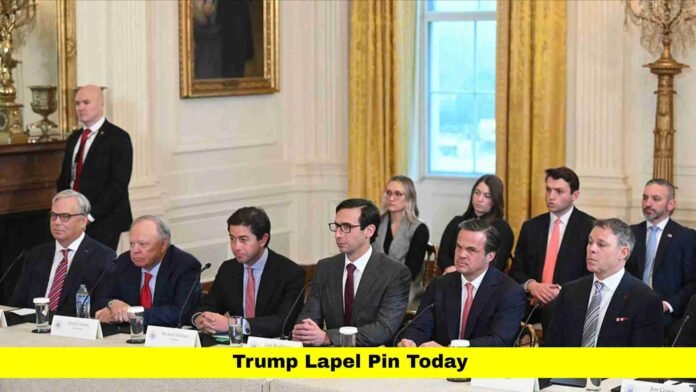

President Trump drew national attention by wearing a cartoon-style lapel pin of himself during a White House energy meeting, blending humor with high-level policy discussions.
The unexpected accessory quickly became a visual symbol of modern, personality-driven political communication.
WASHINGTON, D.C. — A small accessory created a big moment inside the White House this week when President Donald Trump appeared at a high-profile meeting wearing an unexpected and instantly recognizable lapel pin. The pin, featuring a cartoon-style image of the president himself, quickly became the visual focal point of the event and ignited widespread discussion across television, social media, and political circles. The phrase trump lapel pin today began trending almost immediately as viewers tried to understand the meaning, message, and timing behind the unusual choice.
What might have gone unnoticed in another setting became a defining snapshot of the day, not only because of its playful design but also because of the serious policy discussion taking place at the same time. The contrast between lighthearted symbolism and weighty geopolitical issues is what turned this brief visual detail into a national talking point.
A High-Stakes Meeting With an Unexpected Detail
The moment unfolded during a White House meeting between President Trump and senior executives from major U.S. energy companies. The discussion focused on American energy interests abroad, particularly the future of U.S. involvement in Venezuela’s oil sector following recent political changes in the region.
As cameras rolled and reporters gathered, attention shifted almost instantly to the president’s suit jacket. Alongside the traditional American flag pin sat a second accessory: a brightly colored, cartoon-style pin depicting a smiling version of Donald Trump. The exaggerated features and cheerful expression stood in stark contrast to the seriousness of the meeting’s agenda.
When asked about it, the president leaned into the moment. He identified the pin as “Happy Trump” and explained that it had been given to him as a gift. He then added a remark that blended humor with political messaging, stating that he is never truly happy until the country reaches what he considers its full potential.
That brief exchange transformed the accessory from a curiosity into a headline-making symbol.
What the Lapel Pin Looks Like
The pin itself is small but visually striking. It shows a cartoon-like image of President Trump with an oversized head, simplified facial features, and a broad smile. The design resembles a caricature or bobblehead, intentionally playful rather than formal.
Positioned directly beneath the American flag pin, it stood out even more. The pairing of a traditional patriotic symbol with a personal caricature created a layered visual message that many observers immediately began to analyze.
While the president did not reveal who gave him the pin or whether it was produced commercially, he appeared comfortable wearing it in a formal setting, suggesting that the choice was deliberate rather than accidental.
Why Lapel Pins Carry Political Weight
Lapel pins have long played an important role in American political imagery. For decades, elected officials and national leaders have used them to communicate values, alliances, and solidarity without speaking a word.
The American flag lapel pin, now a near-constant presence on presidential suits, became especially prominent in the early 2000s as a symbol of unity and patriotism. Since then, deviations from that standard have often drawn attention and, at times, controversy.
What makes this moment different is the personal nature of the pin. Rather than representing a cause, nation, or group, it represents the president himself. That self-referential element is rare in modern presidential appearances and is one reason the image resonated so strongly.
Humor, Irony, and Political Messaging
President Trump’s explanation of the pin added another layer to its impact. By calling it “Happy Trump” and then insisting that he is “never happy,” the president framed the accessory as ironic rather than celebratory.
He used the moment to reinforce a familiar theme of his public messaging: dissatisfaction with the status quo and a drive to push for further change. In doing so, he turned a lighthearted visual into an extension of his broader political narrative.
Supporters interpreted the moment as a display of confidence and humor. Critics saw it as unconventional or distracting. Regardless of perspective, the pin succeeded in capturing attention and shaping the conversation.
The Policy Backdrop: Energy and Venezuela
The pin’s debut did not occur in isolation. The meeting itself focused on expanding U.S. energy influence in Venezuela, a country with vast oil reserves and a complex political history.
The administration framed the discussion around economic opportunity, energy security, and strategic influence in the Western Hemisphere. Executives and officials explored how American companies could play a larger role in rebuilding and managing Venezuela’s energy infrastructure.
Against this backdrop, the visual moment took on added significance. The contrast between serious geopolitical strategy and a playful accessory highlighted how modern political communication often blends substance with symbolism.
Public Reaction and Online Buzz
Images of the pin spread rapidly across social media platforms within minutes of the meeting. Commentators dissected its design, debated its meaning, and shared reactions ranging from amusement to criticism.
Some users focused on the irony of the name “Happy Trump.” Others saw it as a reflection of the president’s long-standing comfort with personal branding. Memes, commentary videos, and opinion threads multiplied throughout the day.
The speed and scale of the reaction underscored how even minor visual details can dominate news cycles in an era of instant sharing and constant commentary.
Personal Branding in the Modern Presidency
The lapel pin episode fits into a broader trend of highly personalized political communication. Modern presidents operate in an environment where imagery is consumed as quickly as policy statements, often reaching audiences who may never read a full briefing or transcript.
By embracing a self-referential symbol in a formal setting, President Trump reinforced a leadership style that blends personality, branding, and policy. Whether intentional or instinctive, the move aligned with his long-established approach to public engagement.
For supporters, this authenticity is a strength. For critics, it raises questions about tone and tradition. What remains clear is that the strategy is effective at commanding attention.
Symbolism Versus Substance
While the lapel pin dominated headlines, the policy discussion itself remained substantial. Energy executives and administration officials focused on concrete issues such as investment frameworks, regulatory challenges, and international cooperation.
The pin did not replace policy; it coexisted with it. That coexistence reflects the reality of modern governance, where symbolism and substance often move in parallel rather than in opposition.
The image of the president discussing oil strategy while wearing a cartoon version of himself became a snapshot of that balance.
Will the Pin Become a Lasting Symbol?
It is unclear whether the “Happy Trump” pin will reappear at future events or fade into the background as a one-day sensation. Political history is filled with small visual moments that later take on symbolic meaning, as well as others that quickly disappear.
What makes this moment notable is how quickly it captured national attention and how effectively it encapsulated broader themes of personality-driven politics, media culture, and visual storytelling.
Even if the pin itself does not return, the conversation it sparked highlights how leadership is perceived and discussed in the digital age.
Why This Moment Resonated
At its core, the fascination with this moment comes from contrast. A playful image appeared during a serious discussion. A personal symbol sat beside a national one. Humor intersected with high-stakes policy.
Those contrasts made the image memorable and shareable. They also invited interpretation, which is often the key ingredient in viral political moments.
The phrase trump lapel pin today became shorthand for all of that complexity packed into a single photograph.
A Snapshot of Modern American Politics
This episode serves as a reminder that politics is not communicated through speeches and legislation alone. Visuals, gestures, and small details often shape public perception just as powerfully.
In this case, a tiny pin became a lens through which millions viewed a larger political moment. Whether seen as amusing, symbolic, or controversial, it succeeded in doing what few accessories ever do: define the day’s conversation.
What’s your take on this White House moment and the message it sends? Share your thoughts and stay tuned as the story continues to develop.