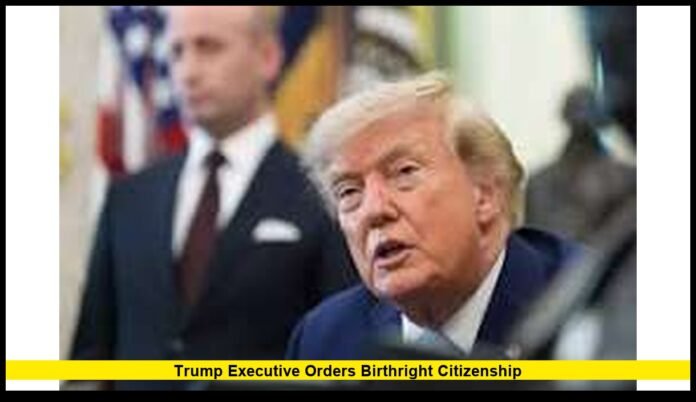

The debate over birthright citizenship has once again become one of the most significant constitutional and immigration issues in the United States. Since returning to office, President Donald Trump has continued pursuing immigration reforms that include executive actions related to automatic citizenship for certain children born on U.S. soil. The issue has attracted national attention because it raises important questions about presidential authority, constitutional protections, federal immigration policy, and the role of the courts.
Recent developments have made the discussion even more important. After an earlier executive order faced a major legal setback in the U.S. Supreme Court, the administration introduced new executive actions in August 2026 that take a narrower approach. These latest directives are already drawing close attention from lawmakers, legal experts, state governments, and immigration advocates as another round of court challenges begins.
For millions of Americans and immigrants living in the country, the outcome of these legal disputes could influence immigration policy for years to come.
Read More – Birthright Citizenship in the United States: The Constitutional Debate Shaping America’s Future
Understanding Birthright Citizenship
Birthright citizenship refers to the principle that most people born within the United States automatically become U.S. citizens at birth. This protection comes from the Citizenship Clause of the Fourteenth Amendment, which was adopted in 1868 following the Civil War.
The constitutional language provides that all persons born or naturalized in the United States and subject to its jurisdiction are citizens of both the United States and the state where they reside.
For generations, this provision has been interpreted broadly. Children born in the United States generally receive citizenship regardless of whether their parents are permanent residents, temporary visa holders, or living in the country without legal immigration status. Only a few limited exceptions have traditionally existed, such as children born to accredited foreign diplomats.
Because this right is rooted in the Constitution rather than ordinary federal law, any effort to change its interpretation has always generated intense legal and political debate.
Why the Issue Returned to the National Spotlight
Donald Trump has repeatedly argued that the current interpretation of birthright citizenship encourages illegal immigration and creates incentives for individuals to enter the United States primarily to secure citizenship for their children.
Throughout his presidential campaigns and during both administrations, he pledged to address what he described as loopholes within the immigration system.
After returning to office for his second term, immigration quickly became one of the administration’s highest priorities. Along with border security initiatives, expanded deportation efforts, visa enforcement measures, and asylum reforms, birthright citizenship once again became part of the administration’s broader immigration agenda.
Supporters viewed the policy as an effort to strengthen immigration enforcement, while critics argued that constitutional protections could not be changed through executive authority alone.
The First Executive Order and Immediate Legal Challenges
Soon after taking office in January 2025, President Trump signed an executive order seeking to limit automatic citizenship for certain children born in the United States.
The order specifically targeted children whose parents were either:
- Living in the country without legal immigration status.
- Present only temporarily under work, student, tourist, or similar visas.
The administration argued that these situations did not necessarily satisfy the constitutional requirement of being “subject to the jurisdiction” of the United States.
However, the executive order immediately faced widespread opposition.
Numerous states, civil rights organizations, immigrant advocacy groups, and affected families filed lawsuits in federal courts across the country. Plaintiffs argued that the order violated the Fourteenth Amendment and decades of Supreme Court precedent.
Federal judges quickly issued injunctions preventing implementation while the lawsuits moved through the judicial system.
The Supreme Court’s Landmark Decision
The constitutional dispute eventually reached the U.S. Supreme Court.
In June 2026, the Court issued one of its most closely watched immigration decisions in recent years.
The justices concluded that the administration’s broad attempt to deny citizenship through executive order was inconsistent with the Constitution. The ruling reaffirmed that the Citizenship Clause continues to provide birthright citizenship for nearly everyone born in the United States, subject only to the historically recognized exceptions.
The decision reinforced long-standing constitutional precedent and confirmed that a president cannot fundamentally redefine citizenship through executive action alone.
Legal scholars widely viewed the ruling as a significant reaffirmation of constitutional limits on executive authority.
Although the decision resolved the earlier executive order, it did not end the political debate surrounding birthright citizenship.
The New Executive Orders Signed in August 2026
Rather than abandoning the issue, the administration introduced two new executive orders on August 6, 2026.
Unlike the earlier directive, these orders do not attempt to broadly eliminate birthright citizenship.
Instead, administration officials describe them as narrower enforcement measures designed to address specific situations that they believe fall within recognized constitutional exceptions.
The White House maintains that these actions focus on immigration enforcement rather than rewriting the Constitution.
Whether courts ultimately agree with that interpretation remains uncertain.
Crackdown on Birth Tourism
One of the primary objectives of the new executive actions is addressing birth tourism.
Birth tourism refers to the practice of foreign nationals traveling to the United States primarily to give birth so that their child automatically becomes a U.S. citizen.
Federal officials have argued that commercial birth tourism operations exploit weaknesses in visa screening and immigration enforcement.
The administration has directed federal agencies to increase coordination in identifying and investigating suspected birth tourism operations.
Potential enforcement efforts include:
- Enhanced screening during visa applications.
- Greater review of travel patterns.
- Investigations into companies promoting birth tourism services.
- Increased cooperation between immigration and border enforcement agencies.
- Stronger enforcement against alleged visa fraud.
Administration officials say these actions are intended to discourage abuse of immigration laws rather than eliminate constitutional citizenship protections.
Narrower Citizenship Exceptions
The second executive order addresses situations that the administration believes may fall outside traditional constitutional protections.
Officials argue that some limited categories of individuals may not qualify under the constitutional requirement of being fully subject to U.S. jurisdiction.
Examples discussed by the administration include certain foreign government personnel and other narrowly defined situations involving national security or diplomatic status.
Legal experts remain divided over whether executive authority extends this far without congressional action or additional judicial approval.
Because the order attempts to define constitutional exceptions, it is expected to become the focus of another series of federal lawsuits.
The Fourteenth Amendment Remains the Foundation
Every legal argument surrounding birthright citizenship ultimately centers on one constitutional provision.
The Fourteenth Amendment has remained one of the strongest protections of American citizenship since the nineteenth century.
Courts have consistently interpreted its language broadly, particularly following the landmark Supreme Court decision in United States v. Wong Kim Ark, which established that children born in the United States generally acquire citizenship regardless of their parents’ nationality.
This precedent has guided immigration and citizenship policy for well over a century.
As a result, many constitutional scholars argue that meaningful changes would require either:
- A constitutional amendment.
- New legislation consistent with constitutional precedent.
- A future Supreme Court decision overturning earlier interpretations.
An executive order by itself has historically faced significant constitutional limits.
Arguments Supporting the Administration’s Position
Supporters of the administration believe the current interpretation has created unintended consequences.
Among the most common arguments are:
- Reducing incentives for unlawful immigration.
- Discouraging organized birth tourism.
- Strengthening border security.
- Preventing immigration fraud.
- Clarifying constitutional exceptions.
- Improving enforcement of existing immigration laws.
Supporters also argue that immigration policies should evolve to reflect modern border security challenges.
Some believe the courts should reconsider earlier constitutional interpretations in light of changing immigration patterns.
Arguments Raised by Opponents
Critics continue to maintain that birthright citizenship is firmly protected by the Constitution.
Civil rights organizations, immigration attorneys, constitutional scholars, and many state governments argue that executive authority cannot override constitutional guarantees.
Opponents contend that:
- The Fourteenth Amendment clearly establishes birthright citizenship.
- Existing Supreme Court precedent already resolves the issue.
- Executive orders cannot rewrite constitutional language.
- Limiting citizenship through executive action creates legal uncertainty for children born in the United States.
- Major constitutional changes require constitutional processes rather than executive directives.
These arguments are expected to remain central during future litigation.
How the Courts Are Expected to Respond
The latest executive orders are almost certain to face immediate legal challenges.
Federal judges will likely examine several key questions, including:
- Whether the new orders differ meaningfully from the earlier order rejected by the Supreme Court.
- Whether the administration has authority to interpret constitutional exceptions independently.
- Whether the orders comply with existing constitutional precedent.
- Whether implementation should be blocked while litigation proceeds.
As of today, no final court ruling has determined the legality of the August 2026 executive orders.
Until that process concludes, significant portions of the legal debate remain unresolved.
Broader Impact on Immigration Policy
Although birthright citizenship receives considerable public attention, it represents only one component of the administration’s wider immigration strategy.
Recent immigration priorities have included:
- Increased border security.
- Expanded immigration enforcement.
- Visa compliance initiatives.
- Asylum policy revisions.
- Enhanced screening procedures.
- Stronger fraud investigations.
The executive orders should therefore be viewed within the broader context of ongoing immigration reforms rather than as isolated policy actions.
Political and Public Interest
Birthright citizenship has become one of the defining constitutional issues in modern immigration debates.
The topic attracts attention from lawmakers, courts, advocacy organizations, universities, and voters because it touches on citizenship, constitutional rights, immigration enforcement, and presidential authority simultaneously.
Supporters see reform as an important part of immigration enforcement.
Opponents believe constitutional protections should remain unchanged regardless of broader immigration policy goals.
The issue is expected to remain a major political discussion throughout the remainder of 2026 and beyond.
Current Status in August 2026
At present, several facts define the legal landscape:
- The Supreme Court’s June 2026 decision rejecting the earlier executive order remains controlling constitutional precedent.
- President Trump signed two narrower executive orders on August 6, 2026.
- The new actions focus primarily on birth tourism enforcement and limited constitutional exceptions.
- Multiple legal challenges are expected to move through the federal court system.
- There has been no final judicial ruling on the legality of the August 2026 executive orders.
- Existing constitutional protections for birthright citizenship remain in effect unless future court decisions determine otherwise.
What Comes Next
The next chapter of this legal dispute will almost certainly unfold in federal courtrooms.
Judges will evaluate whether the administration’s latest executive actions remain within constitutional limits or whether they conflict with the Supreme Court’s earlier ruling.
The administration is expected to defend the measures as targeted enforcement actions addressing narrow constitutional questions.
Opponents are expected to argue that the new directives seek to achieve indirectly what the earlier executive order could not accomplish.
Until the courts complete their review, the constitutional framework governing birthright citizenship remains unchanged, while litigation continues over the scope of presidential authority in immigration policy.
Final Thoughts
The legal and political debate surrounding birthright citizenship remains one of the most closely watched issues in the United States. President Trump’s latest executive actions demonstrate that the administration continues to pursue changes through executive authority, while opponents argue that constitutional protections established by the Fourteenth Amendment cannot be altered without broader legal or constitutional action. As new lawsuits proceed and federal courts evaluate the latest directives, the outcome will help shape the future of immigration policy and clarify the limits of presidential power in interpreting constitutional citizenship.
What are your thoughts on the latest developments? Share your perspective in the comments and stay informed as this important legal story continues to evolve.