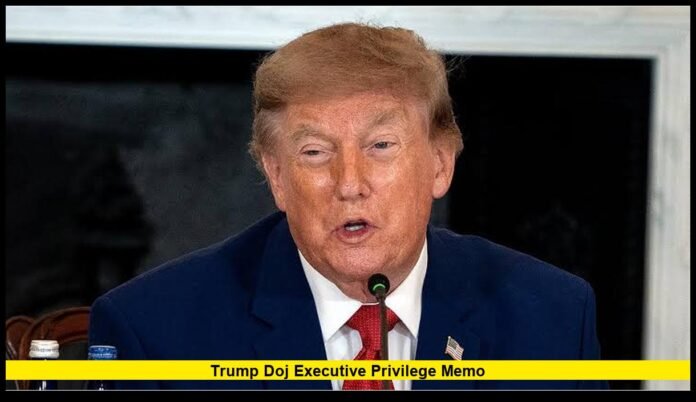

Trump Doj executive privilege memo developments are drawing fresh attention as the American Bar Association challenges the Trump administration’s refusal to identify White House officials involved in developing executive orders targeting major law firms. The dispute has intensified after the Justice Department formally invoked presidential communications privilege and the ABA questioned whether President Donald Trump has a group of advisers whose identities the administration is unwilling to disclose.
The latest development comes from a federal lawsuit in Washington, where the ABA is seeking discovery about the creation, review and approval of Trump administration orders aimed at law firms. The government argues that identifying certain advisers could intrude on presidential decision-making and discourage candid advice to the president. The ABA argues that the privilege claim is too broad and cannot be evaluated without knowing who the relevant advisers are.
The conflict has now become a significant legal fight over the limits of executive privilege, the scope of discovery involving the White House and the separation of powers.
Why the executive privilege dispute matters
Executive privilege generally protects certain confidential presidential communications from disclosure. The doctrine is rooted in the separation of powers and recognizes that presidents need some ability to receive candid advice while carrying out constitutional duties.
The privilege is not absolute. The Supreme Court recognized presidential communications privilege in United States v. Nixon but also made clear that presidential confidentiality does not automatically override every competing legal interest.
The current ABA dispute raises a narrower but important question: how far can the administration go in using presidential communications privilege to prevent discovery about the people involved in presidential decision-making?
That question is particularly important because the government is not simply objecting to disclosure of the contents of particular conversations. The administration has resisted identifying certain individuals who participated in the development of the law-firm executive orders.
The ABA says that creates a circular problem. If the government says privilege applies because the individuals were part of the president’s inner circle, the organization argues that the court must first know who those individuals are to determine whether the privilege actually applies.
The dispute therefore centers on both what information can be withheld and whether the identities of people connected to presidential communications can themselves receive protection.
What the DOJ has argued
The Justice Department formally asserted presidential communications privilege in an August filing responding to an order from U.S. District Judge Amir Ali.
The judge had directed the administration to identify individuals involved in drafting, reviewing and approving the executive orders targeting law firms. Instead, the administration argued that forcing disclosure could interfere with presidential decision-making.
The DOJ also relied on separation-of-powers principles and Supreme Court precedent involving former Vice President Dick Cheney.
The government maintains that communications involving the president and close presidential advisers receive strong protection because confidential advice is important to effective executive decision-making. It has also argued that revealing the identities of advisers could create a chilling effect.
In practical terms, the administration’s position would limit the ABA’s ability to investigate the internal process behind the disputed executive orders.
The government has not claimed that every piece of information connected with the orders is unavailable. Reuters reported that the administration said it was not withholding information that is already public, including material contained in official statements and White House social media posts.
That distinction is important. The dispute is primarily about information that the administration considers protected presidential communications rather than information that has already entered the public record.
Why the ABA wants the advisers identified
The ABA filed its lawsuit in 2025 challenging what it described as an administration policy aimed at intimidating and pressuring lawyers and law firms.
The organization says the executive orders were part of a broader effort to punish firms based on their legal work, political relationships, hiring practices and other activities. The administration has disputed those allegations.
The discovery dispute developed as the ABA sought information about how the challenged orders were conceived and implemented.
The organization wants to identify people involved in several stages of the process, including:
- Proposing the law-firm orders
- Drafting the orders
- Editing the orders
- Reviewing the orders
- Approving the orders
- Participating in the administration’s broader policy effort
The ABA also has sought information about the policy team involved in carrying out Trump’s directive concerning major law firms.
The organization argues that identifying the relevant custodians is essential to determining where responsive records exist and whether the government’s privilege claims are legally valid.
The ABA has therefore pushed back against the idea that the government can claim privilege over identities without providing enough information for the court to assess that claim.
ABA raises the possibility of undisclosed advisers
The latest filing produced one of the most striking elements of the dispute.
The ABA questioned whether Trump has a “secret group of advisors” whose identities the administration is trying to keep hidden. That question appeared in the organization’s response to the government’s position on discovery.
The ABA’s argument is that the identities of senior White House officials are generally not secret. The organization pointed to public information about White House personnel and the administration’s own descriptions of advisers involved in presidential policy.
The filing also noted that the White House provides Congress with information about staff positions and has publicly discussed the work of individual advisers.
The ABA contends that this makes the administration’s position especially difficult to reconcile with the claim that identifying the relevant officials would itself cause serious harm.
The organization is not merely asking the court to release confidential communications immediately. Its discovery request seeks information needed to determine who participated in the challenged decision-making and what records may exist.
That distinction could become central as Judge Ali evaluates the competing arguments.
The August 3 court order
Judge Amir Ali’s August 3 order became an important turning point in the discovery dispute.
The judge attempted to narrow the disagreement between the ABA and the government by addressing the administration’s objections to discovery involving White House officials.
The government responded that there was no basis for the requested discovery and cited separation-of-powers concerns. The DOJ also relied on Supreme Court precedent from 2004 involving Cheney and the limits on discovery directed at the executive branch.
The administration’s position is that courts should exercise particular caution before compelling information from the White House.
The ABA takes a different view. It argues that discovery is justified because the requested information goes directly to the disputed executive orders and the people responsible for creating them.
The disagreement has left the parties at an impasse over how far discovery can proceed.
What the DOJ executive privilege position means
The DOJ’s position does not mean that every communication involving President Trump or a White House adviser is automatically protected.
The Justice Department’s Office of Legal Counsel issued a separate opinion on August 10 addressing executive privilege and presidential communications with private advisers. The opinion provides an important legal backdrop to the current dispute.
The 21-page opinion concluded that executive privilege can apply to presidential communications with private advisers under certain conditions.
The OLC identified three requirements:
- The communication must relate to official presidential decision-making.
- It must involve or reflect communications with the president or his direct advisers.
- The communication must remain confidential.
The opinion is significant because private advisers do not necessarily work for the federal government.
The OLC’s reasoning is that a president may sometimes seek advice from people outside the executive branch because of their particular knowledge or experience. The opinion therefore does not limit the concept of presidential communications solely to government employees.
However, the opinion does not automatically resolve the ABA’s lawsuit.
An Office of Legal Counsel opinion represents the Justice Department’s legal position. A federal judge still must decide how privilege applies in the specific litigation before the court.
Boris Epshteyn and the broader privilege fight
The private-adviser issue also has a direct connection to Boris Epshteyn, a Trump adviser and attorney who is not a federal government employee.
The ABA has sought communications involving Epshteyn as part of its litigation over the law-firm executive orders. The Justice Department has fought the effort and argued that communications involving Epshteyn and the president can receive privilege protection when they involve confidential advice concerning official presidential decisions.
The August 10 OLC opinion gives the administration a broader legal framework for making that argument.
It does not, however, establish that every communication involving Epshteyn is privileged. The opinion itself states that determining whether privilege applies to a particular communication requires information about the specific facts and circumstances.
That limitation could matter as the courts examine the ABA’s discovery requests.
The law-firm orders at the center of the lawsuit
The discovery battle is tied to executive orders issued against several major law firms.
Four firms challenged the administration’s actions in court and obtained orders permanently blocking enforcement of the measures against them. The government’s appeals remain pending.
Reuters reported that nine other firms reached agreements with the administration and pledged nearly $1 billion in free legal work for causes favored by the Trump administration.
The ABA says the history of those orders and agreements makes discovery into the policy’s creation especially important.
The organization wants to understand who proposed the orders, who drafted them, who reviewed them and who ultimately approved them.
That information could help establish the factual record surrounding the policy.
The administration, meanwhile, argues that probing presidential decision-making presents constitutional concerns and risks interfering with the president’s ability to obtain confidential advice.
What the court must decide
The central issue now is not simply whether executive privilege exists. The Supreme Court has recognized a presidential communications privilege.
The harder question involves its scope.
Judge Ali must consider whether the administration can prevent disclosure of adviser identities based on presidential communications privilege and whether the ABA has shown enough need for the requested discovery.
The court also must consider the government’s reliance on separation-of-powers principles.
The ABA argues that courts can review privilege objections without allowing the executive branch to define the scope of its own protection simply by refusing to identify the people involved.
That creates a fundamental tension between two competing principles.
One principle protects confidential presidential decision-making. The other protects the judiciary’s ability to conduct appropriate discovery when a lawsuit directly challenges executive action.
Why the August 10 DOJ memo matters to the case
The August 10 OLC opinion gives the Trump administration a clearly stated position on private presidential advisers.
Before the opinion, the dispute involving outside advisers already presented difficult questions about whether communications with people outside government could qualify for presidential communications privilege.
The OLC has now formally concluded that such communications can receive protection when its three-part test is satisfied.
That position could strengthen the administration’s arguments in future disputes involving private advisers.
At the same time, courts are not required to accept every privilege assertion simply because the Justice Department invokes it.
The specific communication, the people involved, the purpose of the communication and whether confidentiality was maintained can all matter.
That means the ongoing ABA litigation could become an important test of how broadly the administration can apply the privilege in actual discovery.
Where the case stands now
As of August 25, 2026, the discovery dispute remains unresolved.
The Justice Department has formally asserted presidential communications privilege over information concerning advisers involved in the law-firm executive orders. The ABA continues to challenge the government’s refusal to identify those individuals.
The underlying lawsuit remains pending in the U.S. District Court for the District of Columbia under the case name American Bar Association v. Executive Office of the President, No. 1:25-cv-01888.
The litigation therefore has two closely connected tracks.
One concerns the ABA’s underlying challenge to Trump’s law-firm orders.
The other concerns how much information the administration must provide during discovery.
The second dispute could have consequences beyond the individual lawsuit because the court’s treatment of presidential communications privilege may influence future fights over White House discovery.
What happens next
The immediate question is whether Judge Ali will require the administration to provide more information about the individuals it says fall within the protected presidential communications sphere.
If the court requires disclosure, the administration could face a more detailed examination of who participated in developing the challenged orders.
If the court accepts broader privilege protections, the ABA could face additional limits on its discovery requests.
The separate OLC opinion concerning private advisers adds another layer to the legal dispute. Its three-part test gives the Justice Department a framework for arguing that certain communications outside the formal government structure can remain protected.
But the OLC opinion does not itself decide the ABA case.
That decision remains with the federal courts.
The latest filings also show why the dispute has become more than a routine discovery disagreement. The ABA says it needs basic identifying information to test the government’s privilege claims, while the administration says even that disclosure can intrude on presidential confidentiality.
The outcome could help define how courts handle discovery requests that reach into the White House, particularly when the government invokes presidential communications privilege before revealing who participated in the disputed decision-making.
For now, the key unresolved issue remains whether the administration can shield the identities of relevant advisers while simultaneously relying on their role as presidential advisers to justify the privilege.
The Trump-DOJ executive privilege dispute remains active, and readers should watch for the next court ruling that could clarify how far presidential confidentiality extends in White House discovery.