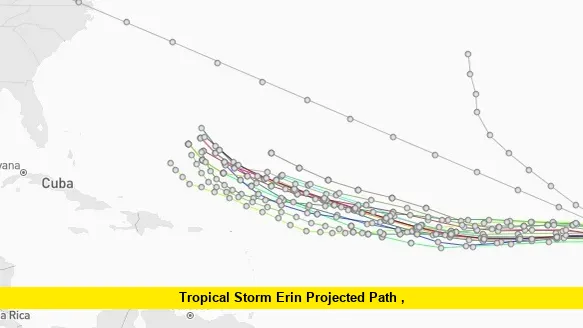

The tropical storm Erin projected path has shifted southward, raising concerns for Caribbean islands as meteorologists predict the storm will strengthen into the Atlantic season’s first hurricane by Friday. The National Hurricane Center reports uncertainty about Erin’s potential impact on the U.S. East Coast, though a southward shift in the track has increased risk for northern Caribbean Islands.
Currently positioned in the central Atlantic Ocean with sustained winds of 45 mph, the storm continues moving westward as forecasters monitor its development closely.
Hurricane Formation Timeline and Intensity Predictions
Tropical Storm Erin is forecast to strengthen into the first hurricane of the Atlantic season by Saturday morning. Weather experts have been tracking the storm’s rapid development since its formation earlier this week.
The storm could reach Category 3 intensity by Sunday, according to the National Hurricane Center, with most projections keeping the storm away from the U.S. coastline. However, meteorologists emphasize that the long-term path remains uncertain.
Erin is predicted to hit Category 3 strength by this weekend, making it a significant weather event for the 2025 Atlantic hurricane season.
Key Points Summary: 🌀 Current Status: 45 mph winds, moving west across central Atlantic 🎯 Hurricane Timeline: Expected to strengthen into hurricane by Friday/Saturday 📍 Projected Path: North of Caribbean islands, including Puerto Rico ⚠️ Risk Areas: Northern Caribbean Islands face increased threat 🔮 Peak Intensity: Could reach Category 3 by weekend 🇺🇸 U.S. Impact: Direct hit unlikely but path remains uncertain
Caribbean Islands Brace for Impact
Erin is expected to develop into a hurricane later this week and could affect Puerto Rico, the Virgin Islands and the northern Leeward Islands. Local authorities in these regions are preparing for potential impacts as the storm approaches.
The National Hurricane Center in Miami said Thursday the storm is expected to remain over open waters and move north-northeast of islands including Antigua and Barbuda and Puerto Rico. This trajectory keeps the storm’s center offshore but could still bring dangerous conditions to nearby islands.
Emergency management officials across the Caribbean are monitoring the situation closely and preparing contingency plans as the tropical storm Erin projected path continues to evolve.
Storm Track Uncertainty and Weather Models
Meteorologists track Tropical Storm Erin as it’s forecast to become the season’s first major hurricane, with various computer models showing slightly different scenarios for the storm’s future path.
Weather prediction models indicate the storm will track north of the Caribbean Islands before beginning a gradual turn northward early next week. The exact timing and location of this northward turn will be crucial in determining potential impacts on populated areas.
Residents in potentially affected areas should stay informed about the latest forecasts as meteorologists continue refining the tropical storm Erin projected path based on new data and atmospheric conditions.
Historical Context and Season Outlook
Tropical Storm Erin formed in the eastern Atlantic Ocean on Monday, becoming the 5th named storm of the Atlantic hurricane season. The storm’s development aligns with typical Atlantic hurricane season patterns, though its potential intensity has drawn particular attention from forecasters.
AccuWeather’s team of hurricane experts expects 13 to 18 tropical storms, of which seven to 10 will become hurricanes and three to five are likely to evolve into major hurricanes, for the 2025 season.
The formation of Erin continues what meteorologists expect to be an active Atlantic hurricane season, with several more storms likely to develop in the coming weeks and months.
Stay informed about Tropical Storm Erin’s latest developments and share your thoughts on how communities can best prepare for hurricane season in the comments below.