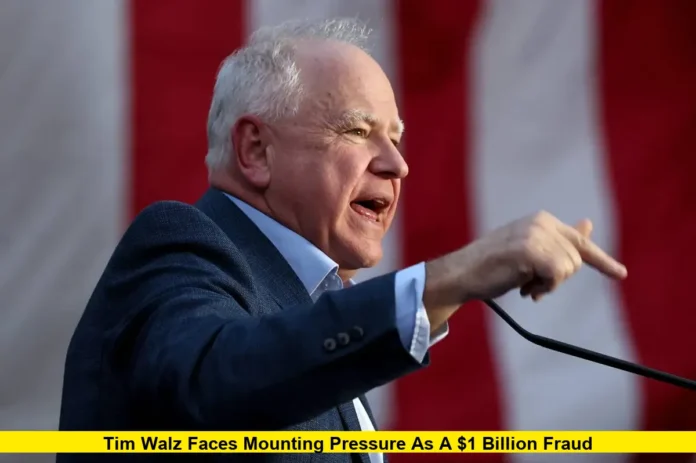

Minnesota’s governor, tim walz, now faces the most consequential challenge of his political career as a sweeping fraud scandal, multiple federal inquiries, and intense political backlash converge to test his leadership and reshape the state’s political landscape.
A Massive Fraud Uncovered
What began as routine audits and whistleblower tips has grown into an investigation revealing widespread abuse of pandemic-era and child-nutrition funds. Authorities have alleged that nonprofit networks diverted substantial public dollars through falsified contracts, sham vendors, and fraudulent paperwork. The scale of the alleged theft has stunned state officials and citizens alike, with investigators describing systemic exploitation that unfolded over several years.
State auditors and law enforcement actors have traced payments to front companies and shell organizations that filed phony invoices and fabricated service reports. Those payments flowed through layers of intermediaries, making the money trail difficult to follow. The alleged misconduct involved administrators, grant recipients, and middlemen—creating a sprawling web of contributors that investigators say took advantage of lax oversight and emergency spending rules enacted during the pandemic.
Immediate Human Consequences
The financial losses are one measure of the scandal’s impact. Equally urgent are the human consequences: children and families who relied on school-based meal programs and community services suffered disruptions. Several nonprofit programs experienced sudden funding freezes or closures as investigators froze assets and agencies shifted to emergency contingency plans. Frontline staff who ran legitimate operations found themselves under suspicion and dealing with the reputational fallout.
Community leaders expressed anger and frustration. For many affected neighborhoods, the scandal amplified long-standing concerns about administrative competence, the equitable distribution of aid, and protections for vulnerable populations during emergencies.
Federal Investigations and National Security Concerns
Federal agencies opened parallel investigations after uncovering evidence that some diverted funds may have crossed state lines or routed through entities with international connections. Investigators have examined whether any funds inadvertently reached organizations with questionable affiliations. The federal involvement intensified scrutiny and broadened the scope of the inquiry beyond state-level mismanagement to potential violations of federal grant rules and anti-money-laundering statutes.
That expanded focus has raised stakes considerably. Federal investigators possess greater subpoena power and cross-jurisdictional resources, meaning consequences could include criminal charges, asset forfeiture, and long-term civil remedies. The presence of federal scrutiny also complicates any political response, since state officials have limited control over the pace and direction of these inquiries.
Administrative Failures and the Question of Responsibility
Critics argue that the scandal exposed fundamental weaknesses in state oversight systems. Internal reviews found that some monitoring mechanisms were understaffed, underfunded, or sidestepped during the rush to distribute emergency funds. Documentation and verification processes were inconsistent across agencies, and automated checks either failed or were bypassed in the urgency of pandemic response.
Supporters of the administration counter that emergency circumstances forced quick decision-making, and that many of the standard safeguards were temporarily modified to speed aid delivery. They maintain that while mistakes occurred, decisive action now—cooperating with federal investigators and launching independent audits—can restore accountability and prevent future abuses.
At the center of that debate is the governor. As the state’s chief executive, he faces calls for answers about how oversight lapses went unnoticed and whether political appointees or career officials share blame. The administration has pledged transparency measures and additional audits, but opponents demand a clearer chain of accountability and faster corrective action.
Political Fallout: Campaigns, Criticism, and Calls for Change
The political repercussions are immediate and intense. Lawmakers from both parties are using the scandal to press for reforms—some framing the failures as evidence of broader administrative negligence, others pointing to weaknesses in program rules that allowed bad actors to exploit emergency flexibility.
Several state legislators have introduced bills to tighten auditing requirements, increase real-time monitoring of aid distribution, and strengthen whistleblower protections. Some proposals seek to centralize oversight across agencies to reduce fragmentation, while others push for technology-driven solutions to detect anomalies before payments issue.
On the campaign trail, opponents have seized on the scandal as a rallying point. Potential challengers argue that the administration did not prioritize safeguards when it mattered most. Supporters of the governor have countered by highlighting his policy achievements and stressing that investigations must run their course before political judgments are made.
Community and Cultural Ripples
Beyond political maneuvering, the scandal has strained community relationships. Several nonprofits that served immigrant and minority populations were implicated or associated with accused parties, producing a wave of public scrutiny that members of those communities say unfairly cast suspicion on legitimate service providers.
Local leaders and activists have urged care in distinguishing between individuals and organizations that committed wrongdoing and the broader communities they served. They warn that generalized blame can harm social cohesion and discourage cooperation between civic groups and public agencies—especially in communities that already face systemic barriers to trust and resources.
Steps Toward Accountability and Reform
In response to the crisis, state officials have announced an array of remedial actions. Emergency audits will examine past contracts and payment records. New procurement protocols are in development to tighten vendor vetting and documentation requirements. Agencies plan to expand internal compliance teams and deploy data analytics to flag unusual payment patterns.
The administration also promised increased collaboration with federal investigators. That cooperation aims to speed asset recovery, identify culpable parties, and clarify where policy changes are necessary to prevent recurrence. Some lawmakers have floated the creation of an independent commission to review fund distribution during emergencies and recommend structural reforms.
Economic and Fiscal Implications
The fiscal ramifications could be far-reaching. Recovering misallocated funds may require lengthy legal processes and could be only partially successful. Meanwhile, tightening procurement and oversight may slow the flow of legitimate service payments in the short term, creating a budgetary squeeze for nonprofits that rely on predictable reimbursements.
Municipal leaders are weighing budget contingencies while planners assess the long-term costs of implementing new monitoring systems. Some analysts warn that safeguarding against fraud requires upfront investment in staffing and technology—resources that must be found within already tight public budgets.
The Governor’s Political Calculus
For the governor, the scandal represents both a leadership test and a political inflection point. He faces pressure to demonstrate decisive reforms and restore public confidence while defending the broader record of his administration. How he balances accountability, cooperation with federal authorities, and political recovery will shape his political future.
Supporters insist that responsible leadership requires transparency and swift corrective measures. Critics argue that the scale of the oversight failure undercuts the governor’s claims of effective governance. As investigations proceed, public perceptions will hinge on the timeliness and substance of the administration’s response.
Looking Ahead: What Matters Most
As the state moves forward, several priorities will determine whether the crisis becomes a catalyst for meaningful reform or an enduring political stain:
- Implementing robust, technology-enabled oversight that can detect irregularities in real time.
- Ensuring that reforms do not unduly hinder legitimate nonprofits and service providers.
- Restoring trust through transparent communication, timely reporting, and independent review.
- Coordinating state and federal efforts to accelerate accountability and asset recovery.
- Addressing community concerns so that aid programs remain accessible to the populations they serve.
These steps will require sustained political will and resources. They will also demand sensitivity to the social dynamics that the scandal exposed—recognizing that oversight failures disproportionately affect vulnerable communities.
Conclusion
The allegations of widespread fraud and the ensuing investigations have thrust a test of leadership and accountability into the spotlight. The state now confronts a complex task: to recover lost funds, reform systems that failed, and restore public trust—all while maintaining essential services for communities that depend on them. The decisions made now will shape governance and civic confidence long after headlines fade.
Share your thoughts on the reforms you’d like to see and how leaders should prioritize accountability and community support.