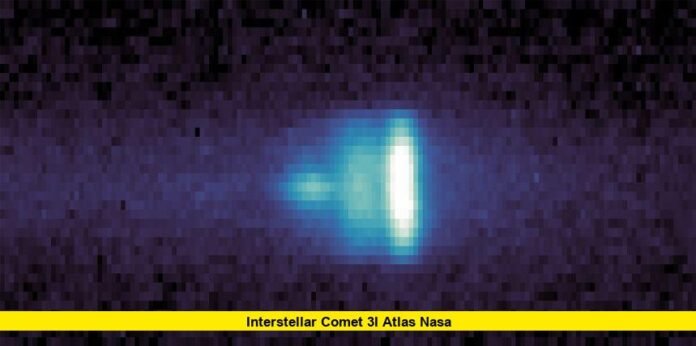

The latest round of scientific observations has delivered some of the clearest and most dramatic views ever recorded of a cosmic visitor from beyond our solar system. Early December imaging of interstellar comet 3I/ATLAS NASA shows rapidly shifting activity, powerful gas emissions, and a striking set of tails that have astonished researchers. With new data continuing to arrive from multiple spacecraft and observatories positioned across the solar system, scientists are gaining an unprecedented look at how an interstellar comet behaves as it interacts with heat, radiation, and gravitational forces near the Sun.
What has emerged in recent days is a picture of a uniquely volatile and scientifically valuable object—one that contains clues to how distant planetary systems formed and evolved. Beyond the visually stunning images now circulating among astronomers, 3I/ATLAS is becoming a benchmark for understanding the structure, chemistry, and dynamics of material that originated around another star.
A Rare Visitor Crossing Our Solar Neighborhood
Interstellar objects are among the rarest sights in astronomy. Only two had ever been confirmed before this one. Unlike comets native to our solar system, which live in the Kuiper Belt or Oort Cloud, interstellar comets formed in completely different star systems and were ejected long ago through gravitational disruptions. They then spend millions of years drifting between the stars before crossing paths with other systems.
What makes 3I/ATLAS unique is the combination of its visibility, activity, and timing. It entered the inner solar system during a period when multiple spacecraft happened to be ideally positioned to study it from various angles. This overlap of opportunity has created a scientific event unlikely to repeat anytime soon. Because the comet will never return once it swings back out into deep space, the current observing window is the only chance researchers will ever have to gather direct measurements.
A Brightening Coma and Complex Tail Structure
The most recent images reveal a comet bursting with activity. The coma—the cloud of gas and dust released as sunlight warms the nucleus—has expanded dramatically compared to just weeks ago. Its brightness suggests a mix of volatile ices that react intensely when exposed to solar heat. The structure of the coma is uneven, with areas showing thicker plumes and others appearing more diffuse. This unevenness indicates that different sections of the nucleus are releasing material in concentrated bursts rather than through a uniform process.
The comet’s tails have also become increasingly defined. The dust tail, composed of tiny solid particles pushed by sunlight, stretches in a gentle curve behind the nucleus. This curved appearance helps scientists determine the size of the particles being ejected and how strongly solar radiation is influencing their motion.
In contrast, the gas tail—which consists of ionized molecules—forms a straighter, narrower line. This is because it is shaped primarily by solar wind rather than light pressure. The separation between the two tails serves as a direct visual measurement of how the Sun interacts with interstellar material. These details help scientists compare the behavior of 3I/ATLAS to that of familiar comets that formed around our own Sun.
Signs of Sudden Outbursts
One of the most revealing features seen in the newest imagery is the presence of sharply defined streaks and clumps within the tails. These features point to sudden, forceful outbursts from the nucleus. Outbursts occur when internal pressure builds beneath the surface, eventually cracking open a vent and releasing a surge of gas and dust.
Such bursts can happen for several reasons:
- A fresh patch of ice becomes exposed
- A previously sealed pocket ruptures
- The comet rotates to expose a sunlit region that was previously in shadow
- Thermal stress fractures the outer layer
For 3I/ATLAS, outbursts appear to be frequent and strong, suggesting a nucleus packed with volatile material. These events drastically change the shape of the coma and tails in a matter of hours or days, contributing to the dramatic transformations captured in recent images.
A Surge in Activity After Passing the Sun
During its closest approach to the Sun, 3I/ATLAS absorbed significant heat that triggered a rapid acceleration in activity. This trend mirrors the behavior of many comets, but the intensity seen in this interstellar visitor is far more extreme than what astronomers typically record from long-period or short-period solar-system comets.
Once the comet passed perihelion, its activity did not immediately decline. Instead, multiple observations show that it continued releasing substantial amounts of gas and dust. This ongoing response indicates that the heat penetrated deeper into the nucleus than expected, likely melting icy materials beneath the surface layers. The delayed response helps researchers estimate the thickness, density, and composition of the nucleus.
Because interstellar objects do not share the same chemical history as comets that evolved around the Sun, the patterns of heating and cooling may differ significantly. Studying these changes provides an invaluable point of comparison that helps refine models of comet behavior across the galaxy.
Comparing 3I/ATLAS to Earlier Interstellar Visitors
The first interstellar object detected, 1I/ʻOumuamua, left more questions than answers. Its shape, behavior, and lack of a visible coma made scientific interpretation difficult. The second, 2I/Borisov, was a more traditional comet but moved through the solar system quickly, allowing limited observation time.
3I/ATLAS combines the advantages of both. It is active enough to study in depth but slow enough to allow extended monitoring. As a result, scientists are gathering far more high-quality data than was possible with either earlier visitor.
One of the most important insights so far is the strong difference in tail behavior and coma brightness between 3I/ATLAS and comets formed around the Sun. The chemical reactions occurring as the comet heats up appear to release different types of dust and gas, offering clues to the conditions in the system where it originated.
A New Era of Multi-Mission Collaboration
Another key factor that makes this comet scientifically significant is the number of missions producing data. Instead of relying on a single telescope or single spacecraft instrument, researchers are analyzing information from multiple viewpoints spread throughout the solar system. Different spacecraft are capturing optical images, thermal readings, and dust signatures, while ground-based telescopes are helping refine the comet’s position and trajectory.
This coordinated, multi-platform approach allows scientists to:
- Track changes in activity in near-real time
- Compare the comet’s appearance from different distances
- Reconstruct three-dimensional features of the coma
- Determine how fast particles are moving
- Identify thermal variations within the nucleus
- Study changes in tail length and direction
This level of coverage has never before been available for an interstellar comet.
Trajectory, Speed, and Future Path
3I/ATLAS is currently moving on a hyperbolic path that will take it out of the solar system permanently after it finishes its outbound journey. Its closest pass by Earth will still place it millions of miles away, far beyond any risk to the planet. Even so, precise tracking matters. Understanding how interstellar objects move through the solar system helps refine models used for planetary defense and early detection of future interstellar visitors.
The comet is gradually dimming as it moves farther from the Sun, but instruments across the solar system will continue monitoring it until it fades from view. Even faint observational data will help scientists learn how the comet cools down, how long particles remain active, and whether smaller secondary outbursts continue as the nucleus contracts in the cold.
Why Scientists Are Calling 3I/ATLAS a Milestone Discovery
Although comets pass through the inner solar system regularly, very few offer insights of this magnitude. Several reasons explain why 3I/ATLAS has captured so much scientific attention:
- It contains unaltered material from another star system.
- It shows chemical signatures not typically observed in Sun-formed comets.
- Its activity level is unusually high for an interstellar object.
- Spacecraft positioned throughout the solar system are collecting detailed data.
- It will help shape long-term research into planetary formation beyond the Sun.
- It provides a test case for tracking fast-moving objects entering the solar system.
The comet’s behavior helps clarify whether the building blocks of distant planetary systems resemble those of our own. If significant differences emerge as more data arrives, it could transform theories of planetary formation across the galaxy.
What Comes Next for Researchers
Over the coming weeks and months, scientists will continue receiving data from spacecraft as the comet moves farther outward. Analysis will focus on:
- Measuring changes in tail shape and length
- Detecting possible fragmentation of surface layers
- Comparing the composition of dust before and after perihelion
- Studying changes in the coma’s brightness
- Modeling how outbursts affect the comet’s movement
- Tracking how fast the nucleus cools
As additional images, spectral readings, and thermal measurements arrive, researchers expect to refine estimates about the comet’s density, structure, and origins. These findings could influence how astronomers search for and identify interstellar objects in the future.
A Visitor That Changes How We See the Galaxy
Many comets offer beautiful views, but few provide transformative scientific insight. With interstellar comet 3I/ATLAS NASA continuing to release valuable information, astronomers now have a clearer window into the makeup of distant planetary systems. Its dramatic behavior, powerful outbursts, and rapidly shifting features reveal just how active an interstellar object can be. Long after the comet disappears into deep space, the data gathered during its brief visit will continue fueling discoveries.
Share your thoughts below and tell us what fascinates you most about this remarkable interstellar traveler.