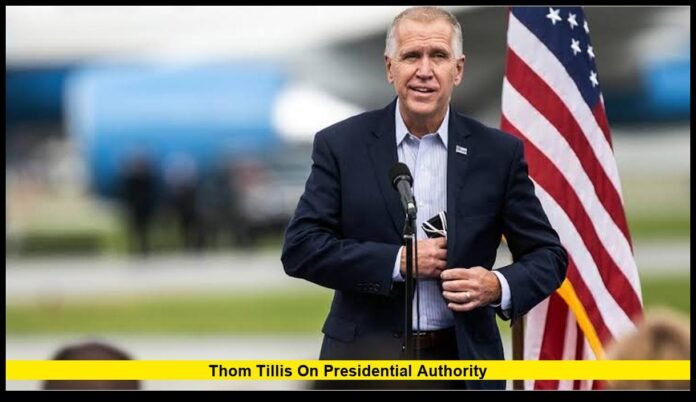

Thom Tillis on presidential authority has become a major focus of the North Carolina senator’s final months in Congress, as he warns that presidents are gaining too much influence over the legislative branch and that lawmakers must restore stronger checks and balances.
Tillis, a Republican who is leaving the Senate in January, made the warning especially clear in an interview broadcast Sunday. He argued that Congress must act as a co-equal branch rather than routinely surrendering authority to the White House.
His comments arrive as President Donald Trump’s second administration faces continuing disputes with Congress over executive actions, military authority and the role of lawmakers in national policy. Tillis has supported Trump on some major issues, including the initial decision to use military force against Iran, but he has also repeatedly argued that presidential authority has limits.
The senator’s position is not simply a criticism of one president. Tillis has said that the same problem existed under Democratic administrations. His concern is that members of Congress often tolerate broader executive power when their own party controls the White House, only to regret that precedent when political control changes.
Tillis says Congress is a co-equal branch
Tillis’ most direct explanation of his position came during his recent television interview. Asked what the Trump administration fails to understand about the Senate and Congress, he pointed to the constitutional relationship between the branches.
His answer was straightforward: Congress is a co-equal branch and should be treated as a peer.
Tillis also acknowledged that Congress has some responsibility for the imbalance. Lawmakers cannot demand respect for their authority while voluntarily giving away their institutional power.
He argued that this pattern has occurred under both parties. When a president belongs to the same political party as congressional leaders, lawmakers can become more willing to accept executive action rather than challenge it.
For Tillis, that approach creates a long-term problem.
A president may benefit from expanded authority today, but a future president from the opposing party could inherit the same powers. That is why Tillis says Congress should protect its institutional role regardless of which party controls the White House.
Why presidential authority has become a central issue for Tillis
Tillis has described a broader trend in which presidents increasingly rely on executive action instead of working through Congress.
He said recent administrations have increasingly governed through executive orders. In his view, the current administration has pushed that approach further, creating greater tension between the executive and legislative branches.
His concern is not that presidents should have no independent authority. The Constitution gives the president important responsibilities, particularly in areas such as foreign policy and national security.
The issue, according to Tillis, is where presidential authority ends and congressional authority begins.
That distinction becomes especially important when a president takes action that affects war, federal spending, government agencies or major national policy without extensive congressional involvement.
Tillis believes Congress must be willing to use its constitutional powers rather than simply accept presidential decisions.
He has also criticized lawmakers who privately disagree with presidential actions but refuse to challenge them publicly because they fear political consequences.
Tillis and the Iran war powers debate
The clearest recent example of Tillis wrestling with presidential authority has involved the U.S. military campaign against Iran.
Earlier in 2026, Tillis supported the administration’s initial military engagement with Iran. He said he believed the president had made the right decision to intervene at that point.
However, his position did not amount to unlimited support for presidential control of the conflict.
In April, Tillis warned that Congress would eventually need to confront the question of whether continued military action required congressional authorization. He said the administration should prepare a well-founded authorization for the use of military force and a funding strategy if the conflict continued.
That position became more significant as the war continued.
In June, Tillis still said he supported the administration’s engagement with Iran. He did not support every effort to immediately terminate U.S. military involvement.
Yet by September, he took a different position on a Senate war powers resolution.
On September 24, Tillis joined Republican Sens. Susan Collins, Lisa Murkowski and Rand Paul in voting for a measure designed to limit Trump’s authority to continue military hostilities against Iran without specific congressional authorization.
The Senate rejected the resolution, 49-50.
The vote was important because Tillis had not previously voted for an Iran war powers resolution during the 2026 conflict. His decision showed that supporting a president’s initial military action did not necessarily mean accepting unlimited presidential authority to continue the operation.
Tillis’ position on presidential military power
His actions during the Iran conflict show several distinctions in his approach:
- He supported the president’s initial decision to use military force.
- He argued that continued military action could require congressional authorization.
- He called for Congress to play a meaningful role in determining the scope and future of the conflict.
- He later voted for a war powers measure seeking to restrict continued military action without congressional authorization.
- He has continued to argue that presidential power must operate within constitutional limits.
That combination is central to understanding Tillis’ position.
He has not argued that the president should be powerless. Instead, he has argued that presidential authority should coexist with congressional authority.
The September war powers vote marked a significant break
The September vote provided the strongest recent evidence of Tillis’ willingness to challenge presidential authority directly.
The resolution would have directed the president to remove U.S. armed forces from hostilities involving Iran unless Congress authorized the military action through a declaration of war or a specific authorization for the use of force.
Tillis voted for the measure.
The proposal failed, but the vote placed Tillis among a small group of Republicans who were willing to break with Trump on the question of congressional war powers.
That decision also fits with comments Tillis made months earlier.
Rather than arguing that Congress should immediately block every presidential military decision, he had called for a more formal congressional role if the conflict continued. His later vote demonstrated that his concerns about presidential authority had not disappeared simply because he initially supported the military operation.
The distinction matters.
Tillis has consistently separated support for a particular presidential action from support for unlimited presidential power.
Tillis says executive power can weaken Congress
Tillis’ broader concern extends beyond military affairs.
In his recent interview, he described executive branch influence as increasingly powerful. He warned that political pressure from the White House can make lawmakers less independent.
One concern he highlighted was the ability of presidents and their political organizations to threaten primary challenges against members of Congress.
That pressure can influence lawmakers before they even cast a vote.
A senator who fears losing a primary may hesitate to challenge a president from the same party. Tillis believes that dynamic can weaken Congress as an institution because elected officials begin considering presidential approval before exercising their own judgment.
In his view, the problem becomes particularly serious when lawmakers privately disagree with presidential actions but refuse to vote accordingly.
Tillis said he believes many Republican senators have expressed reservations about various Trump administration decisions in private. His argument is that private disagreement has limited value if lawmakers never use their votes or institutional powers to change policy.
His concerns extend across political parties
One important feature of Tillis’ position is that he does not describe executive overreach as a problem unique to Republicans.
He specifically included the Obama and Biden administrations in his criticism.
Tillis said lawmakers make a recurring mistake when their own party occupies the White House. They become more willing to transfer power to the president because they trust the person holding the office.
But presidents change.
That means authority granted to one administration can later be used by a president with a completely different political agenda.
Tillis sees congressional independence as a long-term institutional safeguard rather than a partisan weapon.
His argument is essentially that Congress should defend its authority even when doing so creates friction with a president from the same political party.
Tillis connects presidential authority to checks and balances
Tillis has framed the debate around the constitutional system of checks and balances.
He wants the legislative, executive and judicial branches to maintain their individual responsibilities.
His concern is that excessive executive influence can gradually reduce the independence of Congress. If lawmakers become too dependent on the White House, the balance between the branches can shift.
Tillis warned that such a shift could eventually leave the country with what he described as a “dictator king” if political institutions fail to provide meaningful checks.
The comment reflects the seriousness of his warning.
He is not arguing that the United States has already abandoned its constitutional system. Instead, he is warning that institutional erosion can happen gradually when lawmakers repeatedly allow presidential authority to expand.
For Tillis, preserving the constitutional structure requires active participation from Congress.
His criticism of Trump’s advisers also reflects his views on authority
Tillis has increasingly criticized members of Trump’s Cabinet and senior administration team.
He has argued that presidential advisers should provide candid advice rather than simply reinforce what the president wants to hear.
That concern connects directly to his views on presidential authority.
Tillis believes presidents need advisers who are willing to tell them when a proposed action could create serious political, legal or strategic problems.
He has been particularly critical of former Homeland Security Secretary Kristi Noem and Defense Secretary Pete Hegseth.
Tillis supported Hegseth’s confirmation but now describes that vote as one of his biggest regrets. He has also called for Hegseth to leave his position.
At the same time, Tillis has said he wants Trump to succeed.
That distinction has remained central to his approach. He can support the president’s broader goals while challenging specific decisions, advisers or methods.
Tillis’ record shows a complicated relationship with Trump
Tillis began his Senate career before Trump became the dominant figure in the Republican Party.
During Trump’s second administration, the relationship became increasingly strained.
The major break came in 2025, when Tillis opposed Trump’s sweeping tax and spending legislation. Tillis argued that the legislation could have significant effects on low-income North Carolinians, including through changes involving Medicaid.
Trump attacked Tillis publicly and threatened to support a primary challenger.
Tillis subsequently announced that he would not seek another Senate term.
That decision changed the political calculation around his criticism of presidential authority.
Unlike senators seeking reelection, Tillis no longer faces the same electoral pressure from a presidential endorsement or primary challenge.
He has used his remaining time in office to speak more openly about what he sees as congressional weakness.
Tillis’ upcoming book puts his concerns into broader context
Tillis is also using a new book to explain his frustrations with Washington and the modern Republican Party.
The book, How to Lose Friends and Antagonize Presidents: The Trouble with Sycophants, Courage Outsourcing, and Partisan Groupthink, is scheduled for release October 6, 2026.
The book focuses heavily on political loyalty, congressional independence and the behavior of Republican lawmakers around Trump.
Tillis argues that fear of presidential retaliation can discourage senators from exercising independent judgment.
The book also describes private disagreements among Republican senators over administration policies. Tillis says many lawmakers have concerns about presidential decisions but are reluctant to make those disagreements public.
That theme reinforces his argument that Congress needs greater independence from the White House.
Tillis does not reject presidential leadership
It would be inaccurate to portray Tillis as arguing that presidents should play only a limited ceremonial role.
His record shows otherwise.
He has supported Trump on significant policy and national security matters. He supported the initial military action against Iran and has repeatedly said he wants the president to succeed.
His argument concerns boundaries.
Tillis believes presidential leadership works best when it operates alongside Congress rather than above it.
He also recognizes that the president has responsibilities that require executive action. The debate, in his view, is about maintaining constitutional limits while allowing the executive branch to perform its legitimate functions.
That makes his position more nuanced than a simple pro-Trump or anti-Trump label.
What Tillis’ position means as he leaves the Senate
Tillis is scheduled to leave the Senate in January.
That makes his latest comments particularly significant because he is speaking about congressional power from the perspective of a senator who will soon no longer have a vote.
His warning is that Congress must defend its institutional authority regardless of who occupies the White House.
The immediate political consequences of his departure remain uncertain. However, the principle he is emphasizing is clear.
Congress has constitutional responsibilities that cannot be transferred permanently to the executive branch simply because lawmakers find it politically convenient.
Tillis also argues that the issue extends beyond the Trump administration.
If Congress allows presidential power to expand during one administration, future presidents can inherit those powers. That is why he believes institutional rules matter more than short-term partisan victories.
Why Tillis’ warning matters beyond the 2026 election
The debate over presidential authority will continue after the 2026 midterm elections.
Presidents from both parties are likely to face disputes with Congress over executive orders, national security, spending and federal agencies.
Tillis’ central argument is that the answer should not depend on which party controls the presidency.
He wants Congress to operate independently, exercise its constitutional powers and accept the political consequences of doing so.
His recent decision to support an Iran war powers resolution demonstrates that principle in practice. He initially backed Trump’s military decision but later voted to require a stronger congressional role as the conflict continued.
That distinction captures the broader Tillis approach.
He does not believe supporting a president requires surrendering congressional authority.
Frequently Asked Questions
What is Thom Tillis saying about presidential authority?
Tillis argues that presidents have important constitutional powers but that those powers must operate alongside Congress. He believes the legislative branch has become too willing to surrender authority to the White House.
Does Thom Tillis support Donald Trump?
Tillis has supported Trump on several major issues and has said he wants the president to succeed. However, he has also criticized Trump and members of his administration and has opposed some major White House initiatives.
Did Thom Tillis vote against Trump on Iran war powers?
Yes. On September 24, 2026, Tillis was one of four Republican senators who voted for a resolution seeking to limit continued U.S. military action against Iran without congressional authorization. The Senate rejected the measure 49-50.
Does Tillis believe presidents have unlimited military authority?
No. His recent record indicates that he believes presidential military authority has limits and that Congress must play an important role when military operations continue.
Why does Tillis believe Congress should challenge the White House?
Tillis argues that Congress is a co-equal branch of government. He believes lawmakers weaken the constitutional system when they allow partisan loyalty or fear of presidential retaliation to override their institutional responsibilities.
Has Tillis criticized Democratic presidents over executive power?
Yes. Tillis has said his concerns are not limited to Republican presidents. He has specifically argued that Congress made similar mistakes by transferring power to the White House during the Obama and Biden administrations.
Is Thom Tillis leaving the Senate?
Yes. Tillis announced that he would not seek another Senate term after his dispute with Trump over major legislation and the president’s threat to support a primary challenger.
When is Thom Tillis’ book being released?
How to Lose Friends and Antagonize Presidents is scheduled for release on October 6, 2026.
What is the main concern behind Tillis’ warning about executive power?
His central concern is that excessive presidential influence could weaken Congress and reduce the effectiveness of the constitutional checks and balances between the three branches of government.
The bottom line on Thom Tillis and presidential authority
Tillis’ latest comments make clear that his concern is broader than any single dispute with Donald Trump. He believes Congress must reclaim its role as an independent and co-equal branch of government.
His record on Iran shows the distinction. He supported the president’s initial military action but later backed congressional efforts to place limits on continued military operations.
As Tillis prepares to leave the Senate, he is using his remaining influence to make a broader argument: presidential authority should not come at the expense of congressional independence, regardless of which party controls the White House.
What do you think about Thom Tillis’ warning on presidential authority and the balance between Congress and the White House? Share your thoughts and stay informed on the latest developments.