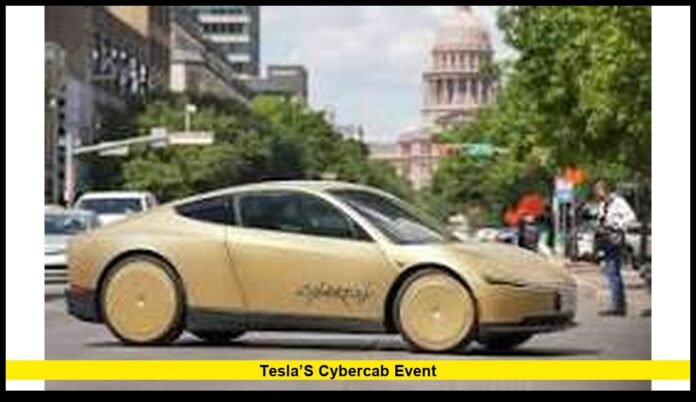

Tesla’s Cybercab event has moved the company’s purpose-built robotaxi from a long-running development project into active passenger service in Austin, Texas. The launch on September 3 introduced dozens of gold-colored Cybercabs without steering wheels, accelerator pedals or brake pedals to Tesla’s Robotaxi operation. The vehicles are now available in limited areas of Austin, giving riders a direct look at Tesla’s approach to fully autonomous transportation.
The Austin rollout represents an important milestone for Tesla. The company has been developing a dedicated autonomous vehicle for years. Cybercab is the first Tesla model designed around the assumption that a human will not drive the vehicle.
Unlike the Model Y vehicles already used in Tesla’s Robotaxi service, the new vehicle does not retain conventional driving controls. Its cabin contains two seats, a large touchscreen and passenger-focused controls.
Tesla has now published a dedicated Cybercab Rider Guide, confirming that the vehicle has entered an operational phase rather than remaining solely a prototype or engineering project.
Austin Becomes the Center of the Launch
Tesla chose Austin as the initial market for the new vehicle. The city already has an established Robotaxi operation, giving Tesla an existing service framework for introducing its dedicated autonomous model.
Cybercab rides currently operate only within limited areas of Austin. Tesla says its broader Robotaxi service also operates in Dallas and Houston, Texas, as well as Miami, Orlando and Tampa, Florida, using its existing vehicle fleet.
That distinction is important. The September launch does not mean Cybercab is immediately available throughout the United States.
Instead, Tesla is introducing the vehicle within a controlled service area while continuing preparations for wider Robotaxi expansion.
The company has already been testing production Cybercabs on public roads. Tesla said production began during the second quarter of 2026, followed by engineering test drives and employee rides at its Texas factory campus in July.
Those steps led directly toward the Austin passenger rollout.
A Vehicle Built Without Traditional Driving Controls
The most striking feature of Cybercab is its interior.
There is no steering wheel. There is no accelerator pedal. There is no brake pedal. Both seats are designed for passengers, reflecting Tesla’s decision to build the vehicle specifically around autonomous operation.
That approach separates Cybercab from ordinary Tesla vehicles.
A Model Y can operate within Tesla’s Robotaxi program while retaining equipment associated with conventional driving. Cybercab removes that equipment entirely.
The cabin instead uses a central touchscreen for passenger interaction.
Riders can start their trip, control the doors, adjust the seats and manage the cabin temperature from the display. Entertainment features are also available during rides.
Tesla has included a dedicated support function on the touchscreen. The cabin also contains a stop button that initiates an immediate pull-over request and connects the rider with Robotaxi Support. Tesla says that function should be used for emergencies.
The design creates a fundamentally different passenger experience.
Riders are not expected to monitor the road or prepare to take control. Their role is to enter the vehicle, secure their seat belt, start the trip and remain seated.
How a Cybercab Ride Works
Tesla’s official rider instructions provide a detailed picture of the customer experience.
A passenger begins by opening the Robotaxi app and entering a destination inside the displayed service area. The app provides an estimated fare and wait time before the rider confirms the trip.
Once the vehicle is dispatched, the app helps the passenger identify it.
Cybercab uses exterior lighting during pickup. The rear lightbar illuminates red, while the front lightbar changes color. The app shows the color assigned to the passenger’s ride.
Tesla also instructs riders to verify the license plate before entering.
When the vehicle reaches the pickup location, the door can open automatically after Cybercab detects the requesting passenger’s phone. A manual door button is also available.
Passengers can place larger belongings in the trunk before entering.
After entering the cabin, the rider fastens the seat belt. The doors can close automatically, and the trip begins after the passenger selects the start function on the touchscreen.
During the journey, the display shows trip progress and estimated arrival information.
Passengers can adjust climate settings and use supported entertainment features. Tesla also allows riders to change the destination through the Robotaxi app.
At the destination, Cybercab shifts into Park and activates its hazard lights. The passenger can then open the door through the touchscreen or use the door lever.
The Cybercab Cabin Focuses on Two Passengers
Cybercab has been designed as a two-person vehicle.
Tesla lists 38.3 inches of headroom and 43.4 inches of legroom. The company also lists 51.9 inches of shoulder room and 50.4 inches of hip room in its current support information.
The rear trunk provides 20.2 cubic feet of cargo space.
Tesla says the trunk can accommodate two standard check-in suitcases and two carry-on suitcases, giving the small vehicle useful storage capacity for passengers.
The compact cabin is intentional.
Cybercab does not attempt to replicate the capacity of a conventional SUV or larger passenger vehicle. Tesla is instead targeting short-distance and point-to-point transportation for one or two riders.
That configuration can also reduce the amount of interior space required for each passenger trip.
Accessibility Is Part of the Design
Tesla has incorporated several accessibility features into the Cybercab passenger experience.
The company says the vehicle uses bench-style seating at wheelchair height to make transfers easier. Tesla also highlights trunk space for wheelchairs and other assistive equipment.
The cabin can accommodate service animals, while Tesla says Braille is included on doors and overhead buttons.
Audio and visual supplemental features are available through the vehicle’s touchscreen and Robotaxi app.
These details are significant because driverless transportation has to serve passengers who may not be able to operate a conventional vehicle.
Removing the driver’s position also creates an opportunity to rethink how passengers enter, sit and interact with transportation.
The Robotaxi App Becomes More Important
The software experience is central to Cybercab.
The app handles the initial booking, identifies the assigned vehicle and provides information during the ride.
Passengers do not simply summon an autonomous car and disappear from the system. Tesla has designed a continuous connection between the rider’s phone, the vehicle and the Robotaxi platform.
The touchscreen extends that connection inside the cabin.
Climate controls, seat adjustments, entertainment, support and trip information are all integrated into the passenger interface.
Tesla’s system also allows riders to request a pull-over or assistance when necessary.
That software layer will become increasingly important as Tesla grows the service.
Production Has Already Started
The Austin launch follows a production milestone Tesla reported earlier in 2026.
Tesla said it started production of Cybercab during the second quarter. Engineering test drives using production vehicles began on public roads during the same period.
Employee rides followed at Tesla’s Gigafactory Texas campus in July. The company described those activities as important steps toward deploying Cybercab within its Robotaxi fleets.
The timing matters because Tesla’s autonomous vehicle strategy depends on more than software.
The company needs a purpose-built vehicle that can be manufactured in meaningful numbers and operated as part of a commercial transportation network.
Cybercab is intended to serve that role.
The Austin deployment is therefore both a technology milestone and a production test.
The Current Fleet Remains Small
Tesla’s launch is significant, but the number of Cybercabs currently operating remains limited.
Reporting surrounding the launch indicated that 45 Cybercabs had been registered in Texas. Tesla had 420 autonomous vehicles registered in the state, with the remainder largely consisting of Model Y vehicles used in its Robotaxi operation.
That number puts the launch into perspective.
Cybercab has reached the road, but Tesla has not yet demonstrated mass deployment of the dedicated vehicle.
The company must increase production if the vehicle is eventually going to become the mainstay of a large autonomous transportation network.
Tesla’s Existing Robotaxi Network Provides the Foundation
Cybercab did not arrive in an empty market.
Tesla already operates Robotaxi services using Model Y vehicles. The company has been expanding unsupervised operation in several U.S. markets while preparing for additional locations.
Tesla’s second-quarter update listed Austin, Dallas and Houston as Texas markets where unsupervised operation was ramping. Miami, Orlando and Tampa were also listed as markets with unsupervised service ramping. Phoenix and Las Vegas were listed as markets where preparations were underway.
That network provides Tesla with operational experience before Cybercab reaches a larger audience.
The company can use the existing Robotaxi infrastructure to manage bookings, passenger support and autonomous trips while adding the purpose-built vehicle.
The Launch Comes With Major Regulatory Questions
The unusual design also creates regulatory considerations.
A vehicle without a steering wheel or pedals does not fit neatly into many traditional assumptions about motor vehicles.
Tesla must operate within federal safety requirements and state-level autonomous vehicle rules as it increases deployment.
Texas has become an important location for Tesla’s driverless operation. Other states have different requirements.
Tesla’s own second-quarter update showed that its Robotaxi expansion strategy involves testing, permitting and first-responder training before entering additional U.S. metropolitan areas.
That means expansion depends on more than manufacturing.
Tesla must also establish operating procedures that local authorities can accept.
Safety Remains Central to the Passenger Experience
The absence of conventional controls makes safety especially important.
A passenger inside Cybercab cannot grab a steering wheel or press a brake pedal if the vehicle encounters an unexpected situation.
Tesla instead provides automated systems and passenger support functions.
The touchscreen includes a pull-over option. A physical stop button also exists inside the cabin for emergency situations. Tesla says pressing it initiates an immediate pull-over request and connects the passenger with Robotaxi Support.
The company also instructs passengers to remain seated and keep their seat belts fastened throughout the journey.
Cybercab contains a cabin camera that helps track vehicle occupancy. Tesla instructs passengers not to block or obscure it.
Those features show how Tesla has built safety procedures around a vehicle where the rider has no driving role.
Public Trust Will Be Another Test
Technology alone will not determine whether Cybercab succeeds.
Passengers must also feel comfortable using a vehicle that drives without human intervention.
That challenge is particularly important in the United States, where driverless transportation remains unfamiliar to many consumers.
Cybercab removes even the psychological reassurance of a steering wheel.
There is no driver’s seat. There is no visible human operator. There is no pedal system that a passenger can use.
Tesla is asking customers to trust the autonomous system from the moment they enter.
The quality of the passenger experience will therefore matter alongside the vehicle’s driving performance.
Smooth pickups, predictable routes and clear communication could help build confidence. Confusing situations could have the opposite effect.
Cybercab Faces Established Robotaxi Competition
Tesla is entering an autonomous ride-hailing market where competitors already have significant operating experience.
Waymo has built a large driverless fleet and operates commercial robotaxi services in multiple U.S. cities.
Tesla’s advantage comes from its enormous existing vehicle fleet, manufacturing infrastructure and large-scale software operation.
The company also has extensive experience collecting driving data from vehicles equipped with its advanced driver-assistance technology.
Cybercab takes that strategy into a dedicated vehicle.
The key question is whether Tesla can combine manufacturing scale with dependable autonomous performance and a passenger experience that consumers accept.
The Next Stage Will Be About Scale
The September 3 launch establishes a starting point.
The bigger test will be what happens after the initial Austin deployment.
Tesla needs to increase Cybercab production, add vehicles to the Robotaxi network and demonstrate consistent performance with passengers onboard.
The company also needs to expand service areas while meeting local requirements in each new market.
Tesla has already identified additional U.S. cities for Robotaxi expansion. Cybercab gives the company a vehicle specifically designed for that broader objective.
For now, however, Austin remains the most important place to watch.
It is where Tesla is moving the concept into an actual passenger service and testing how Americans respond to a vehicle with no conventional driving controls.
Why the Tesla Cybercab Event Matters
The significance of the September launch goes beyond a new vehicle design.
Cybercab represents Tesla’s clearest attempt to build transportation around autonomous driving from the ground up.
Its two-seat cabin, dedicated touchscreen, automated doors, passenger support system and lack of steering controls all serve one purpose.
The vehicle is designed to drive itself.
Tesla has now taken that concept into public passenger service.
The launch does not mean the company has completed its autonomous transportation ambitions. It marks the beginning of a more demanding phase in which production, reliability, regulation and customer acceptance will determine how quickly the program can grow.
For U.S. consumers, the Austin rollout provides the first meaningful opportunity to experience Tesla’s purpose-built autonomous vehicle as a transportation service rather than simply as a demonstration vehicle.
As Cybercab begins its Austin journey, the biggest story now is how quickly Tesla can turn this limited launch into a trusted part of everyday transportation—share your thoughts and stay informed as the rollout develops.