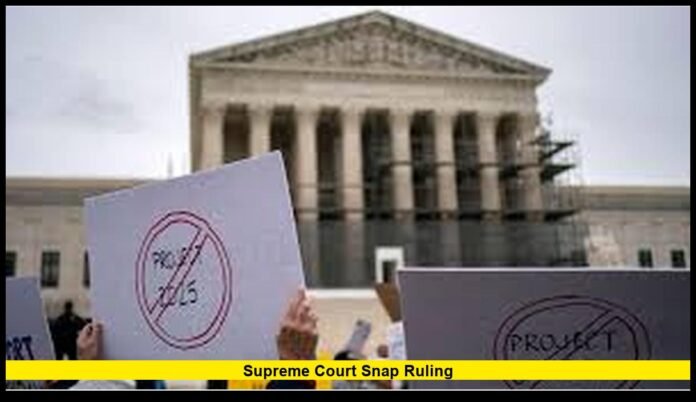

The Supreme Court snap ruling issued on November 7, 2025, has sent ripples through Washington and across the country. In a rare and lightning-fast decision, the justices voted 6–3 to reinstate a federal border enforcement policy that had been blocked by a lower court just days earlier.
The ruling — issued late Thursday without the usual full hearing or written opinion — marks one of the fastest and most consequential actions by the Supreme Court in recent memory. It also highlights a growing trend in how America’s highest court is handling urgent national disputes.
What the Supreme Court Snap Ruling Was About
At the center of this case was a challenge to President Joe Biden’s executive order on border security, signed in late October 2025. The order aimed to speed up deportations for people who crossed the southern border illegally while also expanding humanitarian parole programs for asylum seekers who followed legal channels.
Almost immediately, a coalition of Republican-led states — including Texas, Florida, and Arizona — sued to stop the policy. They argued that it violated federal law and placed extra burdens on state governments.
A federal judge in Texas sided with the states, halting the order before it could take effect. Within hours, the U.S. Department of Justice filed an emergency appeal, asking the Supreme Court to step in.
Less than 48 hours later, the Court delivered what’s now being called the Supreme Court snap ruling, allowing the policy to go forward while the case continues in lower courts.
How the Justices Voted
The justices issued the decision as an unsigned per curiam order — meaning it came from the Court as a whole, without a single author listed.
The six-member majority cited the federal government’s authority over immigration and national security as the reason for reinstating the policy. They emphasized that the executive branch has broad discretion to decide how and when to enforce immigration laws.
Three conservative justices — Clarence Thomas, Samuel Alito, and Neil Gorsuch — dissented. They warned that the Court was moving too fast and bypassing the normal process of careful review.
Justice Alito wrote:
“The Court’s increasing reliance on emergency decisions risks undermining transparency and the careful deliberation our system requires.”
The ruling shows just how divided the justices remain — not just on the issue of immigration, but on how quickly the Court should act when faced with high-stakes, time-sensitive disputes.
What Exactly Is a ‘Supreme Court Snap Ruling’?
A Supreme Court snap ruling is essentially a fast-track decision made through the Court’s emergency or “shadow” docket. These rulings often come in response to urgent petitions — when one side argues that waiting for the normal months-long process could cause serious harm or confusion.
Unlike full opinions, which include public hearings, extensive written arguments, and detailed reasoning, snap rulings are brief and often unsigned. They can be issued within days — sometimes even hours.
In short:
- No oral arguments.
- Short or no written explanation.
- Immediate nationwide effect.
While these decisions can prevent chaos in emergencies, critics say they can also create confusion by skipping public transparency and detailed legal reasoning.
Why the Ruling Matters
The Supreme Court snap ruling matters because it immediately reshaped federal border policy — and showed how quickly the Court can act on major national issues.
For the Biden administration, it’s a major win. The ruling lets the government enforce its border order right away, rather than waiting months for legal challenges to play out.
For the states that sued, it’s a setback. They argue the Court’s decision weakens their ability to challenge federal policies that directly affect local resources.
Beyond immigration, the ruling also signals something broader: the Supreme Court is increasingly comfortable issuing big decisions at record speed.
Reaction From Washington and Across the States
The White House celebrated the decision as a “victory for responsible governance.” In a statement, Homeland Security Secretary Alejandro Mayorkas said the reinstated policy would “restore control and order at the border while protecting lawful asylum opportunities.”
But the reaction from states like Texas and Florida was swift and furious.
Texas Governor Greg Abbott blasted the ruling, saying:
“This decision ties the hands of states trying to defend themselves. Washington has once again ignored the real costs of its reckless immigration policies.”
Florida Governor Ron DeSantis echoed that frustration, warning that the decision “sets a dangerous precedent for unchecked federal power.”
On Capitol Hill, lawmakers reacted along party lines. Democrats praised the Court for acting decisively; Republicans accused it of rubber-stamping executive authority.
Legal Experts Divided Over the Court’s Approach
Legal scholars across the country are split over what this Supreme Court snap ruling means for the future of the judiciary.
Some argue that it shows the Court adapting to a faster, more urgent political world.
Professor Melissa Murray of NYU Law explained:
“The Supreme Court is operating in real time now. When emergencies arise, the justices are showing they can act quickly to prevent disruption.”
Others worry the Court’s speed comes at a cost. Laurence Tribe, a Harvard Law professor, said the growing use of snap rulings risks weakening public trust in the Court’s impartiality.
“Americans deserve to understand why major decisions are made. When rulings come overnight with no reasoning, that transparency disappears.”
The Rise of the Supreme Court’s Shadow Docket
The snap ruling fits into a larger pattern known as the “shadow docket” — a term used by scholars to describe emergency decisions made outside the Court’s regular schedule.
Over the past decade, the use of the shadow docket has exploded. The Court has used it to decide urgent cases on abortion, pandemic restrictions, environmental policy, and election laws.
While previous courts rarely used this power, today’s Supreme Court issues dozens of such orders each year — often with sweeping consequences.
Critics argue that this trend lets major policies take effect without the transparency or public input that the Court’s full docket provides. Supporters say it’s necessary in a fast-moving political world where delays can have real-world costs.
Immediate Impact of the Decision
For now, the Supreme Court snap ruling means the Biden administration’s new border directive is back in force.
Under the order:
- Immigration authorities can expedite deportations of individuals entering illegally between ports of entry.
- Humanitarian parole programs are expanded for vetted asylum seekers applying at official crossings.
- Federal resources will be redirected to process asylum cases more efficiently.
The Department of Homeland Security has already begun implementing the changes, saying they’re designed to “reduce chaos” at the border.
How the Ruling Affects States and Local Governments
While federal officials celebrated, many states are bracing for new challenges.
Texas officials warned that the ruling will increase strain on local law enforcement and border communities. Arizona’s governor said the decision could lead to more confusion over federal versus state authority.
Legal experts note that the ruling could influence future disputes between states and the federal government — not just on immigration but also on issues like healthcare, environmental regulation, and public safety.
Public and Social Media Reaction
The Supreme Court snap ruling immediately took over headlines and social media feeds. Hashtags like #SCOTUSDecision and #SnapRuling trended nationwide.
Some users applauded the Court for acting swiftly to maintain order:
“Finally, decisive leadership. We need quick action on issues that affect the entire country.”
Others voiced concern:
“Fast decisions might sound good, but justice shouldn’t happen in the shadows.”
Pollsters say the debate reflects growing public interest — and skepticism — about how much power the Court now wields in shaping everyday policy.
What Happens Next in the Legal Process
The underlying case, Texas v. United States, now returns to the Fifth Circuit Court of Appeals, where full arguments will begin in early 2026.
That means the fight over the border policy is far from over. If the appellate court sides with the states, the issue could return to the Supreme Court — this time through the normal docket, with full hearings and opinions.
Until then, the reinstated policy remains in effect under the authority of the Supreme Court’s emergency decision.
Broader Implications for the Future
The Supreme Court snap ruling raises big questions about how the judiciary should balance speed with transparency.
It also highlights how much the Court’s role has evolved. Once seen as a slow-moving body that took years to decide cases, the Supreme Court now plays an immediate role in shaping national policy — often faster than Congress or the White House.
Experts say that’s unlikely to change anytime soon. With political gridlock growing and national issues becoming more urgent, the Court’s emergency docket could become an even more common tool of governance.
The Supreme Court snap ruling shows how fast justice can move — for better or worse. Some call it decisive, others call it dangerous. But one thing is clear: the Court’s power to act swiftly has never been more visible. What do you think about this kind of rapid decision-making? Share your thoughts in the comments below and join the conversation.