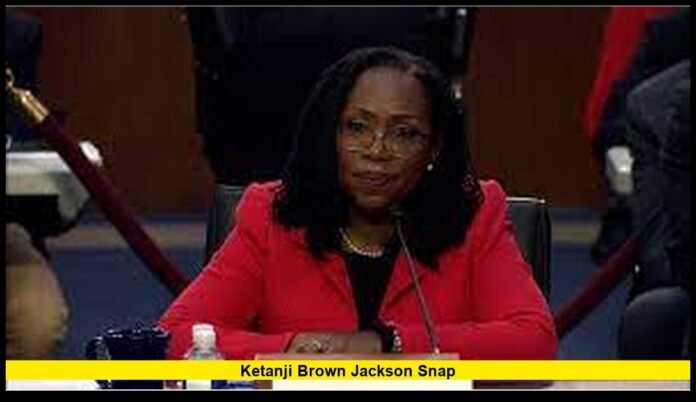

The phrase “Ketanji Brown Jackson snap” has dominated headlines and social media this week, following a striking moment during a Supreme Court hearing that showcased the justice’s intellect, composure, and conviction.
On November 5, 2025, during oral arguments in a major voting rights case, Justice Ketanji Brown Jackson delivered a sharp and eloquent response that has since gone viral — reminding many Americans why she has become one of the most respected voices on the U.S. Supreme Court.
The moment was more than a viral clip; it was a rare glimpse of moral clarity in the country’s most powerful courtroom.
What Sparked the Ketanji Brown Jackson Snap
The now-famous “snap” occurred during oral arguments in United States v. Mills, a case that could reshape how federal oversight applies to state-run elections. At issue was whether a key provision of the Voting Rights Act of 1965 should continue to allow federal monitoring of certain states with histories of racial discrimination in voting laws.
During the hearing, an attorney representing a coalition of state governments argued that “federal oversight has outlived its necessity.”
Justice Jackson leaned forward and, with unmistakable calm yet firmness, delivered a response that drew immediate attention:
“The Constitution does not give states the right to restrict participation under the pretext of sovereignty. Federal oversight exists because history demands it — because democracy cannot thrive where access is denied.”
Her tone was deliberate and unflinching. For a moment, the courtroom fell silent. The Ketanji Brown Jackson snap — as it’s now called online — wasn’t a loss of composure but a controlled, powerful assertion of constitutional principle.
How the Moment Went Viral
Within hours, video clips and transcripts from the hearing began circulating across social media platforms. On X (formerly Twitter), TikTok, and Instagram, the phrase “Ketanji Brown Jackson snap” began trending nationally.
Users praised her eloquence and authority, calling the moment “a masterclass in judicial leadership.”
One viral post read:
“Justice Jackson didn’t snap out of anger — she snapped into history. That’s how you stand for the Constitution.”
Another user commented:
“The Ketanji Brown Jackson snap was everything — poised, brilliant, and fearless.”
Even public figures weighed in. Civil rights attorneys, educators, and journalists hailed the justice’s words as a powerful reminder of why voting rights remain at the heart of American democracy.
Why the Exchange Struck a National Nerve
The Ketanji Brown Jackson snap resonated so widely because it arrived at a time when the nation continues to debate the boundaries of voting access, representation, and constitutional authority.
For many Americans, Justice Jackson’s statement reflected the urgency of protecting democratic participation amid new state-level election laws.
Her moment in court underscored a message that transcends legal circles — that the right to vote is not just a procedural matter but a defining promise of equality.
Political analysts also noted that Jackson’s delivery combined two rare traits: legal precision and emotional resonance. She didn’t shout, posture, or grandstand. She simply stated the truth with the confidence of someone who understands both the law and its human consequences.
Justice Jackson’s Distinctive Approach to the Bench
Since joining the Supreme Court in 2022, Justice Ketanji Brown Jackson has stood out for her thoughtful, historically grounded questioning style.
Her legal philosophy emphasizes context — connecting the Constitution to the real-world effects of judicial decisions. During hearings, she often uses historical examples to show how the law has evolved — or failed to evolve — alongside social realities.
In her first two years on the Court, Jackson has become known for blending sharp legal analysis with accessible language. She regularly pushes lawyers to explain not just what the law says, but what it means for ordinary Americans.
Her approach has made her a favorite among younger lawyers, students, and professors who see her as both a legal scholar and a communicator of justice.
Supporters Applaud Her Strength — Critics Question Her Tone
Like most viral courtroom moments, the Ketanji Brown Jackson snap drew both praise and criticism.
Supporters viewed it as an example of moral leadership from the bench. Legal experts noted that her remarks were consistent with long-standing constitutional interpretations of the 14th and 15th Amendments, which grant Congress the power to enforce voting rights protections.
Civil rights advocates and historians quickly echoed her sentiment, pointing out that the Voting Rights Act has repeatedly proven essential in preventing discriminatory election practices.
However, some conservative commentators accused Justice Jackson of displaying “judicial activism” and argued that her language showed bias toward one side of the argument.
Her defenders countered that strong questioning is an expected — and necessary — part of Supreme Court proceedings.
Legal analyst Erin Chemerinsky, dean of UC Berkeley School of Law, commented:
“Justice Jackson’s remarks were not activism — they were constitutional fidelity. She did exactly what a justice should do: demand accountability from those invoking state power at the expense of individual rights.”
Media Coverage and National Discussion
Major U.S. news outlets, including CNN, The Washington Post, and Reuters, devoted extensive coverage to the exchange. Editorial writers praised Jackson’s statement as a moment that reminded Americans of the judiciary’s responsibility to protect fundamental rights.
Television panels and podcasts debated whether her words reflected a broader shift in how justices communicate. In an age when the Court’s legitimacy is often questioned, many argued that Jackson’s transparency and conviction make the institution feel more relatable to the public.
Her moment also sparked conversations in classrooms and universities across the country. Law professors have been dissecting her remarks as a prime example of judicial rhetoric — showing how clear, direct language can translate legal theory into moral clarity.
Ketanji Brown Jackson’s Broader Impact on the Supreme Court
At just 55 years old, Justice Jackson represents a generational shift on the Court. Her perspective as a former public defender and federal trial judge adds a crucial layer of experience often missing from the bench.
Her written opinions frequently include historical citations that reveal the human context behind legal disputes. She has authored notable dissents on issues like affirmative action, workplace rights, and environmental protections — each written with precision, empathy, and an eye toward justice for future generations.
Many observers believe Jackson’s presence has brought a renewed energy to the Court’s deliberations. Her influence, though relatively new, is already shaping how oral arguments unfold and how Americans engage with the Court’s work.
The Case Behind the Moment: United States v. Mills
The United States v. Mills case — still under deliberation — is expected to become one of the most consequential decisions of the current Supreme Court term.
At its core, the case challenges whether the Department of Justice can continue reviewing changes to voting laws in certain states before they take effect — a safeguard designed to prevent discriminatory practices.
If the Court rules in favor of the states, federal oversight could be significantly reduced, potentially changing how future elections are regulated. If the Court sides with the federal government, it would reaffirm Washington’s authority to intervene in cases where citizens’ access to the ballot might be threatened.
A decision is expected in mid-2026, and legal experts say it could reshape the balance of power between state and federal governments on voting rights enforcement.
Why the Moment Mattered Beyond the Courtroom
The Ketanji Brown Jackson snap moment captured something deeper than a legal argument — it reflected a shift in how Americans see the role of the Supreme Court.
In an era when public trust in institutions has declined, Jackson’s words served as a reminder that integrity and courage still hold power. Her calm but firm defense of constitutional principles showed that leadership doesn’t require loudness; it requires conviction.
Her statement also reignited interest in civic education. Teachers, civic leaders, and commentators have used her remarks to discuss why voting rights — often seen as settled law — remain a living issue that affects millions.
Public Perception: A Justice for the People
Justice Jackson’s popularity continues to grow. Surveys conducted by several media outlets this year show she ranks among the most positively viewed Supreme Court justices.
Americans often describe her as “approachable,” “intelligent,” and “principled.” Her ability to articulate complex legal reasoning in plain terms has made her a symbol of what many hope the judiciary can still represent: fairness and humanity.
The Broader Meaning of the Ketanji Brown Jackson Snap
In the days following the viral moment, opinion writers and public figures alike reflected on what it truly symbolized.
For some, it was a simple instance of judicial sharpness. For others, it was a turning point — proof that reasoned authority still commands respect in an age of political noise.
More importantly, it underscored a truth that Justice Jackson has championed throughout her career: that the law is not abstract. It’s a living framework built to ensure that every person — regardless of background — has a voice.
Justice Ketanji Brown Jackson’s snap wasn’t about confrontation — it was about clarity. Her words echoed far beyond the marble walls of the Court, reminding the nation that justice is strongest when it speaks with both courage and compassion. What are your thoughts on her powerful moment? Share your perspective in the comments below and join the conversation.