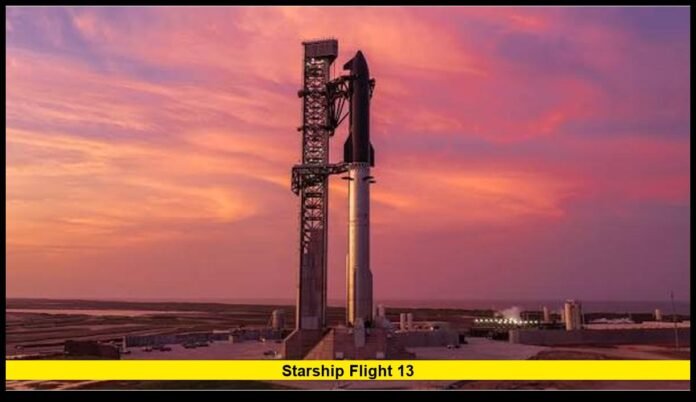

SpaceX continues to push the boundaries of modern spaceflight, and starship flight 13 stands as another significant achievement in the company’s long-running test campaign. The mission successfully demonstrated several important capabilities, including the launch of the latest Starship Version 3 vehicle, deployment of next-generation Starlink satellites, and valuable testing of systems designed for future lunar and Mars missions. Rather than serving as a routine launch, the flight combined multiple engineering objectives that will help shape the future of SpaceX’s fully reusable transportation system.
As Starship evolves through frequent test flights, each mission delivers critical information that cannot be replicated through simulations alone. Flight 13 continued this approach by evaluating launch performance, propulsion systems, thermal protection, communications, payload deployment, and atmospheric reentry. Every stage of the mission contributed new data that engineers will use to improve future vehicles.
SpaceX Continues Its Rapid Starship Development Strategy
Unlike traditional aerospace programs that often wait years between major launches, SpaceX follows a rapid development philosophy. The company builds, flies, studies, and improves its hardware continuously. Every integrated flight test introduces upgrades while also validating changes made after previous missions.
This approach allows engineers to identify real-world challenges quickly and make improvements without long delays. Instead of expecting perfection on every launch, SpaceX treats each mission as part of an ongoing engineering process.
Starship Flight 13 continued that philosophy by combining new technologies with proven systems, helping the company move closer to routine operations.
Understanding the Starship Launch System
Starship is the largest launch vehicle ever developed. Standing roughly 400 feet tall, it consists of two fully reusable stages.
The lower stage is known as Super Heavy, while the upper stage carries the name Starship. Together, they are designed to transport enormous payloads into Earth orbit and eventually carry astronauts and cargo far beyond Earth.
The launch system is intended for a wide variety of missions, including:
- Commercial satellite launches
- Human spaceflight
- NASA lunar missions
- Cargo transportation
- Deep-space exploration
- Future Mars expeditions
Unlike conventional rockets that discard major components after launch, Starship aims to recover both stages for repeated use. This strategy could significantly reduce launch costs while increasing launch frequency.
Flight 13 Continued the Progress of Version 3
Flight 13 featured the latest Starship Version 3 design, representing another major step in the evolution of the spacecraft.
SpaceX regularly updates nearly every aspect of Starship between launches. While many engineering changes occur behind the scenes, Version 3 incorporates improvements intended to increase reliability, simplify manufacturing, and enhance flight performance.
The latest configuration includes refinements to:
- Vehicle structure
- Propulsion systems
- Flight software
- Thermal protection
- Internal plumbing
- Electrical systems
- Manufacturing processes
Rather than introducing one dramatic change, SpaceX continues making hundreds of smaller improvements that collectively strengthen the overall vehicle.
Launch Day Performance
The mission lifted off from SpaceX’s Starbase launch facility in South Texas following final technical reviews and favorable launch conditions.
The powerful Super Heavy booster ignited its array of Raptor engines, producing extraordinary thrust that carried Starship away from the launch pad.
The initial ascent progressed according to plan, with onboard computers continuously monitoring thousands of system parameters throughout the climb.
As the vehicle accelerated through the atmosphere, engineers closely tracked engine performance, structural loads, fuel consumption, guidance systems, and communications.
The successful ascent provided another opportunity to validate improvements introduced since previous flights.
Successful Stage Separation
One of the most important milestones during any Starship mission is the separation between the Super Heavy booster and the Starship upper stage.
This event requires extremely precise timing and coordination.
During Flight 13, the booster completed its primary task before separating cleanly from the spacecraft. The upper stage then continued its planned flight path while the booster began its controlled descent.
Smooth stage separation remains one of the most critical engineering achievements for every integrated Starship mission because it allows both stages to perform their individual flight objectives.
The successful execution during Flight 13 demonstrated continued progress in this complex operation.
Read More – SpaceX Starship Flight Test 12: First Starship V3 Launch Ends in Booster Mishap — Fleet Now Grounded
Super Heavy Booster Recovery Operations
Although SpaceX ultimately plans to recover Super Heavy boosters using the launch tower’s mechanical catch arms, Flight 13 followed a different recovery profile.
Instead of returning to the launch site, the booster performed a controlled descent toward a designated splashdown area offshore.
This approach enabled engineers to focus on collecting flight data while continuing to evaluate descent guidance, engine relight procedures, navigation systems, and overall vehicle stability.
Every recovery attempt, whether involving tower catches or splashdowns, provides valuable information that supports future improvements.
Developing reliable booster recovery remains one of the company’s highest priorities because complete reusability is central to Starship’s long-term mission.
Starlink Satellites Became Part of the Test Mission
Flight 13 became the first Starship mission to carry next-generation Starlink Version 3 satellites.
This represented an important milestone because it expanded Starship’s role beyond pure flight testing.
The satellites served as technology demonstration payloads rather than permanent additions to the operational Starlink constellation.
Their inclusion allowed SpaceX to evaluate several important systems simultaneously, including:
- Payload integration
- Satellite deployment mechanisms
- Communication systems
- Solar array operations
- Internal spacecraft interfaces
Successfully carrying and releasing payloads is essential for Starship’s future commercial role.
As development continues, the vehicle is expected to launch increasingly larger batches of satellites than current launch vehicles can accommodate.
Advancing Thermal Protection Technology
One of the greatest engineering challenges facing reusable spacecraft is surviving atmospheric reentry.
As Starship returns from space, the spacecraft experiences extreme temperatures created by friction with Earth’s atmosphere.
Its heat shield consists of thousands of specialized thermal protection tiles designed to withstand these intense conditions.
Flight 13 included several new experiments intended to improve engineers’ understanding of heat shield performance.
Some tiles were painted white to create visible reference points for imaging during reentry.
Additional cameras captured detailed views of the spacecraft as it descended through the atmosphere.
These observations help engineers study:
- Surface heating
- Tile durability
- Material performance
- Airflow characteristics
- Reentry stability
The information gathered during every mission supports continual improvements to future vehicles.
Raptor Engines Continue to Mature
The Raptor engine remains one of the most advanced rocket engines ever developed.
Powered by liquid methane and liquid oxygen, the engines generate enormous thrust while supporting rapid reusability.
Flight 13 offered another opportunity to evaluate engine performance under operational conditions.
Throughout launch, ascent, stage separation, and descent, engineers monitored numerous engine characteristics, including ignition reliability, chamber pressures, fuel efficiency, and thrust performance.
Every successful flight helps validate design refinements that improve overall reliability.
Because Starship relies on dozens of Raptor engines working together, consistent engine performance remains one of the most important aspects of the entire program.
Communications and Flight Data Collection
Modern launch vehicles generate enormous amounts of telemetry throughout every mission.
Flight 13 collected information from thousands of onboard sensors that continuously measured vehicle performance.
Among the systems under evaluation were:
- Guidance computers
- Navigation equipment
- Flight software
- Structural sensors
- Propulsion systems
- Power distribution
- Communication links
The resulting engineering database provides SpaceX with a comprehensive picture of vehicle behavior throughout every phase of flight.
This information often becomes even more valuable after the mission ends, as engineers carefully review every second of recorded data.
Supporting Future NASA Missions
Starship plays an important role in NASA’s Artemis program.
NASA selected a specialized lunar version of Starship to serve as the Human Landing System for future Artemis missions that aim to return astronauts to the Moon.
Before those missions can occur, SpaceX must continue demonstrating consistent progress across numerous technical areas.
These include:
- Reliable launches
- Precision orbital operations
- Safe spacecraft performance
- Advanced propulsion capabilities
- Long-duration mission support
- Controlled landing procedures
Although Flight 13 was not a crewed mission, the technologies tested contribute directly to the long-term development required for future lunar exploration.
Why Reusability Matters
One of Starship’s defining characteristics is its goal of full reusability.
Historically, rockets have discarded expensive hardware after every mission, making spaceflight extremely costly.
SpaceX is working to change that model.
By recovering both the Super Heavy booster and the Starship spacecraft, the company hopes to reduce launch expenses dramatically while enabling much higher launch frequencies.
Achieving this goal requires repeated testing under real flight conditions.
Every mission—including Flight 13—helps engineers improve landing systems, heat protection, propulsion reliability, and structural durability.
The lessons learned today will influence the operational vehicles of tomorrow.
Growing Interest Around the World
Interest in Starship continues to grow across the global space community.
Engineers, researchers, educators, investors, students, and space enthusiasts closely follow every integrated flight test.
Several factors explain this widespread attention.
Starship is:
- The tallest rocket ever built
- The most powerful launch vehicle ever flown
- Fully reusable by design
- Central to future Moon missions
- Intended for eventual Mars exploration
- A major platform for commercial satellite launches
Its rapid pace of development has made it one of the most closely watched aerospace programs in history.
Each new mission adds another chapter to that story.
Latest Mission Status
As of today, Flight 13 successfully completed its primary planned objectives. The mission achieved launch, stage separation, upper-stage flight operations, deployment of demonstration Starlink Version 3 satellites, and planned splashdowns for both stages.
The flight also gathered extensive engineering information covering propulsion, communications, thermal protection, structural performance, guidance systems, and atmospheric reentry.
SpaceX has not yet released a comprehensive technical report detailing every result from the mission. Engineers continue analyzing telemetry, onboard imagery, and post-flight performance data to guide future improvements.
No official announcement has confirmed the exact launch date for the next integrated Starship test flight. Future missions will proceed once vehicle readiness, regulatory requirements, and operational planning are complete.
What Flight 13 Means for the Future
Starship Flight 13 demonstrated that SpaceX is steadily expanding the capabilities of its next-generation launch system.
The mission successfully combined launch operations, payload deployment, advanced engineering experiments, and extensive data collection into a single integrated test.
As Starship matures, future missions are expected to include increasingly complex objectives while moving closer to operational service.
The vehicle remains central to SpaceX’s commercial launch plans, NASA’s lunar exploration goals, and the company’s long-term vision of transporting people and cargo deeper into the solar system.
Each successful flight strengthens the engineering foundation needed to transform Starship from an experimental vehicle into a fully operational transportation system capable of supporting a new era of space exploration.
Stay connected for the latest Starship news, and share your thoughts on Flight 13 in the comments below.