
Published: May 28, 2026 | Category: Space Exploration | Read Time: ~6 minutes
Overview
SpaceX made history on May 22, 2026, when it launched the very first Starship Version 3 (V3) rocket from its newly built Orbital Launch Pad 2 at Starbase in Boca Chica, Texas. Dubbed Starship Flight Test 12, the mission marked a giant leap forward for the world’s most powerful rocket program — but it also ended with a dramatic booster failure that has since grounded the entire Starship fleet pending a federal investigation.
What Is Starship Flight Test 12?
Starship Flight Test 12 was the 12th integrated test flight of the Starship-Super Heavy launch system and the first flight of the Block 3 (Version 3) vehicles. The mission featured two brand-new vehicles:
- Booster 19 (B19) — a next-generation Super Heavy Block 3 booster powered by 33 Raptor 3 engines
- Ship 39 (S39) — the Starship V3 upper stage, also Block 3 hardware
The 408-foot-tall (124 m) rocket lifted off at 5:30 p.m. local time (CDT) on May 22, 2026, after a one-day delay caused by a faulty hydraulic pin on the launch tower arm that prevented the first attempt on May 21.
It was also the first Starship launch from Pad 2, a brand-new orbital launch pad built at Starbase alongside the original Pad 1.
The Road to Flight 12: Eight Months in the Making
The previous Starship test flight, Flight 11, had launched on October 13, 2025. That eight-month gap between flights was the result of an intensive development cycle. Following five flights of Starship Version 2 in 2025, SpaceX progressed to the next block upgrade of the rocket after extensive testing, including two separate explosive setbacks on the test stand which destroyed a Super Heavy booster and a Starship upper stage.
One of those setbacks came in November 2025 when Booster 18 — originally planned for Flight 12 — suffered a catastrophic anomaly during gas system pressure testing, forcing SpaceX to pivot to Booster 19 as a replacement.
What’s New in Starship Version 3?
Flight 12 introduced a sweeping set of upgrades under the Starship V3 banner:
- Raptor 3 engines — a simplified, more powerful evolution of SpaceX’s main engine, with improved performance and reliability
- Increased propellant capacity on the Super Heavy booster
- Integrated interstage design and a reduction from 4 grid fins to 3 on the booster
- New launch pad (Pad 2) with upgraded ground support equipment
- A redesigned heat shield on the upper stage with experiments to measure tile performance during reentry
SpaceX expects Starship to be capable of carrying 100 metric tons or more of payload into orbit eventually with Version 3.
Flight 12 Mission Objectives
The 12th flight test was packed with ambitious goals for both the booster and the upper stage.
Super Heavy Booster (Booster 19)
Because this was the maiden flight of Block 3 hardware, Booster 19 would not attempt a return-to-pad catch. Instead, it was planned to land in the Gulf of Mexico about seven minutes after liftoff.
Starship Upper Stage (Ship 39)
The Starship upper stage targeted multiple in-space and reentry objectives, including a payload deployment of 20 Starlink simulators similar in size to next-generation Starlink V3 satellites, and two specially modified Starlink satellites. Those two satellites were designed to test hardware planned for Starlink V3 and to attempt to scan Starship’s heat shield and transmit imagery to operators — a method of analyzing heat shield readiness for future return-to-launch-site missions.
A relight of a single Raptor engine while in space was also planned, and a single heat shield tile was intentionally removed to measure the aerodynamic load differences on adjacent tiles.
What Happened During Flight 12?
Liftoff and Ascent
The rocket lifted off cleanly at 5:30 p.m. CDT from Pad 2. The vehicle left the ground ascending nominally, although with an engine shutdown early in flight.
Booster Separation and Failure
After hot-staging — where the upper stage ignites its engines while still attached to the booster — things began to go wrong for Booster 19. Minutes after Starship blasted off from Texas, the booster separated as normal, but engines conked out as it made its way back to Earth.
The boostback burn was off-nominal and had several missing engines, causing the booster to spin out of control. SpaceX intentionally left the flight termination system inactivated. The booster was unable to perform the engine burns needed for a controlled return and ended up experiencing a hard splashdown in the Gulf of Mexico.
Ship 39 Triumphs Despite Its Own Anomaly
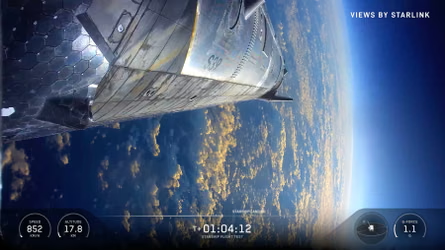
Meanwhile, Ship 39 faced its own mid-flight challenge. The ship experienced an early engine-out when one Raptor Vacuum (RVac) engine shut down just 36 seconds after ignition, forcing the remaining engines to burn longer. Camera views showed significant heating and damage in the engine bay, with glowing red components and sea-level engines gimbaling to compensate for the thrust imbalance.
Despite this, the upper stage reached space, deployed all 22 Starlink satellite simulators, survived reentry, and executed a controlled splashdown in the Indian Ocean.
Two specially modified satellites were equipped with cameras that scanned Starship’s heat shield from orbit and transmitted imagery back to operators. The in-space Raptor engine relight experiment was ultimately skipped due to the anomalies that occurred during ascent.
Ship 39 then completed its reentry and other experiments perfectly, before splashing down in the Indian Ocean on target and with an impressive-looking heat shield.
FAA Investigation: Starship Fleet Grounded
The achievement of Ship 39’s successful splashdown was quickly overshadowed by regulatory action. The Federal Aviation Administration has ordered SpaceX to investigate why its Starship booster failed during the May 22 test flight. This means SpaceX will have to pause any further Starship test launches until the investigation is completed and the results are submitted to the FAA for approval.
The FAA announced Wednesday that the hour-long spaceflight resulted in a mishap based on the performance of the mega rocket’s first-stage booster. There were no reports of injury or property damage, and the FAA will oversee the company’s investigation.
According to the FAA: “A return to flight of the Starship-Super Heavy vehicle is based on the FAA determining that any system, process, or procedure related to the mishap does not affect public safety.”
The grounding also diminishes the chance that another Starship launch will occur before SpaceX’s anticipated IPO in mid-June.
What SpaceX Learned From Flight 12
Despite the booster loss, SpaceX and the broader space community view Flight 12 as a meaningful step forward. While the booster was lost, the flight yielded valuable data on Raptor 3 operations and grid fin performance in off-nominal conditions. The flight carried hundreds of upgrades, including simplified and more powerful Raptor 3 engines, increased propellant capacity, and new systems designed to support Starship’s future operational goals.
Ship 39’s survival and successful splashdown despite losing a vacuum engine also demonstrated the resilience of the new Block 3 design and flight control systems.
What Comes Next for Starship?
SpaceX is already preparing for a follow-up flight. The data gathered from Flight 12 on Raptor 3 operations and off-nominal conditions will inform improvements ahead of the next test. However, no timeline for Flight 13 has been confirmed while the FAA investigation remains open.
The stakes for Starship continue to rise. NASA has selected Starship as the Human Landing System for the Artemis Moon program, and Elon Musk has outlined Starship as the cornerstone vehicle for crewed Mars missions. The sooner SpaceX can resolve the booster failure root cause and return to flight, the sooner those larger ambitions can move forward.
The Starship story is moving fast — drop your thoughts in the comments below and make sure you’re subscribed so you don’t miss a single update as the investigation unfolds and Flight 13 edges closer to the pad.