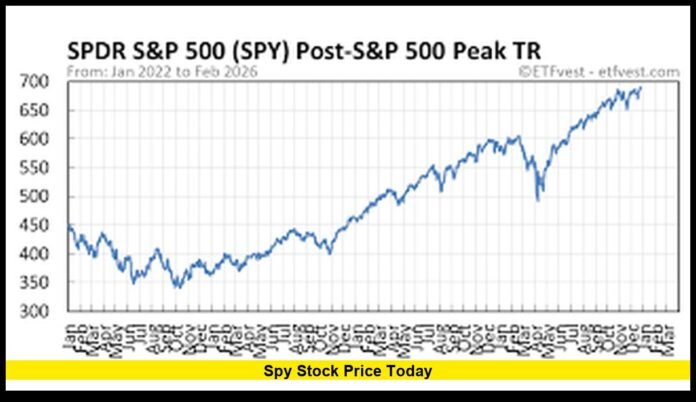

The SPY stock price today reflects the current direction of the U.S. equity market as investors monitor economic data, corporate earnings, and Federal Reserve policy signals. The SPDR S&P 500 ETF Trust (SPY), one of the most actively traded exchange-traded funds in the United States, is currently trading around $680–$682 per share, remaining close to its recent record highs in 2026.
Because the ETF tracks the S&P 500 Index, its daily movement offers a real-time picture of how the broader U.S. stock market is performing. When SPY rises or falls, it usually mirrors the performance of the largest publicly traded companies in America.
SPY Stock Price Today: Key Market Snapshot
As of the latest trading session on March 6, 2026, SPY is trading near $681 per share. Market activity throughout the day has shown moderate movement within a narrow range.
Here is a quick snapshot of the ETF’s latest market data:
| Metric | Current Data |
|---|---|
| Current SPY Price | Around $681 |
| Intraday Range | About $675 – $685 |
| 52-Week Range | Roughly $480 – $697 |
| Dividend Yield | Around 1.1% |
| Expense Ratio | 0.09% |
The ETF remains extremely liquid, with millions of shares traded daily. High liquidity allows investors to enter and exit positions quickly without large price differences.
What SPY Represents in the U.S. Market
The SPDR S&P 500 ETF Trust is designed to track the performance of the S&P 500 Index, which includes 500 of the largest publicly traded companies in the United States.
Because of this structure, SPY offers investors exposure to a wide range of industries and sectors across the economy.
Key features of the ETF include:
- Diversification across 500 major U.S. companies
- Exposure to multiple economic sectors
- High trading volume and liquidity
- Low management cost compared with many mutual funds
For many investors, tracking the SPY stock price today provides a simple way to understand how the overall U.S. stock market is performing.
Recent Factors Influencing SPY
Several economic and global factors have influenced the market in recent trading sessions.
Economic Data and Interest Rate Expectations
Investors remain focused on key economic indicators such as:
- U.S. employment data
- inflation reports
- consumer spending numbers
These reports influence expectations about future interest rate decisions by the Federal Reserve. Changes in rate expectations can quickly affect equity prices.
Global Market Uncertainty
Geopolitical developments and global economic conditions have also contributed to market volatility. When uncertainty increases, investors sometimes shift money into safer assets, which can create short-term declines in stock prices.
Corporate Earnings
Strong earnings from large U.S. companies have supported the broader market over the past year. Many major firms in technology, finance, and consumer sectors have continued to report solid revenue growth.
SPY Performance Over the Last Year
SPY has experienced strong gains over the past year despite periods of volatility.
Important performance highlights include:
- Approximately 16% annual return over the past 12 months
- Record closing highs reached in early 2026
- Continued investor demand for large-cap U.S. stocks
These gains were supported by strong corporate earnings, resilient consumer spending, and continued investment in emerging technologies such as artificial intelligence.
Even during market pullbacks, the ETF has remained near historic levels.
Major Sectors Driving the SPY ETF
The SPY ETF reflects the sector composition of the S&P 500. Several sectors carry the largest weightings and strongly influence daily price movements.
Technology
Technology companies represent the largest portion of the index. Firms involved in artificial intelligence, cloud computing, and semiconductors have contributed significantly to market growth.
Financial Services
Banks and financial institutions play a major role in the ETF. Interest rates and economic growth expectations directly affect this sector.
Healthcare
Healthcare companies provide stability during market fluctuations. Pharmaceutical and biotechnology firms remain important contributors to the index.
Consumer Discretionary
Retail and consumer brands drive growth when consumer spending remains strong. Companies in this sector benefit when the economy expands.
Together, these sectors shape the performance of SPY and the broader market.
Why Many Investors Use SPY
SPY is one of the most widely used investment tools in the United States.
Both institutional and individual investors rely on it for several reasons:
- It provides instant diversification across the U.S. economy
- It allows investors to track the overall stock market easily
- The ETF has very low operating costs
- It offers high liquidity for trading strategies
Many retirement accounts and long-term portfolios include SPY or similar index-tracking funds.
How Traders Analyze SPY Daily
Traders monitoring the SPY stock price today often analyze several indicators before making investment decisions.
Technical Levels
Short-term traders look at support and resistance levels to determine possible price movements.
Trading Volume
Higher trading volume can indicate stronger market conviction behind a price move.
Bond Yields
Changes in Treasury yields influence equity valuations and often affect SPY performance.
Market Sentiment
News events, corporate announcements, and economic updates can quickly shift investor sentiment.
Because SPY trades throughout the entire U.S. market session, it reacts quickly to new information.
Long-Term Role of SPY in Investment Portfolios
Since its launch in 1993, the SPDR S&P 500 ETF Trust has become one of the most important investment vehicles in the world.
The ETF has consistently tracked the performance of the S&P 500, providing investors with exposure to the largest companies in the U.S. economy.
Over the long term, the fund has benefited from economic expansion, corporate innovation, and rising corporate earnings.
As a result, many investors consider SPY a foundational asset in diversified portfolios.
The SPY stock price today remains one of the most watched indicators in financial markets, so keep an eye on market movements and join the discussion about where the U.S. stock market could head next.