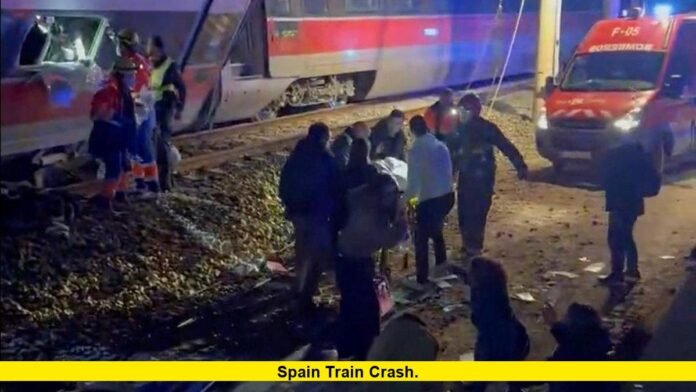

The spain train crash that struck southern Spain has become one of the deadliest rail disasters in the country in recent years, after two high-speed passenger trains collided near the town of Adamuz in the province of Córdoba on the evening of January 18, 2026. The confirmed death toll stands at more than twenty, with scores of passengers injured, several of them critically, as rescue and recovery operations continue and investigators work to determine what caused the catastrophic accident.
Timeline of the Crash
The collision occurred shortly before 8:00 p.m. local time on a high-speed rail corridor linking central and southern Spain. One train was traveling northbound toward Madrid, while the other was heading southbound toward Andalusia.
According to official statements, the first train derailed while traveling at high speed on a straight section of track near Adamuz. After leaving the rails, it crossed into the adjacent line, where it struck an oncoming high-speed service. The impact caused multiple carriages from both trains to overturn, slide down an embankment, and pile into twisted wreckage.
The force of the collision was so severe that several coaches were partially crushed, trapping passengers inside and making access extremely difficult for emergency teams.
Confirmed Casualties and Injuries
Authorities have confirmed that at least 21 people lost their lives in the crash. Medical services reported that more than 100 passengers suffered injuries of varying severity. Dozens were transported to hospitals in Córdoba, Seville, and Madrid, with a number of victims admitted to intensive care units due to head trauma, internal injuries, and fractures.
Emergency officials stated that both trains were carrying a combined total of approximately 400 passengers at the time of the collision. The final number of injured may change as all survivors receive full medical evaluation.
Rescue Operations Through the Night
Rescue efforts began within minutes of the crash. Firefighters, civil protection units, medical teams, and police were dispatched from across Andalusia. Specialized urban search-and-rescue units used hydraulic tools to cut through metal and free passengers trapped in collapsed carriages.
The rural location of the crash site complicated access. Emergency crews had to navigate uneven terrain and narrow service roads to reach the wreckage. Portable lighting systems were installed to allow operations to continue throughout the night, and helicopters were used to evacuate the most critically injured to trauma centers.
Temporary triage and reception areas were set up at nearby train stations and community centers, where survivors received medical checks, psychological support, food, and assistance contacting relatives.
National Response and Government Reaction
Spain’s national and regional leaders responded swiftly. The central government activated emergency coordination protocols, while the Andalusian regional authority placed hospitals on high alert to receive casualties.
The Prime Minister expressed condolences to the families of those who died and pledged full support for the victims and the investigation. The King and Queen of Spain also issued statements of solidarity, describing the crash as a tragedy that has shaken the entire nation.
The Ministry of Transport ordered an immediate review of rail operations on the affected corridor and suspended high-speed traffic between Madrid and several southern cities as a precaution.
Impact on Rail Services
Following the collision, high-speed rail services between Madrid, Córdoba, Seville, Málaga, and Huelva were suspended. Thousands of passengers faced cancellations and delays as rail operators worked to reroute traffic and arrange alternative transportation.
Engineers and safety inspectors began examining the damaged section of track, signaling systems, and nearby infrastructure. The line will remain closed until authorities confirm that it is safe to resume operations.
Spain’s high-speed network is among the largest and most modern in Europe, carrying millions of passengers each year. The sudden halt of a major corridor has had a significant ripple effect on national travel and logistics.
What Investigators Are Examining
A full judicial and technical investigation is underway. Rail safety authorities are analyzing data from onboard event recorders, signaling logs, and control center communications. Forensic teams are also inspecting wheel sets, rails, and track geometry in the derailment zone.
Officials have confirmed that the section of track involved had undergone recent maintenance and modernization. Investigators are therefore focusing on several key areas:
- Train speed and braking performance
- Track condition and alignment
- Signaling and communication systems
- Automatic safety controls and their response
- Human factors, including operational procedures
At this stage, no official cause has been announced. Authorities have emphasized that only confirmed technical findings will be released and that the investigation will be thorough and transparent.
Eyewitness Accounts from Survivors
Passengers who survived the collision described a sudden, violent jolt followed by chaos inside the carriages. Many reported being thrown from their seats as luggage and debris flew through the air. Windows shattered, lights went out, and smoke filled parts of the trains.
Some passengers escaped through broken windows, while others waited for rescuers to cut through damaged doors. Several survivors praised the rapid response of emergency teams, saying that firefighters and medics worked tirelessly under dangerous conditions to reach those still trapped.
Spain’s Rail Safety Record
Spain’s high-speed rail system has long been regarded as one of the safest in the world, with advanced signaling, automatic train control, and strict maintenance standards. Serious accidents are rare, which is why this spain train crash has had such a profound impact on public confidence and the national consciousness.
The last comparable disaster occurred more than a decade ago, making this incident one of the most severe rail tragedies in modern Spanish history. Transportation experts say the findings of the current investigation could lead to new safety protocols, infrastructure upgrades, or operational reforms across the network.
Support for Victims and Families
Counseling services and assistance centers have been established for survivors and relatives of the victims. Authorities are coordinating with hospitals, social services, and legal teams to provide long-term support, including psychological care and help with travel and accommodation for families coming to identify loved ones.
Compensation procedures and insurance processes are also being prepared, though officials stress that the immediate priority remains medical care, recovery, and a complete understanding of how the crash occurred.
A Nation in Mourning
As Spain observes moments of silence in several cities, flags have been lowered at public buildings, and messages of condolence have poured in from across Europe and beyond. The tragedy has sparked a national conversation about rail safety, infrastructure investment, and emergency preparedness.
The investigation is expected to take months, but its conclusions will play a critical role in shaping the future of high-speed rail safety in Spain and potentially across Europe.
Share your thoughts on this tragic event and stay connected for continued updates as the investigation unfolds.