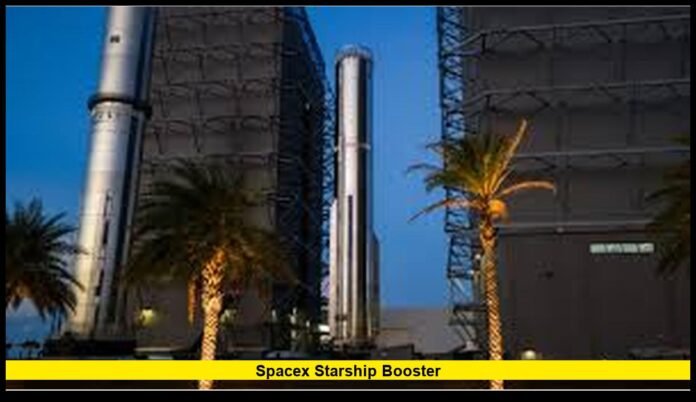

In early hours of November 21, 2025, the spacex starship booster known as Booster 18 experienced a dramatic failure during a ground pressure test at SpaceX’s facility in South Texas. The anomaly occurred while the booster was undergoing gas-system pressurization ahead of structural proof testing, and the event has prompted a detailed investigation and pause in that vehicle’s test campaign.
Background & context
Booster 18 marks the first of the upgraded Super Heavy first-stage boosters intended for the next generation of the Starship system. SpaceX placed the vehicle on a test stand at its Starbase site on November 20, signaling the beginning of its ground-qualification sequence for this version. The vehicle had not yet received its engines nor been loaded with propellant when the test sequence began.
During the test window, a sudden release of gas and visible deformation occurred around the liquid-oxygen tank and lower shell region of the booster. Observers captured the event via livestream and still imagery, showing the lower section buckling and large structural tears forming. The company confirmed the anomaly and stated that no one was injured.
Why this matters
This booster plays a pivotal role in advancing SpaceX’s launch architecture. Its design upgrades—intended to enable higher thrust, faster turnaround and increased structural margins—are critical for meeting upcoming mission goals. With this test setback, the schedule for validating those improvements faces delay. For a program that emphasizes rapid iteration and frequent flights, such a ground failure is particularly noteworthy.
In effect, the setback raises immediate questions:
- Will the vehicle be repairable, or will it need to be retired?
- How will this affect the availability of upgraded boosters for upcoming launches?
- What insight does it provide about the structural and propellant-system risks inherent in the design?
Sequence of key events
- Nov 20, 2025: Booster 18 is rolled out to the test-stand area at the South Texas facility.
- Late night / early morning of Nov 21: The vehicle undergoes a scheduled gas-system pressure test ahead of structural proof testing.
- Around 4:00 a.m. CT: The anomaly occurs. The lower structure and LOX tank area rupture under pressure.
- Immediately following the event, SpaceX issues a brief statement acknowledging the incident and that no propellant or engines were aboard.
- Engineers begin inspection and assessment to determine damage scope and next steps.
Technical analysis of the failure
Pressure proof testing is a fundamental step in rocket-stage validation. It subjects tanks, piping and load-bearing structures to worst-case loads and internal pressure to verify margins before cryogenic propellant loading or engine install. In this case, the rupture of the tank appears to have originated from overpressure of a gas line or COPV (composite-overwrapped pressure vessel) within the tank system. The sequence suggests a chain-reaction failure: litigation indicates that a COPV inside a chine may have failed, triggering tank rupture upward.
Because the booster was in a non-propellant, engine-less state, the failure did not escalate into a fire or explosion, which limits the damage to structural components rather than a full-scale disaster. Still, the lower section of the booster shows significant deformation and blast ruptures. That likely renders the booster unusable without either extensive repairs or scrapping.
The updated version of the booster includes changes such as new internal plumbing, larger COPVs, revised tank walls and structural reinforcements. Failures at this stage may indicate one or more of the following:
- Inadequate weld or join quality in new tank sections
- Unexpected interactions between the new gas plumbing and tank structures
- Test-procedure parameters (pressure ramp-rate, hold times) that exceeded design margins
- COPV design or installation defects in the new configuration
Because SpaceX uses a “test-to-failure” ethos in many of its developments, this failure offers data—but also demands schedule adjustments and possibly redesigns.
Impact on the flight campaign
With Booster 18 sidelined pending investigation, upcoming launch planning faces adjustment. The program’s original roadmap had built this booster into a near-term flight slot. That slot now needs reallocation—either another vehicle will take its place or the flight timeline must shift. For a company that aims high on cadence, this entails ripple effects: preparation timelines, pad readiness, crew scheduling, and risk profiles all shift.
In practical terms:
- Flight test timelines may push back by weeks or more.
- Resources may re-prioritize other boosters (e.g., Booster 19) for early readiness.
- The validation sequence for the version-3 booster architecture may extend.
- Stakeholders—including government customers and partners—may adjust expectations.
Local and regulatory landscape
The South Texas site where the test occurred is under both local and federal oversight. Although this incident caused no injuries or off-site damage, such ground-test anomalies draw attention from regulators like the FAA and state agencies. Historical test mishaps at the facility have triggered environmental concerns and regulatory review. In this case, because the vehicle lacked propellant and engines, public risk was low—but the size and potential energy of the system still warrant thorough investigation.
SpaceX’s quick acknowledgment and transparent early communication help, but the aftermath will include deeper review of safety protocols, test-stand design, and facility risk mitigation. Local authorities will watch how the cleanup and repair operations are handled, and how future test scheduling is coordinated with surrounding communities.
SpaceX’s statements and next steps
The company’s initial statement emphasized the following: the booster encountered an anomaly during pressure testing; no propellant or engines were fitted; no personnel were injured; investigation is ongoing; and the vehicle remains secured. Engineers will examine telemetry, video footage, structural integrity, weld logs, sensor data and test-stand instrumentation to determine root causes.
Next steps likely include:
- Full structural inspection of Booster 18 to assess repair-versus-scrap decision
- Review of design and manufacturing changes in the version-3 booster’s tank and plumbing systems
- Update of test procedures (ramp-rates, hold times, instrumentation) to avoid similar failures
- Re-sequencing of the flight schedule and assignment of other boosters to upcoming slots
- Communicating revised timelines to partners and stakeholders
How this fits into recent program history
SpaceX has maintained a high-visibility, iterative test campaign for its Starship system. Previous flights and ground tests have delivered both successes and failures. For example, earlier versions of boosters and upper stages experienced in-flight failures, static-fire mishaps and ground-test ruptures. The current version-3 booster architecture is intended to incorporate lessons learned, improve margins and enable rapid reuse.
Because this failure occurred at the very beginning of the version-3 proof campaign, it underscores the challenge of moving from previous designs to an upgraded architecture. On one hand, SpaceX’s rapid building and testing approach accelerates learning. On the other, failures still generate schedule and cost impacts, and they may affect confidence among customers and partners.
Broader implications for the U.S. launch industry
Given the prominence of this program in U.S. spaceflight—both commercial and governmental—the failure has ripple implications beyond the company. The booster in question was tied to future heavy-lift and interplanetary ambitions, and stakeholders likely will watch closely how quickly SpaceX recovers. Because the U.S. space ecosystem depends increasingly on rapid-turnaround launch providers, any significant delay may influence competitive positioning, supply-chain planning and launch-manifest allocations.
It also highlights the inherent risks of pushing large, complex systems under tight schedules. As space launch systems grow in scale and ambition, the margin for error narrows. In the current climate of commercial competition, regulatory scrutiny and political interest, a structural failure during ground testing sends messages about pace, risk tolerance and engineering readiness.
What to watch in the coming weeks
- A detailed SpaceX root-cause update: What exactly failed? Was it a weld, a COPV, test parameters, or some combination?
- Decision on the fate of Booster 18: Will it be repaired, re-qualified or scrapped?
- Progress status of Booster 19 or other early version-3 boosters: Are they being accelerated to compensate?
- Revised schedule for the first version-3 flight: Will the delay extend into early 2026 or beyond?
- Any regulatory commentary or facility-safety review triggered by the incident at the South Texas site.
- Observers and partner agencies, including potential governmental customers, may request updated readiness assessments.
Conclusion
The event involving the spacex starship booster may prove to be a setback—but it also follows the development pattern of rapid testing, failure, iteration and improvement. For a company pushing the boundaries of scale, speed and performance, this incident is part of the journey. The key will be how quickly and transparently the failure is addressed, and how effectively the lessons are integrated into future builds. The timeline may shift, and the schedule may flex—but with ongoing resources and resolve, the program can recover.
We invite you to share your thoughts in the comments and stay tuned for further updates as the investigation and next-steps unfold.