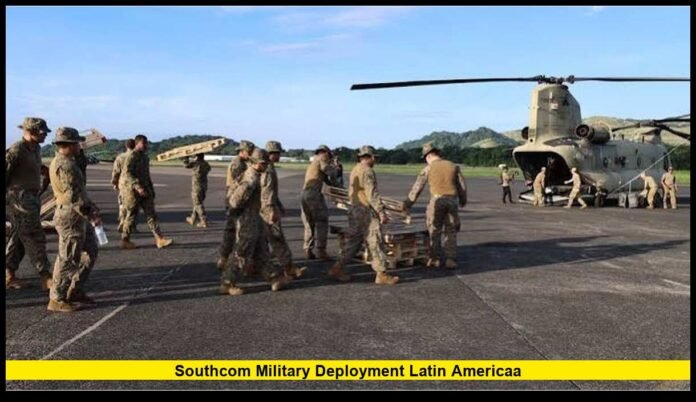

The southcom military deployment latin america effort remains a major part of the United States’ strategy for disrupting international drug trafficking, improving maritime security, and strengthening military cooperation across the Western Hemisphere. As of October 15, 2026, U.S. Southern Command continues to oversee regional security activities, including Operation Southern Spear, multinational military training, and cooperation with Latin American and Caribbean partners.
Recent developments highlight the range of missions under the command. U.S. forces have conducted maritime interdictions against vessels associated with suspected trafficking networks, participated in joint exercises in Peru, and supported humanitarian assistance following natural disasters in the region. These activities demonstrate that the U.S. military presence is not limited to combat operations or permanent installations.
Instead, SOUTHCOM coordinates a combination of operational deployments, temporary exercises, intelligence support, maritime patrols, and security partnerships. The scale and location of these activities vary according to mission requirements, host-country agreements, and changing regional conditions.
What Is U.S. Southern Command?
U.S. Southern Command, commonly known as SOUTHCOM, is one of the Department of Defense’s unified combatant commands. Its headquarters is in Doral, Florida, and its area of responsibility includes Central America, South America, and much of the Caribbean.
The command works with U.S. military services, federal agencies, and regional governments to address security challenges that cross national borders. Its responsibilities include countering transnational criminal organizations, supporting partner-nation defense capabilities, conducting maritime operations, and preparing for humanitarian emergencies.
SOUTHCOM does not operate as a single military unit. It coordinates capabilities provided by different services, including the Army, Navy, Marine Corps, Air Force, and Space Force, as well as joint task forces and supporting organizations.
Depending on the mission, deployed personnel may include sailors aboard naval vessels, aviators conducting surveillance, Marines operating from amphibious ships, soldiers participating in training exercises, and specialists supporting logistics or intelligence activities.
This structure allows the command to respond to different security requirements without relying on one permanent formation for every task.
Operation Southern Spear Remains a Central Priority
Operation Southern Spear has become one of the most prominent elements of the U.S. military campaign against drug-trafficking networks in the Western Hemisphere. Launched in September 2025, the operation combines military capabilities and counter-narcotics efforts intended to disrupt the organizations and logistical systems that facilitate illicit maritime trafficking.
In a September 2, 2026, progress update, U.S. officials reported substantial reductions in illicit maritime activity across several operating areas. The reported declines reached 65% in the Western Caribbean, 60% in the Eastern Caribbean, and nearly 50% in key areas of the eastern Pacific.
These figures reflect reductions reported by U.S. officials in specific maritime operating areas. They should not be interpreted as equivalent reductions in all drug trafficking, total drug production, or the availability of illegal drugs in American communities.
The campaign focuses on more than individual boats carrying suspected contraband. Trafficking organizations can depend on refueling vessels, logistical support, communications, and networks that help smaller boats travel long distances. Disrupting those supporting activities can complicate operations and increase the risks and costs faced by criminal groups.
Southern Spear has involved naval assets, patrol aircraft, surveillance capabilities, and Marine Corps personnel. The operation’s changing requirements mean that the participating forces and their locations can differ over time.
Recent Maritime Interdictions in the Eastern Pacific
Maritime interdictions have remained an important feature of SOUTHCOM’s regional operations in September 2026.
On September 15, U.S. forces operating under SOUTHCOM interdicted a floating refueling station in the eastern Pacific. U.S. authorities identified the vessel as supporting illicit maritime drug trafficking associated with the Ecuadorian criminal organization Los Choneros.
Following the operation, personnel removed from the vessel were to be transferred to Ecuadorian authorities. U.S. forces cleared the vessel, disembarked its crew, and sank it.
The incident illustrated the emphasis on disrupting the logistical networks that support trafficking operations. Refueling vessels can help smaller craft remain at sea longer, extending the range of routes available to criminal organizations.
SOUTHCOM also reported interdictions of floating refueling stations in the eastern Pacific on September 3, 5, 7, and 8. Those operations formed part of a continuing effort to target maritime support systems rather than focusing exclusively on individual suspected drug shipments.
The command reported a separate lethal strike against a go-fast vessel operating along established trafficking routes in the Caribbean on September 9.
These actions involve different methods and consequences. An interdiction may result in the seizure or destruction of a vessel and the transfer of individuals to local authorities. A lethal strike uses military force and carries substantially different legal and operational implications.
Public announcements provide information about individual incidents, but they do not establish a complete accounting of every vessel operating in the region or every unit supporting the campaign.
Why the Caribbean and Eastern Pacific Matter
The Caribbean and eastern Pacific are important to U.S. counterdrug operations because maritime trafficking networks use extensive sea routes to move illicit drugs between producing regions, transit locations, and international markets.
The geography presents a significant challenge. Small vessels can travel across large stretches of water, while remote routes and offshore refueling arrangements can make detection more difficult.
The Caribbean also contains numerous island states, shipping corridors, and connections between Central America, South America, and North America. The eastern Pacific provides additional routes that trafficking organizations can use to move cargo toward Central America and other destinations.
U.S. military assets can contribute surveillance, communications, transportation, and maritime presence. Coordination with partner nations is also important because territorial waters and law-enforcement authorities differ from international waters and military operating areas.
The broader objective is to make trafficking networks harder to operate by disrupting their movement, support systems, and access to maritime routes.
Nevertheless, military activity at sea represents only one part of the response to transnational crime. Criminal organizations also depend on financial networks, corruption, local distribution systems, and other activities that require cooperation among law-enforcement agencies and governments.
Southern Vanguard 2026 Builds Regional Military Readiness
SOUTHCOM’s regional activities also include multinational training designed to improve cooperation between U.S. forces and partner militaries.
Exercise Southern Vanguard 2026 brought together nearly 400 personnel from Peru, the United States, Chile, and Argentina for training in Sauce, Peru, during September.
The Peruvian Army hosted the exercise at its jungle training school. Participating forces practiced operations in the demanding environment of the Amazon region, where dense vegetation, waterways, humidity, and difficult terrain can complicate movement and communications.
Training included jungle survival, waterborne operations, tactical movement, combined planning, and coordination among multinational units. The exercise also included field training and command-post activities designed to test how participating forces plan and execute operations together.
The Peruvian Army played a central role in the exercise, providing instruction and drawing on its experience in jungle environments.
For U.S. personnel, the training offered an opportunity to learn from regional partners familiar with conditions that differ significantly from many U.S. training environments. For participating countries, the exercise supported shared procedures and improved coordination.
Southern Vanguard illustrates why military deployments should not automatically be treated as evidence of a new combat operation. Temporary training deployments can strengthen readiness and partnerships without creating a permanent U.S. military presence in the host country.
Southern Seas 2026 and the Naval Presence
Another major regional engagement was Southern Seas 2026, a U.S. Navy deployment designed to improve maritime cooperation with Latin American partners.
The deployment featured the Nimitz-class aircraft carrier USS Nimitz and the guided-missile destroyer USS Gridley. The ships conducted maritime activities and passing exercises with partner-nation forces as they traveled around South America.
Planned engagements included Argentina, Brazil, Chile, Colombia, Ecuador, Peru, Mexico, El Salvador, Guatemala, and Uruguay. Port visits were planned for Brazil, Chile, Panama, and Jamaica.
The Navy announced the deployment in March 2026. On June 17, the service reported that USS Nimitz and its strike group had completed the Southern Seas deployment.
The exercise provided opportunities for maritime training, professional exchanges, and engagement between U.S. naval leaders and regional officials. It also demonstrated the ability of U.S. naval forces to operate alongside partner navies across different maritime environments.
The distinction between a deployment announcement and a completed mission is important. Southern Seas 2026 is a documented 2026 engagement, but its completion does not mean that the same ships remain deployed in the SOUTHCOM region in October.
Naval deployments can strengthen relationships and readiness even after the participating vessels return to their assigned homeports or move to another operational area.
The Role of Marine Expeditionary Forces
Marine Corps forces have also contributed to SOUTHCOM missions during 2026.
The 22nd Marine Expeditionary Unit completed a nearly 10-month deployment supporting Operation Southern Spear and broader regional priorities. Marines and sailors began returning to Marine Corps Base Camp Lejeune, North Carolina, in waves on June 1.
The unit operated aboard the Iwo Jima Amphibious Ready Group, which included the amphibious assault ship USS Iwo Jima, the amphibious transport dock ship USS San Antonio, and USS Fort Lauderdale.
An expeditionary unit combines personnel and equipment for operations that may require mobility, logistics, aviation, and the ability to respond from ships. Its capabilities can support maritime security, contingency operations, and other missions depending on authorization and operational requirements.
The unit’s return in June is a significant point in understanding the timeline of the regional deployment. It would be inaccurate to describe the entire 22nd Marine Expeditionary Unit as still deployed under the same mission in October solely because it supported Southern Spear earlier in the year.
Panama and Strategic Maritime Infrastructure
Panama holds a prominent position in regional security because the Panama Canal connects the Atlantic and Pacific oceans. The canal is an important international shipping route, and disruptions to its operation could affect maritime transportation and supply chains.
U.S. engagement with Panama includes security cooperation, military training, and coordination on regional challenges. The United States also works with partner countries on activities intended to strengthen maritime awareness and counter transnational criminal networks.
Cooperative security locations, including facilities in El Salvador and the Aruba-Curaçao area, provide access to existing airfields for approved regional missions. These arrangements differ from conventional permanent U.S. military bases and operate within agreements with host governments.
That distinction is important when interpreting reports of military expansion. An aircraft using a partner-country facility, a temporary training team, and a permanently stationed combat unit represent different types of presence.
Regional access can support surveillance, transportation, and cooperation, but the existence of a facility does not by itself establish that a large force is stationed there.
Humanitarian Assistance and Disaster Response
SOUTHCOM’s responsibilities extend beyond counterdrug operations and military exercises. Its forces can also support humanitarian missions when disasters overwhelm local transportation or logistical capacity.
In June 2026, U.S. military assets supported disaster assistance in Venezuela after earthquakes struck on June 24. The response included the amphibious transport dock ship USS Fort Lauderdale and the littoral combat ship USS Billings, which arrived in the region to support humanitarian assistance and disaster relief operations.
U.S. forces also supported assistance efforts following an earthquake in Colombia on August 10. Military aircraft transported disaster-assistance cargo as part of the broader U.S. response.
These missions demonstrate the logistical value of military assets during emergencies. Aircraft and ships can move supplies, personnel, and equipment to affected areas, particularly when roads, ports, or other infrastructure face disruption.
Humanitarian operations have different goals from maritime strikes or interdictions. Their emphasis is on relief, transportation, and support for affected communities rather than direct action against criminal organizations.
The ability to shift assets between missions can provide flexibility, although each deployment remains subject to its own operational requirements and authorization.
What the SOUTHCOM Deployment Means for the United States
The southcom military deployment latin america strategy has several implications for U.S. security and regional relations.
Counterdrug operations aim to interfere with the maritime routes and logistical systems used by trafficking organizations. Military exercises improve coordination with partner forces, while naval deployments demonstrate the ability to operate across long distances and different maritime environments.
Humanitarian missions provide another form of regional engagement, helping move supplies and personnel when natural disasters affect communities.
However, evaluating the effectiveness of these efforts requires more than counting ships, aircraft, or personnel. Relevant measures include documented interdictions, the disruption of trafficking networks, partner-force readiness, and the outcomes of humanitarian missions.
It is also important to distinguish confirmed operations from planned activities and avoid treating temporary deployments as permanent changes in the U.S. military footprint.
As of October 15, 2026, public reporting confirms ongoing SOUTHCOM counterdrug activity in September, the completion of Southern Seas 2026 in June, the return of the 22nd Marine Expeditionary Unit, and multinational training in Peru during September. Those developments provide a factual picture of the command’s varied responsibilities without implying that every previously deployed force remains in the region.
Conclusion
SOUTHCOM’s regional mission combines maritime security, counterdrug operations, multinational training, strategic cooperation, and disaster response. Operation Southern Spear remains a major focus, while exercises such as Southern Vanguard demonstrate the value of working with Latin American partners. The exact composition of deployed forces changes with operational needs, making it essential to distinguish current missions from completed deployments and scheduled activities.
Which SOUTHCOM mission do you believe matters most for regional security: counterdrug operations, military cooperation, or humanitarian assistance? Share your thoughts and follow the latest developments.