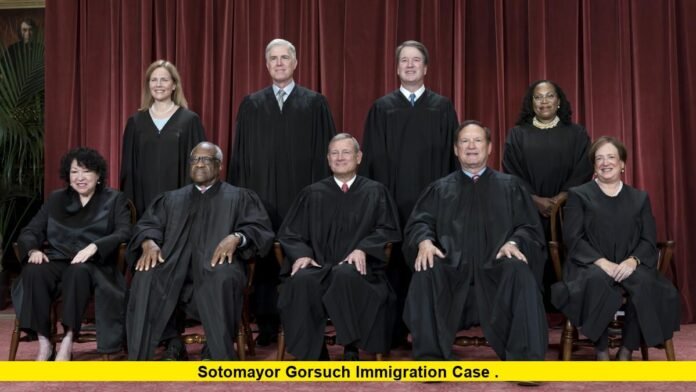

The Sotomayor Gorsuch immigration case has drawn attention after Supreme Court Justices Sonia Sotomayor and Neil Gorsuch jointly raised serious constitutional concerns about the federal government’s prosecution of a Mexican national for illegal reentry into the United States. In a statement issued on October 13, 2026, the two justices questioned whether the government had effectively punished Jesus Herrera-Salazar twice for the same continuing offense while restricting his ability to leave the country.
The Supreme Court declined to hear Herrera-Salazar’s appeal, leaving his conviction in place. However, Sotomayor’s statement, joined by Gorsuch, highlighted questions about the Fifth Amendment’s Double Jeopardy Clause and the government’s treatment of people serving supervised release after criminal convictions.
The case is significant because it demonstrates how immigration enforcement can intersect with constitutional protections against repeated prosecution. Although the Supreme Court did not overturn the conviction, the justices’ concerns could inform how lower courts approach similar cases in the future.
What Is the Sotomayor-Gorsuch Immigration Case About?
The case is Herrera-Salazar v. United States, Supreme Court docket number 25-6989. It concerns Jesus Herrera-Salazar, who was convicted twice under a federal law that criminalizes being found in the United States after deportation without the required authorization.
The central legal question involves whether the government can prosecute someone a second time for being unlawfully present in the country when the person has already been convicted for that continuing conduct and is subsequently subject to restrictions imposed by the government itself.
Sotomayor and Gorsuch expressed concern that Herrera-Salazar’s circumstances presented a serious constitutional problem. After his first conviction, he was required to remain in a designated area in Oklahoma while serving supervised release. He was later prosecuted again for being found in the United States.
The justices questioned whether the government could reasonably treat his continued presence as a new offense when he had already been punished and was prohibited from leaving the country under the conditions of his supervision.
Why Did the Supreme Court Decline to Hear the Case?
On October 13, 2026, the Supreme Court denied Herrera-Salazar’s petition for a writ of certiorari. This means the justices declined to review the lower court’s decision.
Sotomayor explained that she agreed with the decision not to grant review because Herrera-Salazar had already been removed from the United States and because she hoped the unusual circumstances of his case would not recur. Gorsuch joined her statement.
Importantly, the denial of certiorari does not mean the Supreme Court ruled that the second prosecution was constitutionally valid. The Court did not issue a majority opinion resolving the Double Jeopardy question.
Instead, the lower court’s judgment remains in effect, while the joint statement from Sotomayor and Gorsuch signals their concern about how the government handled the prosecution.
This distinction matters when interpreting the case. The justices raised constitutional objections, but their statement is not a binding Supreme Court ruling that automatically invalidates similar convictions.
Who Is Jesus Herrera-Salazar?
Herrera-Salazar is a Mexican national whose criminal proceedings became the focus of the Supreme Court dispute.
He was previously removed from the United States in 2015. In 2020, he was convicted of being found in the country after that removal, in violation of federal law. He served his prison sentence and was subsequently subject to supervised release.
During supervised release, Herrera-Salazar was instructed not to leave the Eastern District of Oklahoma. He was later stopped by police in Heavener, Oklahoma, and charged again under the same federal illegal-reentry statute.
A jury convicted him a second time, and he received another prison sentence followed by a new period of supervised release. His legal challenge argued that the second prosecution violated the Constitution’s protection against double jeopardy.
The Tenth Circuit Court of Appeals rejected his arguments and upheld the conviction in September 2025. Herrera-Salazar then asked the Supreme Court to review the decision.
By the time the Supreme Court considered his petition, he had been removed to Mexico.
What Is the Double Jeopardy Clause?
The Double Jeopardy Clause is part of the Fifth Amendment to the U.S. Constitution. It generally protects people from being prosecuted or punished more than once for the same offense.
The protection is especially important when the government attempts to bring a second prosecution based on conduct that has already resulted in a conviction. However, determining whether two prosecutions concern the same offense can require detailed statutory interpretation.
In Herrera-Salazar’s case, the dispute centered on Section 1326 of Title 8 of the United States Code. This provision criminalizes certain conduct involving reentry into the United States after removal, including being found in the country without the required permission.
The government treated Herrera-Salazar’s later discovery in Oklahoma as a separate violation. His challenge argued that the second conviction improperly punished the same continuing unlawful presence that had already formed the basis of his earlier conviction.
Sotomayor and Gorsuch questioned whether that interpretation adequately respected the constitutional protection against double jeopardy.
Why Sotomayor and Gorsuch Raised Constitutional Concerns
The unusual feature of the case was the conflict between Herrera-Salazar’s supervised-release conditions and the government’s subsequent prosecution.
According to Sotomayor’s statement, Herrera-Salazar had already been convicted and punished for being found in the United States. His supervision conditions then required him to remain within a specified area rather than leave the country.
The justices questioned how the government could subsequently prosecute him for continuing to be present in the United States when its own restrictions prevented him from leaving.
Sotomayor described the situation as presenting a serious constitutional problem. The concern was not simply that Herrera-Salazar faced another criminal charge, but that the second prosecution arose from conduct that potentially remained continuous with the offense underlying his first conviction.
Gorsuch’s decision to join the statement is notable because the two justices are often associated with different judicial approaches. Their agreement in this case reflects a shared concern about the application of constitutional protections to an unusual set of facts.
Nevertheless, the statement should not be interpreted as evidence that the justices agree on immigration policy generally. Their position was focused on the specific legal and constitutional issues presented by Herrera-Salazar’s prosecution.
What Did the Lower Court Decide?
The Tenth Circuit Court of Appeals upheld Herrera-Salazar’s second conviction in United States v. Herrera-Salazar, an unpublished order and judgment issued on September 26, 2025.
The appeals court concluded that the second prosecution did not violate double jeopardy protections. Its reasoning focused on the statutory language governing illegal reentry and the circumstances under which a person who has previously been deported can commit another offense by being found in the United States.
The court also rejected Herrera-Salazar’s argument that the government had failed to establish a separate offense after his earlier conviction.
The Supreme Court’s subsequent refusal to hear the case leaves that appellate judgment intact. However, Sotomayor and Gorsuch’s statement draws attention to the constitutional questions that the lower court’s interpretation raises.
Could the Case Affect Future Immigration Prosecutions?
The Sotomayor-Gorsuch immigration case could be relevant to future legal arguments involving repeated prosecutions for illegal reentry, particularly when defendants remain in the country under government supervision.
The justices emphasized the importance of examining whether the conduct underlying a later prosecution is genuinely separate from the conduct that resulted in an earlier conviction.
Their concerns may encourage lawyers and lower courts to examine the relationship between supervised-release conditions, continuing criminal conduct, and the Double Jeopardy Clause when similar circumstances arise.
However, the practical impact remains limited by the Supreme Court’s decision not to grant review. The statement does not establish a new nationwide legal rule, overturn existing precedent, or prevent prosecutors from bringing separate illegal-reentry charges when the law supports them.
The case also does not change immigration enforcement policy nationwide. Its importance lies primarily in the constitutional questions surrounding the government’s handling of this particular defendant.
What the Case Means for Immigration Law
The dispute highlights a distinction between the government’s authority to enforce immigration laws and the constitutional limits that apply when criminal prosecutions are involved.
Federal law allows the government to prosecute certain people who return to the United States after removal without authorization. Those prosecutions remain subject to constitutional protections, including the prohibition against double jeopardy.
The Herrera-Salazar case illustrates why the details of a defendant’s criminal history and supervision conditions can matter. A second prosecution may raise different questions when it concerns a genuinely separate offense than when it appears to involve the same continuing conduct.
The case also demonstrates that Supreme Court justices can express serious concerns about a lower court’s reasoning even when the Court declines to hear the appeal.
For now, Herrera-Salazar’s conviction remains in place. Any broader change would depend on future judicial decisions, legislation, or other developments in federal immigration law.
Frequently Asked Questions
What is the Sotomayor Gorsuch immigration case?
It is Herrera-Salazar v. United States, a case involving a Mexican national who was convicted twice under federal illegal-reentry law. Justices Sonia Sotomayor and Neil Gorsuch raised concerns about whether the second prosecution violated the Fifth Amendment’s Double Jeopardy Clause.
When did Sotomayor and Gorsuch issue their statement?
The Supreme Court issued its order denying review and Sotomayor’s statement, joined by Gorsuch, on October 13, 2026.
Did the Supreme Court overturn Herrera-Salazar’s conviction?
No. The Supreme Court declined to review the case, leaving the lower court’s judgment in place.
Why did Sotomayor and Gorsuch criticize the prosecution?
They questioned whether Herrera-Salazar could constitutionally be prosecuted again for being found in the United States after his earlier conviction, particularly because his supervised-release conditions restricted his ability to leave the country.
What is double jeopardy in immigration cases?
Double jeopardy is a constitutional protection against being prosecuted or punished more than once for the same offense. In immigration-related criminal cases, courts must determine whether separate charges involve distinct offenses or impermissibly repeat a prosecution for the same conduct.
Does this case change immigration law across the United States?
No. The Supreme Court did not issue a ruling on the merits. The justices’ statement raises constitutional concerns but does not establish a new binding nationwide rule.
Conclusion
The Sotomayor-Gorsuch immigration case highlights an important constitutional question about how federal authorities prosecute people for illegal reentry when their circumstances involve continuing unlawful presence and government-imposed restrictions. Although the Supreme Court declined to hear Herrera-Salazar’s appeal, the joint statement from Sotomayor and Gorsuch underscores the need to consider double jeopardy protections carefully in similar cases.
The decision leaves the existing conviction intact, but the constitutional concerns raised by the justices remain relevant to discussions about criminal prosecution, immigration enforcement, and the limits imposed by the Fifth Amendment.
What do you think about the constitutional concerns raised by Sotomayor and Gorsuch? Share your thoughts in the comments and follow the latest updates on significant Supreme Court immigration cases.