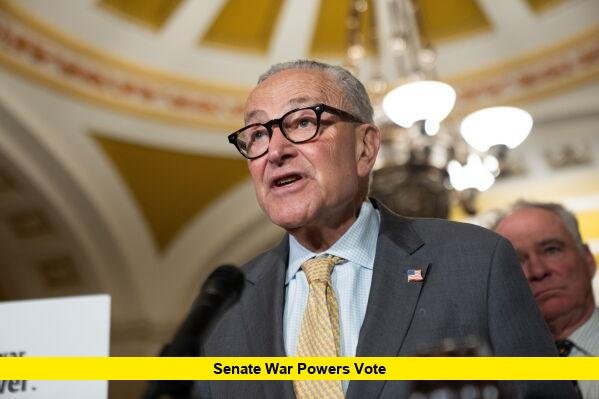

Senate war powers vote remains one of the most closely watched issues in Washington after the U.S. Senate’s latest action on legislation aimed at limiting President Donald Trump’s authority to continue military operations against Iran without explicit congressional authorization. The latest vote ended with the Senate rejecting the resolution, while the House approved a separate war powers measure, highlighting the continuing constitutional debate over Congress’s role in authorizing military force.
What Happened in the Latest Senate War Powers Vote?
The Senate voted 49-47 against advancing a resolution that would have directed the president to remove U.S. armed forces from hostilities involving Iran unless Congress specifically authorized continued military action through a declaration of war or an Authorization for Use of Military Force (AUMF).
The measure was introduced by Democratic lawmakers seeking to reassert Congress’s constitutional authority over decisions involving war. Although supporters argued that military operations should require legislative approval, opponents maintained that the president possesses sufficient authority as commander in chief to continue current operations.
The vote did not achieve enough support to move forward, meaning the Senate did not adopt the latest proposal.
Final Senate Vote Breakdown
| Item | Result |
|---|---|
| Vote Outcome | Failed |
| Senate Vote | 49-47 |
| Resolution Purpose | Require congressional authorization for continued military action against Iran |
| Status | Not adopted |
The vote reflected limited bipartisan crossover.
Key voting developments included:
- Republican Sen. Susan Collins voted in favor of advancing the measure.
- Democratic Sen. John Fetterman opposed it.
- Republican Sens. Rand Paul and Lisa Murkowski did not vote on the latest Senate action.
House Took a Different Position
Only hours before the Senate vote, the House of Representatives approved its own war powers resolution.
The House passed the measure by a 214-208 vote after four Republicans joined Democrats in support. The resolution called for requiring congressional approval before continued military involvement against Iran.
The four Republicans supporting the House resolution were:
- Brian Fitzpatrick
- Thomas Massie
- Warren Davidson
- Tom Barrett
The differing outcomes between the House and Senate illustrate the divisions inside Congress regarding presidential military authority.
Why the Vote Matters
The debate extends far beyond a single military operation.
It centers on one of the oldest constitutional questions in American government:
Who has the authority to take the nation to war?
The Constitution gives Congress the power to declare war, while the president serves as commander in chief of the armed forces.
Over decades, presidents from both political parties have initiated military operations without formal declarations of war, often relying on existing statutory authority or constitutional interpretations.
The latest Senate debate reflects continued disagreement over where those powers begin and end.
Understanding the War Powers Resolution of 1973
Much of the debate references the War Powers Resolution of 1973, enacted after the Vietnam War.
The law attempts to balance presidential flexibility during emergencies with Congress’s constitutional authority.
Major provisions include:
- The president must notify Congress after introducing U.S. forces into hostilities.
- Notification generally must occur within 48 hours.
- Military action generally cannot continue beyond statutory time limits without congressional authorization unless certain exceptions apply.
- Congress retains authority to authorize or terminate military involvement.
Successive administrations from both parties have questioned portions of the law, particularly whether some provisions are constitutional limitations on presidential authority.
That disagreement remains unresolved.
Arguments From Supporters of the Resolution
Lawmakers supporting the measure argued that Congress must exercise its constitutional responsibilities before the United States remains involved in an extended military conflict.
Supporters emphasized several points:
- Congress should authorize prolonged military operations.
- The Constitution assigns war-declaration authority to Congress.
- Greater legislative oversight promotes accountability.
- Military commitments deserve public debate through elected representatives.
Many supporters stressed that the resolution did not prohibit self-defense but instead required congressional approval for ongoing hostilities.
Arguments From Opponents
Opponents argued that the president needs sufficient flexibility to respond quickly to evolving threats.
Their concerns included:
- Military commanders require operational flexibility.
- Delays in authorization could affect national security.
- The commander in chief has constitutional authority during active military operations.
- Existing legal authorities provide sufficient basis for current actions.
Several senators maintained that limiting presidential authority during an ongoing conflict could create unnecessary risks for U.S. forces.
Political Significance of the Vote
Although the resolution failed in the Senate, the debate carries important political implications.
The issue has become one of the most visible congressional discussions involving:
- Executive power
- Congressional oversight
- Foreign policy
- National security
- Constitutional interpretation
The House’s approval and the Senate’s rejection demonstrate that lawmakers remain divided over how much authority presidents should exercise during overseas military operations.
The issue is also drawing attention because several members crossed party lines in both chambers, though only in limited numbers.
Timeline of Recent Congressional Action
| Date | Event |
|---|---|
| Earlier in 2026 | Multiple war powers proposals introduced regarding Iran |
| July 23, 2026 | House passes war powers resolution, 214-208 |
| July 23, 2026 | Senate rejects similar resolution, 49-47 |
How This Fits Into Previous Congressional Practice
Congress has periodically considered war powers legislation during major military engagements.
Similar debates occurred during conflicts involving:
- Vietnam
- Kosovo
- Iraq
- Libya
- Syria
- Yemen
Presidents from both Republican and Democratic administrations have faced congressional questions regarding military authority.
The recurring disputes illustrate that disagreements over executive and legislative powers are longstanding rather than unique to any single administration.
Could Congress Vote Again?
Yes.
Nothing prevents lawmakers from introducing additional war powers legislation in the future.
Congress may consider:
- New resolutions
- Authorization for Use of Military Force legislation
- Defense authorization amendments
- Funding restrictions
- Oversight hearings
Future votes would depend on developments in military operations and congressional priorities.
What Happens After the Senate Vote?
Because the Senate rejected the latest proposal, no immediate statutory change resulted from this vote.
Current military policy remains governed by existing law and presidential authority as interpreted by the executive branch.
However, congressional oversight continues through:
- Committee hearings
- Classified briefings
- Defense legislation
- Future war powers resolutions
Lawmakers from both parties have indicated that debate over congressional authority is likely to continue.
Key Constitutional Questions Still Being Debated
Several major legal questions remain unresolved:
Does the president require congressional approval for extended military campaigns?
Many constitutional scholars argue that sustained hostilities should receive congressional authorization.
Others contend presidents possess broader commander-in-chief authority.
Is the War Powers Resolution fully constitutional?
Every administration since its enactment has raised constitutional objections to at least portions of the law.
No definitive Supreme Court ruling has settled all disputes surrounding its enforcement.
Can Congress effectively restrict military operations?
Congress retains important powers through legislation and appropriations, although practical and legal questions continue regarding enforcement.
What Americans Should Know
For many Americans, the debate concerns more than legal theory.
Questions surrounding war powers affect:
- Military deployments
- Federal spending
- Foreign policy
- Congressional accountability
- Presidential authority
The latest Senate action does not end the broader discussion. Instead, it marks another chapter in the ongoing constitutional balance between Congress and the White House over decisions involving military force.
Looking Ahead
The latest Senate vote leaves the status quo in place, while the House’s approval of a similar measure underscores continuing divisions within Congress. As military operations and international developments evolve, lawmakers are expected to revisit the issue through additional hearings, legislation, and oversight efforts.
Whether future proposals gain enough bipartisan support remains uncertain, but the constitutional debate over war powers is likely to remain a central issue in U.S. national security policy.
What do you think about Congress’s role in approving military action? Share your thoughts in the comments and stay updated on future developments.