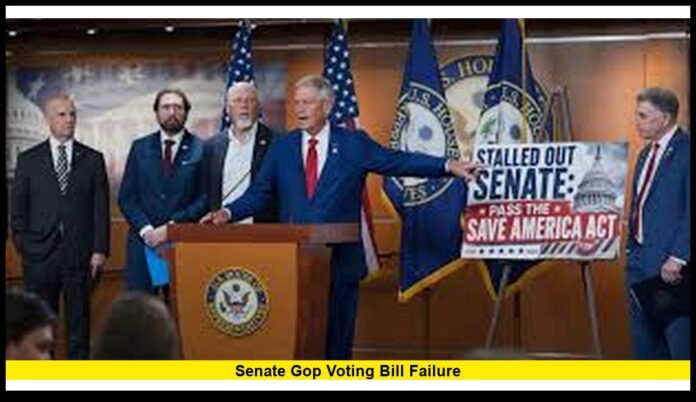

The senate gop voting bill failure has left Republicans without a Senate-approved voting measure as lawmakers begin their August recess. The SAVE America Act remains stalled after Senate Republicans could not secure enough support to overcome procedural barriers before leaving Washington.
The setback follows months of debate over federal voting requirements. President Donald Trump has made the legislation a major priority, while Senate Majority Leader John Thune has faced pressure from conservatives to keep lawmakers in session until the measure advances.
Senators ultimately left Washington without passing the SAVE America Act. The development moves the dispute into the next congressional session, when Republicans are expected to consider whether to revive the legislation or pursue selected provisions through another legislative vehicle.
Why the SAVE America Act Matters
The SAVE America Act has become one of the central election-related proposals supported by Trump and congressional Republicans.
The legislation seeks to establish additional federal requirements for voter registration and voting in federal elections. Its most prominent provisions involve documentation showing U.S. citizenship when registering and identification requirements when voting.
Republicans supporting the legislation argue that stronger documentation and identification standards would provide additional safeguards for federal elections.
Democrats have opposed the measure. They have raised concerns about the effect of additional documentation requirements on eligible voters and have resisted the Republican effort to move the legislation through the Senate.
That disagreement has prevented the two parties from reaching the support necessary to move the bill through the chamber.
The Senate Vote Math Created the Biggest Obstacle
Republicans currently hold 53 seats in the Senate, while Democrats hold 47.
That majority gives Republicans control of the chamber, but it does not provide enough votes to overcome a legislative filibuster on most major bills.
Most legislation requires 60 votes to invoke cloture and end extended debate.
Republicans therefore would need support from at least seven Democrats if all 53 GOP senators backed the measure.
Democratic senators have not provided the support needed to advance the SAVE America Act.
That leaves Republican leaders with a difficult choice. They can continue searching for bipartisan support, attempt to change Senate rules or look for another legislative route.
So far, none of those options has produced passage of the voting legislation.
John Thune Faces Pressure From Both Sides
Senate Majority Leader John Thune has played a central role in determining how Republicans approach the voting legislation.
Thune supports the Republican voting agenda but has also acknowledged the difficulty of securing the votes required to move the bill.
Conservative senators have urged him to take stronger action.
Some Republicans wanted the Senate to remain in Washington during the August recess rather than leave while the voting bill remained unresolved.
Their argument was straightforward: lawmakers should continue working until the Senate completes one of the administration’s major legislative priorities.
Thune ultimately allowed the chamber to begin its scheduled recess.
That decision disappointed some conservatives but reflected the reality facing Senate Republicans. Keeping senators in Washington would not automatically produce the votes needed to overcome Democratic opposition.
Read More – US House speaker says ‘nothing to hide’ in Epstein files
Trump Pushed Republicans to Keep Working
President Donald Trump repeatedly pressed Senate Republicans to act on the voting legislation before lawmakers left Washington.
Trump wanted the Senate to remain in session until Republicans completed work on the bill.
His pressure added urgency to an already difficult debate.
The president has argued that federal voting rules should include stronger citizenship verification and identification requirements.
Trump also criticized the Senate’s use of the legislative filibuster when Democrats opposed Republican priorities.
He has encouraged Senate Republicans to consider changing the rules when necessary to advance his agenda.
Thune has resisted eliminating the legislative filibuster.
That difference has contributed to tension between the White House and some Senate Republicans over how aggressively the party should pursue the legislation.
The SAVE America Act Is Not Yet Law
The most important result of the Senate dispute is that the SAVE America Act has not become federal law.
Because Congress has not completed the legislative process, the provisions contained in the legislation have not taken effect nationwide.
Existing federal and state election rules therefore remain in force.
The Senate’s inability to advance the bill means Republicans must decide what to do when lawmakers return.
They could bring the legislation back for another vote.
They could attempt to negotiate changes with Democrats.
They could also pursue narrower election provisions through separate legislation.
Each approach carries different political and procedural challenges.
A Narrower Photo-ID Proposal Also Failed
Republicans also attempted to advance a narrower photo-identification proposal during the Senate’s earlier voting debate.
Sen. Jon Husted of Ohio became a leading Republican voice behind that effort.
His proposal focused specifically on requiring voters to present acceptable photo identification when voting.
The initiative was significant because it separated one of the most prominent Republican election proposals from the broader SAVE America Act.
Republicans hoped a narrower measure could attract wider support.
That effort did not succeed.
A Senate vote on Husted’s photo-ID amendment produced 53 votes in favor and 47 against. The result fell short of the 60 votes required to advance the measure.
The vote illustrated the broader challenge confronting Republicans.
Even with all Republican senators supporting a narrower proposal, the party could not reach the threshold needed under existing Senate rules.
What the Photo-ID Vote Revealed
The photo-ID vote provided a clear picture of the Senate’s political divide.
Republicans generally supported the measure as an election-security initiative.
Democrats opposed advancing it.
Because neither side could bridge the divide, the proposal remained stalled.
The vote also demonstrated why the full SAVE America Act faced such a difficult path.
The broader bill contains several election-related provisions. If Republicans could not secure enough votes for a narrower identification measure, advancing the entire package presented an even greater challenge.
Republican leaders therefore faced pressure to determine whether a different strategy would produce a better result.
The August Recess Became a Major Deadline
The scheduled August recess became an important deadline for the voting bill.
Trump and conservative senators wanted the Senate to complete work before lawmakers departed Washington.
The Republican leadership had to balance that demand against other legislative priorities.
The Senate ultimately continued with other business and then adjourned for the recess.
The voting legislation remained unfinished.
The decision means the issue will carry into the next period of congressional activity.
For Republicans, the timing is significant because the 2026 midterm elections are approaching.
The party had hoped to make progress on its election agenda before the fall campaign intensifies.
Instead, the voting bill remains unresolved.
Republicans Have Considered Other Legislative Options
The failure to pass the standalone voting legislation does not mean Republicans have stopped pursuing its provisions.
Republican senators have discussed alternative approaches for moving parts of the voting agenda.
One possibility involves incorporating election-related provisions into a broader legislative package.
Budget-related legislation could provide another potential route for some provisions, depending on the exact language and Senate rules governing the measure.
Such an approach would not necessarily produce the full SAVE America Act.
Instead, lawmakers could attempt to advance selected provisions that fit within another bill.
The success of that strategy would depend on the final legislation and whether Senate Republicans could maintain enough support among their own members.
Republican Unity Remains Important
The voting bill debate has also highlighted differences within the Republican conference.
Most Republican senators support stronger election requirements, but they have not always agreed on the best procedural strategy.
Some conservatives favor keeping pressure on the Senate until the legislation passes.
Others have focused on the practical limitations created by the 60-vote threshold.
Thune has emphasized the need to work within the Senate’s existing rules.
The White House has taken a more aggressive position.
That difference does not mean Republicans have abandoned the voting issue. It shows that the party must resolve both the Democratic opposition and internal questions about strategy.
Why September Could Become Important
The next major stage of the debate will come when Congress returns from its August break.
Republican leaders will have to decide whether to put the SAVE America Act back on the Senate calendar.
They could also prioritize a narrower proposal.
Another option would involve attaching selected election provisions to a larger legislative package.
The exact strategy remains dependent on congressional negotiations.
The Senate’s vote requirements will continue to shape those discussions.
Unless Republicans change the Senate’s rules or obtain Democratic support, a major standalone voting bill will continue to face the 60-vote hurdle.
The Role of Jon Husted
Husted’s involvement is important because his photo-ID proposal provided Republicans with a narrower alternative to the full legislation.
His Senate office presented the proposal as a way to establish a clear identification requirement for voters.
The measure included several forms of identification that voters could use.
However, the Senate did not provide enough votes to advance the amendment.
That result did not end Republican efforts to pursue voter identification requirements.
Instead, it became another indication that election legislation would remain difficult to move through the chamber without bipartisan support.
Democrats Continue to Oppose the Republican Approach
Democratic senators have consistently challenged the Republican voting proposals.
Their opposition centers on the additional requirements that Republicans want to impose on voter registration and voting.
Democrats argue that federal election legislation should not create unnecessary barriers for eligible voters.
Republicans reject that position and maintain that stronger requirements would help protect election integrity.
The two parties therefore remain divided over both policy and procedure.
That disagreement has prevented the Senate from reaching the bipartisan support needed for the legislation.
What the Senate GOP Voting Bill Failure Means
The senate gop voting bill failure means Republicans enter the August recess without delivering the federal voting legislation that Trump and conservative lawmakers wanted.
The SAVE America Act remains pending rather than becoming law.
The narrower photo-ID effort also failed to clear the Senate.
Republicans still control the chamber, but their 53-seat majority is not sufficient to overcome the Senate’s 60-vote threshold for legislation facing a filibuster.
That reality will remain central when lawmakers return.
Republican leaders must determine whether to continue pursuing the full bill, negotiate a narrower proposal or use another legislative vehicle.
The 2026 Midterm Election Connection
The timing of the dispute makes the legislation especially significant.
The 2026 midterm elections are approaching, and election rules remain a major political issue.
Republicans want stronger federal voting requirements to become part of their election agenda.
Democrats continue to oppose the Republican legislation.
With the August recess underway, lawmakers have less time to complete major legislative changes before the election cycle reaches its most intense period.
That makes the next congressional session particularly important for the future of the SAVE America Act.
What Happens Next
The Senate will return from its scheduled August recess and confront the unresolved voting legislation.
Republican leaders will then have to determine whether they have a viable path forward.
The White House is expected to continue pressing Republicans to act.
Conservative senators may also renew their calls for immediate Senate action.
Meanwhile, Democratic opposition is likely to remain a major obstacle to any proposal that retains the core provisions of the SAVE America Act.
For now, no new federal voting requirements from the legislation have taken effect.
The Senate has not passed the SAVE America Act, and the photo-ID alternative has also failed to advance.
The next stage of the debate will depend on the choices Republican leaders make when lawmakers return to Washington.
The Senate’s August departure therefore leaves the voting bill unresolved, with Republicans facing the same central challenge: finding enough votes to move their election legislation through a chamber where 60 votes are generally required to overcome a filibuster.
What do you think Senate Republicans should do next on the voting bill? Share your thoughts and stay updated as the Senate debate continues.