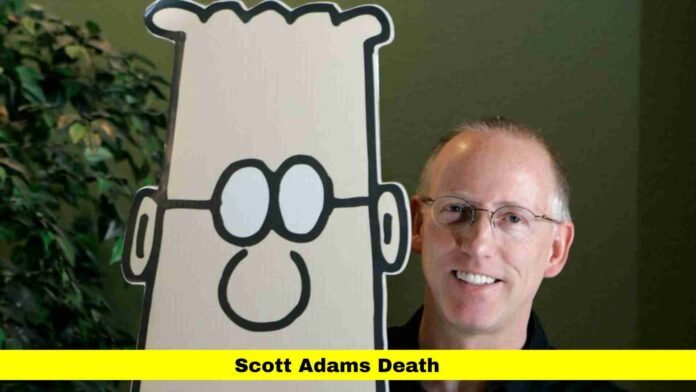

Renowned cartoonist Scott Adams, best known as the creator of the iconic Dilbert comic strip, has died at the age of 68, with the scott adams death now confirmed following a long and very public battle with prostate cancer that had spread to his bones.
Adams’ passing marks the end of a remarkable and complex life in which his work shaped how millions of people viewed office culture, humor, and satire. His legacy includes not only the comic that became a cultural phenomenon but also a career that evolved through writing, commentary, and controversial public moments that will be part of his enduring narrative.
Final Days and Public Announcement of Passing
On January 13, 2026, Scott Adams passed away at his home in Pleasanton, California, at the age of 68 following complications from metastatic prostate cancer. His first ex-wife, Shelly Miles, announced his death publicly, reading a statement he had prepared in advance and reflecting on his life and choices while he was still of sound mind.
In the statement she read, Adams acknowledged that his body was failing even as his mind remained clear, and he expressed appreciation for the life he lived. His passing came after months of declining health, during which he received hospice care at home surrounded by family and caregivers.
Early Life and Rise to Fame
Scott Raymond Adams was born on June 8, 1957, in Windham, New York. Before becoming a household name in comics, he worked in corporate roles while drawing as a passion project. In 1989, he launched Dilbert, a comic strip that humorously exposed the absurdities of white-collar office life with wit, satire, and a unique visual style.
Adams’ ability to capture the frustrations and quirks of corporate culture resonated with readers worldwide. Dilbert grew rapidly in popularity throughout the 1990s and early 2000s, eventually appearing in thousands of newspapers across dozens of countries and translated into multiple languages.
Cultural Impact of Dilbert
At the peak of its syndication, Dilbert was published in more than 2,000 newspapers across at least 70 countries. The comic became synonymous with the everyday struggles of office workers struggling with bureaucracy, pointless meetings, clueless managers, and absurd corporate policies.
Adams’ simple artistic style and sharp writing made Dilbert a cultural touchstone for multiple generations of workers. His work also inspired books, merchandise, and even a TV adaptation that brought the characters to life in animated form.
For many fans, Dilbert provided comic relief and catharsis by articulating frustrations they saw in their own workplaces and careers. The strip’s success helped define a genre of workplace satire that remains influential today.
Later Career Evolution
Later in his career, Adams expanded into political commentary, writing books on business and psychology, and hosting his own podcast and livestream shows. He aimed to dissect not only corporate behavior but also human thinking patterns, leadership challenges, and social dynamics.
However, his shift into outspoken political and social commentary drew growing attention and sometimes heated reactions. His commentary became a significant part of his public identity beyond the comic strip world, attracting both followers and critics.
Controversy and Loss of Syndication
In early 2023, Scott Adams became embroiled in controversy after he made racially inflammatory remarks during a livestream broadcast. His comments triggered widespread backlash and led many newspapers and publications to drop Dilbert from syndication.
The strip’s removal from broad distribution represented a dramatic shift in Adams’ public standing. Readers worldwide who had long enjoyed Dilbert were suddenly unable to access new strips through traditional print channels, and Adams’ legacy became more complicated as a result.
Following the backlash, he continued producing content independently and maintained an online presence where he engaged with audiences directly through livestreams and commentary.
Health Struggles and Public Updates
In May 2025, Adams publicly revealed that he had been diagnosed with metastatic prostate cancer, a form of cancer that had spread beyond the prostate into his bones. He shared on his podcast that his health outlook was dire, stating that the cancer was terminal and that his chances of recovery were “essentially zero.”
Over the following months, Adams experienced increasingly severe complications from the disease, including paralysis below the waist and significant pain. By early January 2026, he made another public health update describing worsening symptoms and preparing his audience for the final stage of his illness.
His condition declined rapidly, and in the days before his death he received hospice care at home. Family members and caregivers supported him around the clock as he faced the end of his battle with cancer.
Personal Life and Relationships
Scott Adams’ personal life included two marriages, and he maintained active relationships with his children and stepfamily. His first ex-wife, Shelly Miles, played a prominent role in announcing his passing and sharing his prepared statement with the public.
Adams’ life outside his work encompassed interests in philosophy, writing, commentary, and the dynamics of human behavior. He built a sizable following through his online platforms, where he often blended humor and opinion.
In the final months of his life, Adams also shared that he had made personal spiritual reflections, including a decision to embrace Christianity as he faced mortality — a significant turn for someone who had previously described himself as a longtime non-believer.
Legacy in Comics and Beyond
Scott Adams leaves behind a legacy that spans multiple domains. In the field of comics, Dilbert revolutionized how office culture and white-collar experiences were portrayed in popular media. His work offered a mirror to corporate life that many readers found deeply relatable, often using a simple stick-figure aesthetic to convey complex emotions and situations.
His contributions included books on leadership, creativity, and cognitive patterns, which influenced readers interested in personal development and organizational behavior. He also became a prominent voice in the online community through podcasts and livestreams that reached hundreds of thousands of viewers.
While his later years were marked by controversy and debate, the impact of his early work remains significant in the history of American comics and satire.
Reflections on a Complex Career
Adams’ career trajectory highlights both the power and pitfalls of public influence. From humble beginnings as a corporate employee drawing comics on the side, he achieved global fame and changed the way people thought about workplace humor.
His later forays into social and political commentary drew mixed reactions, illustrating how an artist’s public statements can shape and reshape their legacy. Yet many fans still remember Dilbert for the laughter, insight, and recognition it brought to everyday office life.
His death at 68 closes a chapter on one of the most recognizable and influential voices in comic satire.
Public Reaction and Tributes
Following the announcement of Adams’ death, tributes and reactions poured in from across the creative world. Fans shared memories of how Dilbert strips helped them navigate office challenges, while colleagues and acquaintances reflected on his impact on comedy and cartooning.
Figures in entertainment and publishing acknowledged Adams’ contributions to popular culture and the unique niche he carved out with Dilbert and his varied body of work. His ability to capture relatable workplace absurdities helped define an era of comic expression.
Final Thoughts on a Distinctive Life
Scott Adams’ story is one marked by creativity, controversy, influence, and evolution. His work connected with millions, offering humor and critique wrapped in simple lines and clever punchlines.
Whether remembered for the laughs he brought through Dilbert or the discussions his later work sparked, his imprint on American pop culture is undeniable.
How do you remember Scott Adams and the impact of his work? Share your thoughts and stay connected as we continue to reflect on his life and legacy.