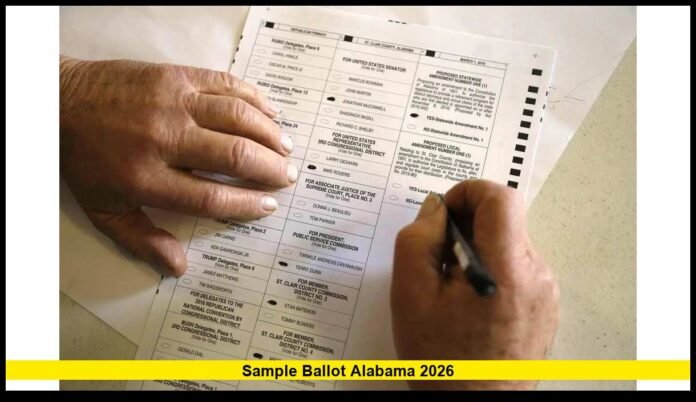

The Sample Ballot Alabama 2026 helps voters prepare for the November 3 general election by identifying the candidates, public offices, and proposed constitutional amendments appearing on their ballots. Alabama voters can review county-specific sample ballots before voting, making it easier to understand the available choices and prepare for an informed decision.
The Alabama general election features important federal, state, and local contests. Voters will choose a candidate for the U.S. Senate, elect members of the U.S. House of Representatives, and decide several statewide offices. All 35 Alabama State Senate seats and all 105 Alabama House of Representatives seats are also part of the 2026 election cycle.
In addition to candidate elections, voters will consider four statewide constitutional amendments. Local contests and additional ballot questions may appear depending on the county and voting district.
The Alabama Secretary of State provides sample ballots for all 67 counties. Because the offices and candidates vary by location, voters should review the ballot for their own county rather than rely on a sample from another part of the state.
Where to Find the Sample Ballot Alabama 2026
The official county sample ballots are available through the Alabama Secretary of State’s election information resources. The state publishes these documents after counties approve their ballots and the election office receives the necessary materials from the ballot-printing vendor.
The November 3, 2026, general election sample ballots are organized by county. Voters can identify their county and open the corresponding document to review the contests scheduled for the election.
Alabama has 67 counties, including Jefferson, Mobile, Madison, Montgomery, Baldwin, Shelby, Tuscaloosa, Lee, and Limestone. Each county may have different local contests and district-specific offices.
To find the appropriate sample ballot, voters should follow these steps:
- Identify the Alabama county where they are registered to vote.
- Open the November 3, 2026, general election sample ballot for that county.
- Check the listed offices, candidate names, and ballot questions.
- Determine which legislative, judicial, and local districts apply to their residence.
- Review the ballot instructions and confirm their polling location before voting.
Some county sample ballots contain contests for multiple districts. A voter may not be eligible to participate in every race shown on a shared county document. Checking the district information is therefore essential.
The sample ballot is designed to help voters prepare. It does not replace the official ballot provided at the polling place, and voters must follow the instructions issued by election officials when casting their votes.
What the Alabama 2026 General Election Includes
The November 2026 election covers several levels of government. Understanding the difference between federal, state, judicial, and local contests can help voters navigate a lengthy ballot.
Federal Elections
Alabama voters will elect a U.S. senator and representatives to the U.S. House of Representatives.
The U.S. Senate race is particularly important because the winning candidate will represent Alabama in the upper chamber of Congress. Senators vote on federal legislation, participate in the confirmation process for certain federal appointments, and help shape national policy.
Alabama has seven congressional districts. Each district elects one member of the U.S. House, so voters select candidates according to the district where they live.
House members represent their districts in Washington, D.C., and participate in decisions involving federal spending, taxes, national security, health policy, infrastructure, and other national issues.
The sample ballot identifies the candidates eligible to appear in the relevant federal contests. Voters should review the candidate information for their own district rather than assume that every congressional candidate appears statewide.
Statewide Elections
The 2026 Alabama general election also includes several major statewide offices.
These include:
- Governor
- Lieutenant governor
- Attorney general
- Secretary of state
- State treasurer
- State auditor
- Commissioner of agriculture and industries
Each position has distinct responsibilities.
The governor leads the executive branch and plays a central role in implementing state policy. The lieutenant governor presides over the Alabama Senate and performs duties assigned by state law.
The attorney general serves as the state’s chief legal officer, while the secretary of state oversees major election administration responsibilities and other state functions.
The state treasurer manages designated financial responsibilities, the state auditor performs duties involving state financial oversight, and the commissioner of agriculture and industries oversees functions related to agriculture and associated regulatory responsibilities.
The sample ballot provides the candidate names for each applicable office. Voters can use that information to compare candidates’ qualifications, experience, policy positions, and public records before making a selection.
Alabama State Legislature
Every seat in the Alabama Legislature is included in the 2026 election cycle.
The Alabama Senate has 35 members, while the Alabama House of Representatives has 105 members. These legislators consider state laws, approve budgets, and address issues affecting residents across Alabama.
Legislative decisions can influence public education, transportation, taxes, economic development, criminal justice, healthcare policy, and state government spending.
However, each voter participates only in the legislative races associated with their residence. The sample ballot identifies the relevant State Senate and House districts.
Reviewing these races is important because state legislators often make decisions that directly affect local communities, even when their campaigns receive less national attention than federal contests.
Judicial and Other State Offices
Depending on the applicable district and ballot, voters may also encounter judicial contests.
These can include positions on the Alabama Court of Civil Appeals, Court of Criminal Appeals, circuit courts, and district courts. Certain State Board of Education and Public Service Commission seats are also part of the 2026 election cycle.
Judicial positions influence how courts interpret and apply the law. State education board members participate in decisions affecting public education policy, while the Public Service Commission has responsibilities involving regulated utilities.
The sample ballot helps voters identify the positions that require a decision in their district. Candidates for judicial and regulatory offices may receive less campaign coverage than candidates for governor or Congress, making advance ballot review particularly useful.
County and Local Elections
County and local contests can have a direct impact on everyday life.
Depending on the jurisdiction, voters may see candidates for county commission, sheriff, probate judge, school board, and other local offices. Certain ballots may also include local constitutional amendments or other questions that apply only to a particular county or area.
Local officials can influence public safety, court administration, county services, school governance, and the use of local resources.
Because these races vary significantly, a statewide candidate list cannot fully describe every voter’s ballot. The county sample ballot is the better starting point for identifying the local choices that matter to a particular voter.
Alabama Constitutional Amendments on the 2026 Ballot
The November 3 general election includes four statewide constitutional amendments. These proposals address government administration, county school system consolidation, public school policies, and the performance of the national anthem.
Constitutional amendments deserve careful consideration because they can change the state’s governing framework. Voters should read the actual ballot wording and the official plain-language explanation before deciding whether to vote yes or no.
Statewide Amendment 1: Lieutenant Governor Vacancy and Legislative Administration
Statewide Amendment 1 concerns the process for filling a vacancy in the lieutenant governor’s office during certain circumstances.
Under the proposal, an election would be required to fill the remainder of an unexpired lieutenant governor’s term if the vacancy occurs more than 60 days before the next general election in which state officers are elected.
The amendment also addresses the authority to set the salaries of the lieutenant governor and certain legislative officers. It would authorize the Legislature to establish those salaries through a joint resolution.
Another provision concerns legislative travel expenses. The proposal would require expenditures of legislative funds for lawmakers’ travel to receive approval from an officer elected by members of the relevant legislative chamber.
Voters considering Amendment 1 should evaluate its proposed changes to vacancy procedures, compensation authority, and oversight of legislative travel spending.
Statewide Amendment 2: Consolidation of County School Systems
Statewide Amendment 2 would establish a constitutional process for consolidating two or more neighboring county school systems.
Under the proposal, affected county boards of education could agree to merge their systems through formal resolutions. Before a consolidation could proceed, the Alabama State Board of Education would have to conduct an impact study and publish its findings.
The study would examine potential effects on students, families, educational programs, transportation, finances, taxes, and school operations.
The proposal also establishes a process for public opposition. If at least 25% of qualified voters in any affected county school system submit a written protest, the proposed consolidation could not take effect without voter approval.
In that situation, a majority of voters in each affected county would need to approve the consolidation, along with an overall majority of votes cast across the participating counties.
Amendment 2 does not automatically merge school systems. Instead, it would establish a framework for considering and approving qualifying consolidations.
Voters may wish to consider how the proposed process would affect local control, educational administration, transportation arrangements, and the delivery of school services.
Statewide Amendment 3: School-Day Pledge of Allegiance and Student-Led Prayer
Statewide Amendment 3 concerns policies for public K–12 schools involving the Pledge of Allegiance and student-initiated, student-led prayer.
If approved, the amendment would require local boards of education to adopt policies requiring public schools to conduct the Pledge of Allegiance at the beginning of each school day and to provide students an opportunity to participate voluntarily.
It would also require local school boards to adopt policies permitting student-initiated and student-led prayer.
The proposal states that students could not be required to participate in prayer and would retain the right to opt out of either the pledge or the prayer based on their beliefs. Reported violations would be reviewed by the local superintendent of education.
The amendment would change the Alabama Constitution’s requirements concerning these school policies. Voters should review the full ballot statement to understand the proposal’s scope and the distinction between permitting voluntary participation and requiring students to participate.
Statewide Amendment 4: The Star-Spangled Banner in Public Schools
Statewide Amendment 4 concerns the performance of the first stanza of The Star-Spangled Banner in public K–12 schools.
If approved, it would require local boards of education to adopt policies requiring schools to broadcast the first stanza at least once per week during school hours.
A school board could instead authorize a school-approved band, choir, vocal group, or vocalist to perform the first stanza using the version archived by the Library of Congress.
The proposal addresses school policies rather than creating a requirement for every student to sing the anthem.
Voters reviewing Amendment 4 should consider the precise policy requirements, the permitted performance options, and the effect of changing the state constitution.
Local Constitutional Amendments
In addition to the four statewide proposals, some voters may encounter local constitutional amendments.
These measures apply to particular counties or designated areas rather than the entire state. Their subjects and eligibility rules can differ, so voters should not assume that a local amendment appearing on one county’s ballot will appear on another’s.
The county sample ballot is the appropriate document for identifying local questions. Reading the complete ballot language can help voters understand what a proposed change would do and which communities it would affect.
How to Review a Sample Ballot Before Voting
A sample ballot is most useful when voters take time to examine its contents rather than simply check the candidate names.
Start by identifying each office and determining what responsibilities the position carries. Understanding the role helps voters compare candidates on relevant qualifications and priorities.
Next, review the candidates’ publicly stated positions and professional experience. Voters can consider their records, policy proposals, and approach to the responsibilities of the office without relying entirely on campaign slogans.
Constitutional amendments require a different type of review. Rather than comparing candidates, voters should examine the proposed legal changes and understand the consequences of approving or rejecting each measure.
For example, a school consolidation amendment concerns the process for combining school systems, while the lieutenant governor amendment addresses vacancies and legislative administration. Each proposal involves different legal and practical questions.
It is also useful to check the ballot’s instructions. Many ballots specify how many candidates a voter may select for a particular office. Following those instructions helps prevent mistakes when marking the ballot.
A sample ballot does not tell voters how they should vote. Its purpose is to help them understand the choices and prepare to make their own decisions.
Alabama Voter Registration and Election Day Requirements
The general election takes place on November 3, 2026. Alabama voters who plan to cast ballots in person should verify their registration status, assigned polling location, and identification requirements before going to vote.
The regular voter registration deadline for this election was October 19, 2026. Voters who are unsure about their registration should review their status and seek guidance from the appropriate election officials.
Alabama generally requires an acceptable photo ID for in-person voting. Voters should check the state’s identification requirements if they are uncertain whether their document qualifies.
Polling places are scheduled to operate from 7 a.m. to 7 p.m. local time on Election Day. Voters should allow sufficient time to reach their assigned location and complete the voting process.
A polling location may differ from the one used in a previous election, so checking current information is important. Voters should also follow the instructions of poll workers if they need assistance with the ballot or the voting equipment.
People who encounter a registration or identification issue should ask election officials about the procedures that apply to their situation. Provisional voting may be available under specific circumstances, but voters should not assume that every issue is resolved in the same way.
Absentee Voting Information for Alabama Residents
Alabama provides absentee voting for voters who meet the applicable eligibility requirements.
For the November 3, 2026, general election, the regular deadline to apply for an absentee ballot by mail was October 27. The deadline to apply in person was October 29.
The deadline to hand-deliver a regular absentee ballot was November 2. Absentee ballots returned by mail generally must arrive at the appropriate election office by noon on Election Day, subject to applicable exceptions for eligible military and overseas voters.
These deadlines are important because requesting a ballot and returning a completed ballot are separate steps. A voter who has received an absentee ballot should follow the return instructions and ensure the election office receives it within the applicable deadline.
Voters who have already submitted an absentee ballot and need to resolve a problem should consult election officials about their specific circumstances. They should not assume that they can automatically cast another ballot in person without following the applicable rules.
Latest Updates on Sample Ballot Alabama 2026
The Alabama Secretary of State has published the county sample ballots for the November 3, 2026, general election. The documents cover all 67 counties and allow voters to examine the candidates and measures relevant to their jurisdictions.
The official election information also includes certified candidate materials and the approved ballot statements for the four statewide constitutional amendments.
The 2026 primary election took place on May 19, followed by the primary runoff election on June 16. Special primary elections were also scheduled during the year for certain congressional and state legislative contests.
Those earlier elections helped determine the candidates advancing to the general election. Voters preparing for November 3 should use the general election ballot rather than an earlier primary ballot, since primary ballots reflect different candidates and voting procedures.
Candidate certification and local ballot details can be especially important when a race involves a district-specific contest or a local dispute over ballot access. Voters should rely on the final county ballot and applicable election instructions rather than outdated candidate lists.
The most relevant information for an individual voter remains the sample ballot for their county and the voting district associated with their residence.
Mistakes to Avoid When Checking an Alabama Sample Ballot
A few common errors can make ballot preparation less effective.
Using the wrong county ballot: Local candidates, district boundaries, and ballot questions vary. Always select the correct county document.
Relying on a primary ballot: A May primary ballot or June runoff ballot does not necessarily match the November general election ballot.
Ignoring district information: A county document may display multiple legislative or judicial contests. Check which district applies to your residence.
Overlooking constitutional amendments: Ballot measures can change state law or constitutional provisions. Read their wording and summaries before deciding how to vote.
Assuming a sample ballot is the voting ballot: A sample ballot is intended for review before voting. Follow the instructions and procedures at your polling place when casting the official ballot.
Waiting until the last moment to prepare: Reviewing candidates, ballot measures, identification requirements, and polling information in advance can reduce confusion on Election Day.
Final Thoughts on Sample Ballot Alabama 2026
The Sample Ballot Alabama 2026 gives voters an important opportunity to understand the candidates, offices, and constitutional amendments included in the November 3 general election. From the U.S. Senate and congressional races to state legislative contests and local offices, the ballot reflects decisions that affect Alabama at several levels of government.
The four statewide constitutional amendments also make ballot review important. They address the lieutenant governor’s office, county school system consolidation, public school policies concerning the Pledge of Allegiance and student-led prayer, and the weekly performance of the national anthem in public schools.
Because ballot contents vary by county and district, voters should examine the appropriate county sample ballot and confirm their polling location before voting. Reviewing candidate information, understanding ballot measures, and following election procedures can help voters make informed choices.
Share your thoughts in the comments and stay updated for the latest Alabama election news, sample ballot information, and voter guidance.