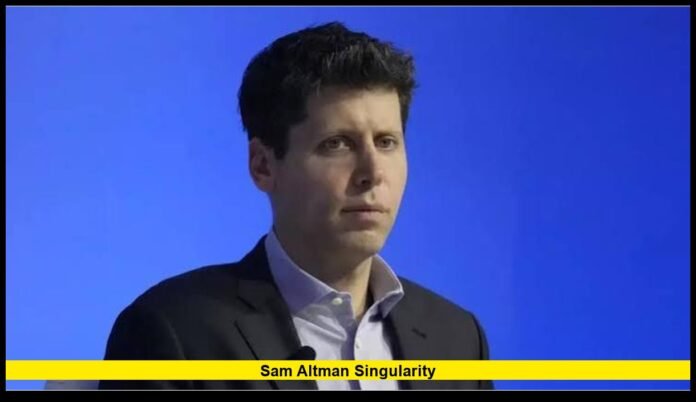

Sam Altman singularity is one of the most discussed topics in the technology world after OpenAI CEO Sam Altman said that humanity has already entered the early stages of the technological singularity. His recent comments have sparked conversations across the artificial intelligence industry, with business leaders, software developers, researchers, and policymakers debating what this moment means for society. While experts continue to disagree on the exact definition of the singularity, Altman believes AI has advanced enough that the world is already living through a transformational era rather than waiting for it to begin.
Artificial intelligence has become part of everyday life for millions of Americans. From workplace productivity to education, healthcare, finance, and entertainment, AI tools are expanding rapidly. Altman’s latest remarks reflect his view that these developments are not isolated breakthroughs but signs of a much larger shift that will shape the coming decades.
What Is the Technological Singularity?
The technological singularity is a concept describing a point where artificial intelligence advances so quickly that predicting future technological progress becomes extremely difficult. In many discussions, the singularity is associated with AI systems becoming capable of improving themselves, leading to increasingly rapid innovation.
Although the idea has existed for decades, there is still no universally accepted scientific definition. Different researchers use different benchmarks to describe when the singularity begins.
Some believe it requires artificial intelligence to outperform humans in nearly every intellectual task. Others argue that society enters the singularity once AI becomes deeply integrated into economic and scientific progress.
Sam Altman falls into the latter camp, suggesting that the transition has already started.
Why Sam Altman Says Humanity Has Already Entered the Singularity
Altman recently explained that the world should stop thinking about the singularity as a single event that suddenly changes civilization overnight.
Instead, he believes the transition has been gradual.
Artificial intelligence has improved year after year, reaching a point where businesses, researchers, governments, and everyday consumers now depend on AI-powered tools for important work.
According to Altman, the cumulative effect of these advances signals that humanity has crossed into a new technological era.
Rather than one dramatic breakthrough, the singularity is unfolding through continuous progress.
AI Has Changed Faster Than Many Expected
Only a few years ago, most AI systems performed narrow tasks with limited flexibility.
Today’s leading models can assist users with:
- Writing documents
- Software development
- Data analysis
- Research assistance
- Language translation
- Image creation
- Video generation
- Voice conversations
- Mathematical reasoning
- Business planning
The pace of improvement has surprised even experienced technology observers.
Every major update introduces stronger reasoning, better accuracy, broader knowledge, and new capabilities.
That rapid progress supports Altman’s view that AI development has entered an entirely different stage.
OpenAI’s Central Role in Modern Artificial Intelligence
OpenAI has become one of the world’s most influential AI companies.
The organization accelerated public adoption of generative AI after releasing ChatGPT, which introduced millions of people to conversational artificial intelligence.
Since then, OpenAI has continued releasing increasingly capable AI systems that serve individuals, businesses, educators, researchers, and developers.
The company’s technology now powers countless applications across multiple industries.
Its products have demonstrated how AI can improve productivity while making advanced computing accessible to ordinary users.
OpenAI’s work has also encouraged competitors to accelerate their own AI development programs.
The result has been one of the fastest periods of innovation in technology history.
Mira Murati vs. Sam Altman: Former OpenAI CTO Testifies Under Oath That CEO Lied to Her
What Makes Today’s AI Different From Earlier Systems?
Artificial intelligence has existed for decades.
However, modern AI differs significantly from earlier generations.
Current models can understand context far more effectively, process multiple forms of information, and generate sophisticated responses within seconds.
Many systems now combine text, images, audio, and video into a single experience.
Businesses no longer see AI as an experimental feature.
Instead, many organizations now consider AI essential infrastructure.
Companies use AI to improve efficiency, reduce repetitive work, and assist employees with increasingly complex tasks.
That widespread adoption is one reason Altman believes the world has entered a historic technological transition.
How AI Is Affecting Everyday Americans
Artificial intelligence already influences daily routines across the United States.
Many consumers interact with AI without realizing it.
Examples include:
- Smart search tools
- Digital assistants
- Navigation services
- Customer support chatbots
- Personalized shopping recommendations
- Financial fraud detection
- Streaming recommendations
- Email organization
- Writing assistants
- Healthcare scheduling
The technology continues expanding into more services every year.
As AI becomes increasingly capable, consumers can expect additional automation across both personal and professional life.
Businesses Continue Investing in AI
Corporate investment in artificial intelligence has accelerated dramatically.
Large technology companies continue spending billions of dollars on AI infrastructure, computing hardware, software development, and research.
Meanwhile, organizations across nearly every industry are adopting AI to improve operations.
Common business applications include:
- Customer service automation
- Software engineering
- Marketing content
- Sales support
- Financial forecasting
- Legal document review
- Medical research
- Supply chain optimization
- Human resources
- Business intelligence
Rather than replacing every employee, AI often serves as a productivity tool that helps workers complete tasks more efficiently.
This trend continues expanding across both large enterprises and small businesses.
The Debate Over Artificial General Intelligence
Altman’s comments naturally connect to discussions about artificial general intelligence, often called AGI.
AGI refers to AI systems capable of performing a broad range of intellectual tasks at or above human levels.
Researchers continue debating how close the industry is to achieving that goal.
Some believe recent advances indicate rapid progress.
Others argue that today’s models remain limited despite impressive capabilities.
Current AI systems can still produce mistakes, misunderstand complex situations, and require human supervision in many professional settings.
Because of these limitations, some experts hesitate to describe the present moment as the beginning of the singularity.
Why Experts Continue Disagreeing
The singularity remains one of technology’s most debated concepts.
Several factors explain why opinions differ.
First, there is no official scientific threshold marking the beginning of the singularity.
Second, artificial intelligence continues evolving rapidly, making long-term predictions difficult.
Finally, researchers measure intelligence differently.
Some focus on reasoning ability.
Others prioritize creativity, adaptability, or scientific discovery.
As a result, respected experts often reach different conclusions while reviewing the same technological developments.
AI Safety Remains a Major Priority
Although Altman often speaks positively about AI’s future, he has consistently acknowledged the importance of responsible development.
Advanced artificial intelligence presents significant opportunities but also important challenges.
Industry discussions continue focusing on:
- AI safety
- Cybersecurity
- Privacy protection
- Responsible deployment
- Election integrity
- Copyright concerns
- Workforce adaptation
- National security
Technology companies continue investing heavily in safeguards designed to reduce harmful uses of AI.
Governments around the world are also evaluating regulatory frameworks that balance innovation with public protection.
Will Artificial Intelligence Replace Human Jobs?
Employment remains one of the most frequently discussed topics surrounding AI.
Many workers understandably wonder how automation will affect future careers.
Altman has generally argued that AI will transform work rather than eliminate human labor altogether.
History provides several examples of technological revolutions creating new industries while changing existing occupations.
Artificial intelligence appears likely to follow a similar path.
Routine and repetitive tasks may increasingly become automated.
Meanwhile, demand for new skills involving AI supervision, implementation, security, infrastructure, and system design continues growing.
Professionals who learn to work alongside AI may benefit from significant productivity improvements.
Healthcare Could See Major Benefits
Healthcare represents one of AI’s most promising applications.
Researchers continue exploring how artificial intelligence can assist with:
- Medical imaging
- Drug discovery
- Clinical documentation
- Patient scheduling
- Administrative efficiency
- Personalized treatment planning
While physicians remain responsible for patient care, AI increasingly supports healthcare professionals by reducing administrative workloads and helping analyze large amounts of medical information.
These developments illustrate why many technology leaders believe AI could significantly improve quality of life.
Education Is Also Changing
Schools, universities, and online learning platforms increasingly incorporate artificial intelligence into education.
Students use AI for tutoring, language practice, writing assistance, coding instruction, and research support.
Teachers also benefit from tools that simplify lesson planning, grading assistance, and classroom preparation.
Educational institutions continue developing policies to encourage responsible AI use while maintaining academic integrity.
The Economic Impact of AI
Artificial intelligence has become one of the world’s fastest-growing technology sectors.
Investment continues flowing into:
- Semiconductor manufacturing
- Cloud computing
- AI software
- Data centers
- Robotics
- Enterprise platforms
- Research laboratories
These investments support thousands of jobs while encouraging additional innovation across multiple industries.
Many economists believe AI will remain a major driver of economic growth throughout the coming years.
Competition Among AI Companies Continues Intensifying
OpenAI is not the only organization pushing artificial intelligence forward.
Major technology companies continue introducing new AI models, software platforms, developer tools, and enterprise services.
Competition has accelerated innovation while encouraging rapid improvements in quality, speed, and accessibility.
Consumers benefit from a growing selection of AI-powered products designed for business, education, creativity, and everyday productivity.
This competitive environment is likely to remain one of the defining characteristics of the AI industry.
What Altman’s Perspective Means
Whether or not someone agrees that humanity has already entered the singularity, Altman’s comments highlight how dramatically artificial intelligence has evolved.
His argument is less about predicting a distant future and more about recognizing how much the present has already changed.
AI now influences communication, commerce, healthcare, education, software development, scientific research, and countless daily activities.
That level of adoption would have seemed extraordinary only a few years ago.
For many observers, the debate is no longer whether artificial intelligence will transform society but how quickly that transformation will continue.
Looking Ahead
Artificial intelligence remains one of the fastest-moving areas of modern technology.
Researchers continue improving reasoning capabilities, multimodal understanding, software automation, scientific discovery, robotics, and digital assistants.
Businesses continue expanding AI investments.
Governments continue evaluating policies.
Consumers continue adopting AI-powered tools at record levels.
As these trends continue, discussions surrounding the technological singularity will likely become even more prominent.
Regardless of where experts draw the line, artificial intelligence is already reshaping how people work, learn, communicate, and solve problems.
Sam Altman’s latest remarks have added fresh momentum to that conversation by suggesting the future many imagined is no longer approaching—it is already unfolding through the technologies people use every day.
How do you view Sam Altman’s assessment of the singularity? Share your perspective in the comments and keep following for the latest developments in artificial intelligence.