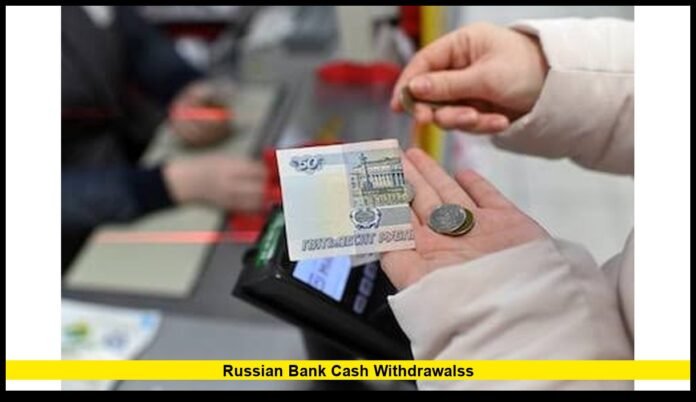

Russian bank cash withdrawals remain an important financial issue in 2026 as temporary foreign-currency restrictions, international sanctions, payment-network changes, and new rules governing the movement of cash across Russia’s borders continue to shape how people access their money.
The current environment is particularly significant for Russian bank customers holding U.S. dollars or euros, foreign nationals with accounts in Russia, and travelers who may need physical rubles during a visit. Although cash remains widely used, the ability to withdraw a particular currency depends heavily on the type of account, the source of the funds, the card being used, and the bank’s own operating rules.
Current Foreign-Currency Withdrawal Restrictions
One of the most important developments is the continued extension of temporary restrictions on cash withdrawals in certain foreign currencies.
The Bank of Russia has extended the measures through September 9, 2026. The restrictions apply primarily to cash withdrawals involving U.S. dollars, euros, British pounds and Japanese yen under the circumstances specified by the regulator.
For individuals with qualifying foreign-currency accounts or deposits opened before March 9, 2022, the existing framework allows eligible cash withdrawals up to the amount that was available at the relevant cutoff, subject to a maximum of $10,000 or the equivalent amount in euros.
The $10,000 figure is therefore not a universal ATM withdrawal limit for every person in Russia. It is part of a specific regulatory framework governing certain foreign-currency cash withdrawals.
This distinction matters because customers sometimes interpret the rule as meaning that anyone with a Russian bank account can withdraw $10,000 in cash. Eligibility depends on the account, currency, timing of the funds and other applicable conditions.
Why the $10,000 Limit Matters
The foreign-currency restriction was introduced as Russia’s banking system faced severe disruption to access to physical foreign currency following international sanctions.
The continued restrictions show that the issue has not simply disappeared with time. Russian financial institutions remain subject to a substantially different international banking environment than before 2022.
For an eligible customer, the permitted foreign-currency cash withdrawal can provide access to part of an existing balance. However, customers with larger balances should not automatically expect the entire account to be available as physical dollars or euros.
The rules are designed around access to cash rather than the underlying existence of the account balance.
That means a customer can have a substantial foreign-currency balance while still facing restrictions on how much physical foreign currency can be collected from a branch.
What Happens to Money Above the Foreign-Cash Limit?
A major point of confusion concerns balances that exceed the amount that can be provided in physical foreign currency.
Where the applicable rules prevent a bank from paying the entire amount in foreign banknotes, the remaining funds may be paid out in Russian rubles.
This creates an important difference between:
- The currency displayed in a customer’s account
- The currency in which the bank can provide physical cash
- The exchange rate used for converting the amount
- The amount of cash that can actually be withdrawn
Customers planning a large withdrawal should therefore speak with their bank before visiting a branch.
The bank may also need advance notice when a customer requests a substantial amount of physical currency. Even when a withdrawal is legally permitted, a particular branch may not have the required banknotes immediately available.
Ruble Withdrawals Are a Different Matter
The restrictions on certain foreign currencies should not be interpreted as a general ban on withdrawing Russian rubles.
Ruble cash continues to be an important part of Russia’s domestic financial system. Customers using Russian-issued banking products can generally access rubles through ATMs and bank branches, subject to the normal restrictions and limits imposed by their bank.
This distinction is particularly important because Russia’s domestic payment infrastructure has become increasingly separate from international card networks.
A Russian customer using a locally issued payment card may have substantially different access to cash than a foreign visitor carrying a card issued by a U.S. or European bank.
Can Americans Withdraw Cash From Russian ATMs?
For U.S. travelers, the situation is significantly more complicated.
Foreign-issued Visa and Mastercard cards generally do not operate normally inside Russia because of the suspension of international payment services and sanctions affecting Russian financial institutions.
As a result, an American traveler cannot assume that a standard U.S. debit card will work at a Russian ATM.
This is one of the biggest differences between traveling to Russia and traveling to many other international destinations.
In countries where international banking networks operate normally, travelers can usually insert a U.S.-issued debit card into a compatible ATM, select the local currency and withdraw cash. That assumption does not apply in Russia.
Anyone planning to visit should therefore understand their available payment options before traveling rather than relying on a foreign bank card after arrival.
What About Visa and Mastercard Cards Issued in Russia?
After Visa and Mastercard suspended operations in Russia in 2022, Russian banks increasingly relied on domestic payment infrastructure to maintain local card transactions.
Russia’s domestic Mir payment system has consequently become a major component of the country’s card-payment environment.
Russian-issued cards can continue to function within the domestic system under applicable arrangements, but their ability to operate internationally is a separate question.
This creates an unusual situation in which a card carrying the Visa or Mastercard branding may work domestically in Russia while a Visa or Mastercard card issued abroad generally does not work in the country.
For consumers, the issuing bank and payment infrastructure matter just as much as the logo printed on the card.
Is UnionPay an Option?
UnionPay remains relevant to some foreign visitors and customers because certain Russian ATMs can process UnionPay cards.
However, acceptance is not universal.
A UnionPay card issued outside Russia may work at some participating Russian ATMs, but availability can depend on the specific Russian bank, ATM, card issuer, transaction rules and sanctions environment.
Withdrawal limits and fees can also vary.
This means travelers should not interpret UnionPay acceptance as a guarantee that every ATM in Moscow, St. Petersburg or another Russian city will accept their card.
Before relying on a UnionPay card, travelers should confirm:
- Whether their specific card is supported in Russia
- Which Russian ATMs participate in the network
- Whether cash withdrawals are enabled
- The daily withdrawal limit
- Foreign-exchange charges
- ATM operator fees
- Any restrictions imposed by the issuing bank
Because banking conditions can change, information obtained months before a trip may no longer be accurate when the traveler arrives.
Why ATMs Can Be Unreliable for Foreign Visitors
Even when a payment card is technically compatible with a Russian ATM, access to cash can still be affected by operational restrictions.
An ATM can have insufficient cash, impose its own transaction ceiling, reject a particular card type or temporarily stop accepting certain networks.
A traveler may therefore encounter a situation in which one ATM rejects a transaction while another machine accepts it.
For this reason, foreign visitors should not treat access to one functioning ATM as evidence that the entire Russian ATM network will accept their card.
The safest approach is to understand the payment system available to the traveler before arrival and maintain an appropriate backup plan.
New Restrictions on Taking Rubles Out of Russia
Cash withdrawal is only one part of the issue.
In 2026, Russia introduced additional restrictions affecting the export of cash rubles to other countries belonging to the Eurasian Economic Union.
Beginning April 1, individuals generally became prohibited from taking cash Russian currency to EAEU member states when the amount exceeded the equivalent of $100,000, calculated using the official Bank of Russia exchange rate on the date of export.
The EAEU includes Russia, Armenia, Belarus, Kazakhstan and Kyrgyzstan.
The measure is particularly important for people who withdraw a large amount of cash in Russia and then intend to cross the border into another EAEU country.
There are specified exceptions involving designated international airports and documentation demonstrating the legitimate origin or withdrawal of the funds.
The rule also imposes stricter requirements on businesses and individual entrepreneurs.
This means that someone planning a substantial cash withdrawal should consider not only whether a Russian bank will release the money but also whether the money can legally be transported across the intended border.
Withdrawal Rules and Border Rules Are Separate
The distinction between banking rules and customs or export restrictions is crucial.
A bank may legally allow a customer to withdraw a certain amount of money.
That does not automatically mean the customer can carry the same amount across an international border.
The two stages involve different regulatory questions.
Banking stage
The customer must determine whether the bank is permitted to release the requested amount and currency.
Transportation stage
The customer must determine whether the cash can legally leave Russia and whether declarations or supporting documents are required.
Anyone moving a large amount of cash should examine both sets of requirements before making the withdrawal.
Why Account History Matters
The date on which an account was opened and the date on which funds were deposited can affect eligibility under the temporary foreign-currency rules.
This is particularly important for customers who opened accounts or deposited money after the March 9, 2022 cutoff.
A person may have a dollar-denominated account today, but that alone does not necessarily mean the entire balance qualifies for physical-dollar withdrawal under the temporary framework.
Customers should obtain a clear account history and ask the bank which portion of the balance qualifies for cash withdrawal in the requested currency.
This can prevent confusion at the branch and reduce the possibility of expecting cash that the bank cannot provide under current regulations.
Businesses Face Different Rules
The rules can also differ substantially for legal entities and companies.
Russian resident businesses may have restrictions on withdrawing certain foreign currencies except for permitted purposes, including qualifying business-travel expenses.
Non-resident legal entities can face additional limitations involving U.S. dollars, euros, British pounds and Japanese yen.
These rules should not be confused with the framework applying to ordinary individual customers.
A company planning a large foreign-currency cash withdrawal should therefore obtain professional regulatory advice and confirm the current bank requirements before attempting the transaction.
Why Physical Cash Remains Important
Russia has developed extensive digital and domestic payment infrastructure, but physical cash remains relevant.
Cash can become especially important when digital payment systems experience disruptions.
In 2026, reports of internet shutdowns and payment interruptions led to increased demand for physical cash among some Russian consumers. This demonstrated that even in a highly digital financial environment, people may still turn to banknotes when electronic payments become unreliable.
The continued importance of cash also explains why restrictions affecting physical foreign currency receive considerable attention.
A customer may be able to maintain a digital balance without difficulty while encountering a completely different set of restrictions when requesting physical banknotes.
The Digital Ruble Adds Another Layer
Russia is also moving forward with its digital ruble project.
The digital ruble is designed as a central bank digital currency rather than a conventional banknote or ordinary commercial-bank account balance.
The planned broader rollout in 2026 could eventually change how some domestic transactions are conducted.
However, a digital ruble should not be viewed as a direct replacement for physical cash for every situation.
Digital currency and physical banknotes serve different purposes, particularly for travelers, cross-border transactions and situations where access to electronic infrastructure is limited.
The development of the digital ruble therefore adds another layer to Russia’s changing payment landscape without eliminating the importance of conventional ruble cash.
What Customers Should Check Before a Large Withdrawal
Anyone considering a significant withdrawal should contact the relevant Russian bank beforehand.
Important questions include:
- Is the account eligible for the requested cash withdrawal?
- Which currency can actually be provided?
- Does the foreign-currency limit apply?
- When were the funds credited?
- Is advance ordering required?
- Does the branch have enough cash available?
- What exchange rate applies to a ruble conversion?
- Are there bank or ATM fees?
- Are identification documents required?
- Will the money be transported across a Russian border?
These questions become increasingly important as the withdrawal amount increases.
What Travelers Should Know Before Going to Russia
Foreign travelers should pay particular attention to their payment arrangements.
A traveler should not assume that an ordinary U.S.-issued debit or credit card will work at Russian ATMs.
Likewise, travelers should not assume that a particular international card network will be accepted everywhere simply because it operates in other countries.
Before departure, travelers should verify current banking conditions, understand their available payment options and review official travel and financial guidance.
They should also avoid making plans based on old information because Russia’s banking environment has changed repeatedly since 2022.
What Could Change Next?
The Bank of Russia’s current extension of foreign-currency cash restrictions runs through September 9, 2026.
That date is therefore an important point to watch.
However, an expiration date does not guarantee that all restrictions will disappear automatically. The regulator has previously extended temporary measures, meaning customers should wait for an official decision before assuming that the rules will change.
The broader direction of Russia’s payment system also suggests that domestic infrastructure, the Mir network and the digital ruble will remain important parts of the country’s financial strategy.
At the same time, international sanctions and restrictions on foreign financial networks continue to influence how Russian banks interact with the global financial system.
Bottom Line
The rules governing access to cash in Russia in 2026 are considerably more complicated than a simple ATM withdrawal limit.
For eligible individuals with qualifying older foreign-currency accounts, the current temporary framework generally permits access to up to $10,000 or the euro equivalent in physical U.S. dollars or euros, subject to the specific regulatory conditions. Amounts that cannot be paid in permitted foreign cash may instead be provided in rubles.
For foreign travelers, the challenge is different. International cards issued outside Russia, particularly Visa and Mastercard cards, generally cannot be relied upon for ATM withdrawals. Some UnionPay cards may provide an alternative at participating machines, but acceptance and limits can vary.
The introduction of new restrictions on taking large amounts of cash rubles to EAEU countries also means that withdrawing money and transporting it across a border are separate legal questions.
Ultimately, anyone dealing with a substantial amount of cash should verify the latest rules with the relevant bank and authorities before acting. The financial landscape can change quickly, and assumptions based on older banking conditions may no longer apply.
Have the latest Russian banking rules affected your experience with cash or ATMs? Share your thoughts below and keep checking back for the latest financial updates.