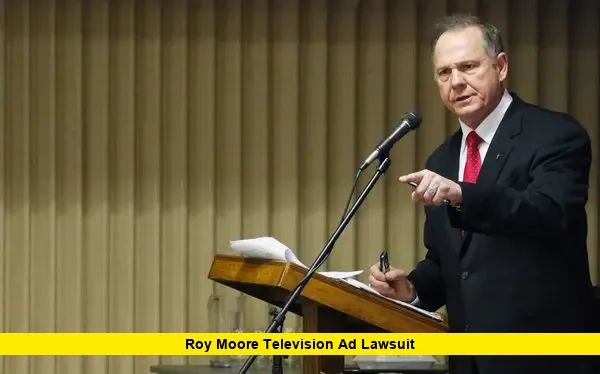

In a major legal development, a federal appeals court has overturned an $8.2 million defamation verdict that had been awarded to former Alabama Supreme Court Chief Justice Roy Moore. The ruling, handed down on April 24, 2026, by the 11th U.S. Circuit Court of Appeals, closes a years-long legal battle over a controversial 2017 political television advertisement.
Background: The 2017 Senate Race and the Television Ad
Roy Moore, a former Republican judge known for his hard-line stances opposing same-sex marriage and supporting the public display of the Ten Commandments, lost the 2017 Alabama Senate race after his campaign was rocked by misconduct allegations he firmly denied.
At the center of the lawsuit was a single television commercial produced by Highway 31, a political group funded by Senate Majority PAC, which ran a $4 million advertising campaign against Moore during the race. The ad recounted accusations of sexual misconduct that had surfaced during the campaign and became the flashpoint for years of litigation that followed.
Moore’s attorneys argued that the ad — through the deliberate juxtaposition of statements and partial quotes drawn from news articles — falsely implied that he had solicited sex from young girls at a shopping mall. Specifically, the ad stated that “Roy Moore was actually banned from the Gadsden Mall … for soliciting sex from young girls,” followed immediately by the statement that “one he approached was 14 and working as a Santa’s helper.”
The woman referenced in that second statement, Wendy Miller, later testified that while Moore had approached her, he had not explicitly solicited sex from her. She testified that he was “probably” flirting with her but stopped short of saying she was traumatized or that he had made any direct sexual advance.
The 2022 Jury Verdict
Following a trial in 2022, a jury awarded Roy Moore $8.2 million in damages — a significant victory that seemed to validate his years of insistence that the ad had unfairly destroyed his reputation and derailed his political career.
The jury deliberated and found in Moore’s favor on the defamation-by-implication theory, concluding that the ad’s framing had created a false and defamatory impression in the minds of viewers. Senate Majority PAC immediately challenged the verdict, arguing that Moore had not met the legal threshold required for a public figure to prevail in a defamation case.
The Appeals Court Ruling: Why Moore Lost
On April 24, 2026, a three-judge panel of the 11th U.S. Circuit Court of Appeals reversed the jury’s verdict and ordered the trial judge to enter summary judgment in favor of Senate Majority PAC.
The core issue was the legal standard known as actual malice. Under established First Amendment law, when a public figure sues for defamation, they must prove by clear and convincing evidence that the defendant either knew the statement was false at the time of publication, or acted with reckless disregard for its truth or falsity. This is a deliberately high bar designed to protect free speech — particularly in the context of political campaigns.
The appeals court found that Moore failed to clear that bar. While the judges acknowledged that the PAC may have made what amounted to a negligent error in how the ad was constructed, they ruled that negligence alone is not sufficient to establish actual malice. The court wrote that the evidence presented at trial was “inadequate to support a finding of the necessary intent to defame” under the actual malice standard in a defamation-by-implication case.
What Is Defamation by Implication?
Traditional defamation claims allege that a specific, identifiable statement is false and damaging to the plaintiff’s reputation. Moore’s lawsuit took a more nuanced approach by pursuing a legal theory known as defamation by implication.
Rather than pointing to a single false sentence in the ad, Moore argued that two technically accurate statements, when placed side by side, combined to create a new and false implied message — namely, that he had specifically solicited sex from Wendy Miller, the 14-year-old Santa’s helper.
The appeals court acknowledged that defamation by implication is a recognized legal theory but noted it is “fraught with subtle complexities and is more nuanced than express defamation.” Applying the actual malice standard to this kind of implied claim proved fatal to Moore’s case. The PAC successfully argued that any misleading implication was the result of imprecise phrasing, not an intentional effort to convey a falsehood.
Reactions to the Ruling
The decision drew immediate and sharply contrasting reactions.
Attorneys for Senate Majority PAC called the ruling a complete vindication. The PAC’s legal team argued that the ad had been based on accurate reporting from major national news outlets and that the organization had made good-faith efforts to verify the accuracy of its claims before broadcasting the commercial.
On Moore’s side, attorney Jeff Writtenbrink expressed disappointment and said his team was exploring further appeal options, including the possibility of seeking review before a larger panel or pursuing the case to the U.S. Supreme Court. Several other defamation cases with similar legal questions were noted to be working their way through the courts, potentially offering future opportunities to revisit the actual malice standard.
Moore’s Broader Legal History
The Senate Majority PAC lawsuit was one of several defamation battles Moore pursued in the wake of his failed 2017 Senate campaign. He also filed a separate defamation suit against Leigh Corfman, one of the women who publicly accused him of sexual misconduct. Corfman countersued Moore for defamation as well. In 2022, a jury deliberated for roughly three hours and found that neither side had proven its case in that parallel trial.
Moore additionally pursued defamation claims related to tweets, a press release, and a digital ad connected to Priorities USA — another Democratic-aligned political committee — though those claims were dismissed at earlier stages of litigation.
What This Ruling Means for Political Ad Law
Beyond the specifics of Moore’s case, the 11th Circuit’s decision carries broader implications for political advertising and the boundaries of defamation law in campaign contexts. Several key takeaways stand out for legal observers and political operatives alike.
Public figures face a formidable legal burden. Politicians and prominent public officials cannot prevail in defamation suits simply by demonstrating that a statement was inaccurate or misleading. They must prove the publisher acted with deliberate intent to deceive or with reckless disregard for the truth — a standard that courts have consistently applied rigorously.
Implied defamation claims are especially difficult to sustain. Even when the combination of true statements arguably creates a false impression, plaintiffs must still show that the publisher intended to create that false impression. Accidental or negligent implication is not enough.
Negligence does not equal malice. The court’s finding that the PAC’s phrasing may have been a negligent error — yet still ruling in the PAC’s favor — illustrates how significant the gap is between careless speech and legally actionable defamation when public figures are involved.
Political ads retain broad protection. The ruling reinforces the wide latitude that political organizations have to run hard-hitting ads based on news reporting, provided they are not acting with deliberate or reckless disregard for accuracy.
Conclusion
The 11th Circuit’s decision to reverse Roy Moore’s $8.2 million defamation award brings a lengthy and high-profile legal saga to what appears to be its final chapter — at least at the appellate level. The ruling is a clear reaffirmation of the actual malice standard that has governed public figure defamation cases since the landmark New York Times v. Sullivan decision in 1964, and it demonstrates how difficult it remains for public figures to succeed in defamation claims arising from political speech.
While Moore’s legal team has signaled it may seek further review, the courts have consistently ruled against him across multiple defamation battles stemming from the 2017 Alabama Senate race. For political campaigns, media organizations, and legal scholars, this case serves as an important reminder of where the law draws the line between vigorous political advertising and actionable defamation.