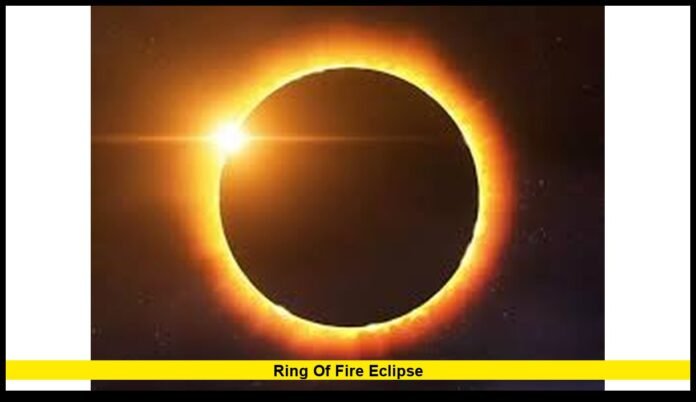

The ring of fire eclipse on February 17, 2026 marked the first solar eclipse of the year, delivering a striking celestial display across one of the most remote regions on Earth. While most Americans could not witness it in person, the event generated global interest due to its rare annular alignment and dramatic solar geometry.
This detailed report covers confirmed timing, global visibility, orbital mechanics, scientific importance, eclipse season context, and what comes next for skywatchers.
What Happened on February 17, 2026
On Tuesday, February 17, 2026, the Moon passed directly between Earth and the Sun during a new moon phase. However, because the Moon was positioned near apogee — its farthest point from Earth — it appeared slightly smaller than the Sun in the sky.
That size difference prevented complete solar coverage. Instead of darkness, observers within the narrow path of annularity saw a thin, brilliant circle of sunlight surrounding the Moon’s silhouette.
The full annular phase occurred primarily over Antarctica and nearby Southern Ocean waters.
The event lasted several hours from start to finish, though peak annularity spanned only a few minutes at any given location along the path.
Exact Timing of the 2026 Solar Event
The eclipse unfolded in three primary stages:
- Partial phase began at approximately 09:56 UTC
- Maximum annularity occurred close to 12:00 UTC
- Partial phase concluded near 14:27 UTC
Because the eclipse track stayed far south, timing conversions varied significantly by region. In Eastern Time within the United States, the event occurred during early morning hours but remained entirely below the horizon.
Where the Annular Phase Was Visible
The path of annularity traced a narrow corridor across:
- Western Antarctica
- Coastal Antarctic research regions
- Sections of the Southern Ocean
Very few people were positioned inside that corridor. Scientists stationed at Antarctic research facilities had the clearest opportunity to observe the full ring effect.
Satellite monitoring confirmed that at maximum coverage, roughly 96 percent of the Sun’s diameter was obscured.
Despite the dramatic alignment, daylight never vanished completely.
Partial Visibility Across the Southern Hemisphere
Although the full annular phase remained limited to Antarctica, partial eclipse phases reached wider populated areas.
Regions that experienced partial solar coverage included:
- Southern Chile and Argentina
- Portions of South Africa
- Madagascar
- Surrounding oceanic zones
In these locations, the Moon covered a noticeable portion of the Sun, creating a crescent-shaped solar disk.
The amount of coverage varied depending on distance from the central path.
Why It Was Not Visible in the United States
Many American readers asked whether the February 17 alignment could be seen from North America.
The answer is no.
The eclipse path remained confined to extreme southern latitudes. The curvature of Earth prevented any phase of the event from appearing above the horizon in the continental United States.
Even Alaska and Hawaii were outside the visibility zone.
However, live feeds and observatory streams allowed U.S. audiences to follow the event in real time.
How an Annular Solar Eclipse Forms
Understanding the orbital mechanics helps explain why this event produced a glowing ring instead of total darkness.
Three conditions must align:
- A new moon must occur.
- The Moon must pass near one of its orbital nodes.
- The Moon must be far enough from Earth to appear smaller than the Sun.
The Moon’s orbit is elliptical. At perigee, it appears larger. At apogee, it appears smaller.
On February 17, the Moon was near apogee.
That distance created the distinctive solar ring.
Difference Between Annular and Total Solar Eclipses
Many readers compare this event to the total solar eclipse that crossed the United States in April 2024.
The key difference lies in apparent size.
During a total eclipse:
- The Moon fully covers the Sun.
- The solar corona becomes visible.
- Daylight briefly turns to twilight.
During an annular event:
- The Sun is never fully covered.
- A bright outer ring remains visible.
- The corona does not emerge.
Both events require certified solar eye protection at all times.
Eclipse Magnitude and Duration
At peak annularity in Antarctica:
- Approximately 96 percent of the Sun’s diameter was covered.
- The ring remained visible for several minutes.
- Atmospheric dimming was noticeable but not dramatic.
The duration varied depending on location within the central path.
The closer an observer stood to the centerline, the longer the annular phase lasted.
Scientific Importance of the 2026 Event
Even though the eclipse occurred over remote terrain, researchers gathered valuable data.
Scientific benefits include:
- Measuring subtle changes in solar brightness
- Observing atmospheric response to temporary dimming
- Refining lunar orbital models
- Monitoring temperature fluctuations during annularity
Space agencies and observatories captured high-resolution imagery from satellites.
Ground-based instruments in Antarctica collected environmental readings during peak coverage.
Every solar alignment contributes incremental knowledge to long-term astronomical modeling.
Eclipse Season Context in 2026
Solar eclipses occur in clusters known as eclipse seasons.
These seasons happen roughly every six months when the Sun aligns closely with the Moon’s orbital nodes.
The February 17 event marked the first eclipse of 2026.
Within weeks, a total lunar eclipse followed on March 3, visible across multiple continents.
This pairing reflects the predictable rhythm of celestial mechanics.
Global Public Interest and Online Engagement
Although direct viewing was limited, interest surged online.
Search trends in the United States spiked in the days leading up to the event.
Astronomy livestreams attracted international audiences.
Social media platforms featured time-lapse clips and scientific commentary throughout the day.
Digital participation continues to grow during eclipse years, even when geographic visibility is restricted.
Weather Conditions in Antarctica During Peak Coverage
Satellite imagery confirmed relatively stable atmospheric conditions over portions of western Antarctica at maximum annularity.
Cloud cover varied by region, but several research stations reported clear viewing windows.
Extreme cold did not interfere with imaging equipment.
Because Antarctica experiences continuous daylight during summer months, the eclipse occurred against a bright polar sky.
Eye Safety Remains Critical
Even though this event was not visible in the United States, safety reminders remain important for future eclipses.
Key guidelines include:
- Use ISO-certified solar eclipse glasses
- Never rely on regular sunglasses
- Attach approved filters to optical equipment
- Avoid direct viewing without protection
Annular eclipses are especially dangerous because sunlight remains visible throughout the event.
Upcoming Solar Eclipses After February 2026
Skywatchers in the U.S. now look ahead to future alignments.
Notable upcoming events include:
- August 12, 2026: A total solar eclipse visible across parts of Greenland, Iceland, and Spain
- February 6, 2027: Another annular eclipse crossing sections of South America
While none of these will match the nationwide impact of April 2024, interest remains high.
Travel planning often begins years in advance for total eclipses.
How Eclipse Paths Are Calculated
Astronomers predict eclipse tracks decades ahead using:
- Orbital mechanics
- Gravitational modeling
- Historical cycle analysis
- The Saros cycle system
The Saros cycle spans approximately 18 years and 11 days.
Eclipses separated by one Saros share similar geometry.
The 2026 event belongs to a repeating Saros series that will continue producing annular eclipses in future decades.
Why Antarctica Frequently Hosts Rare Alignments
Because Earth’s axis tilts at 23.5 degrees, solar paths shift north and south throughout the year.
Certain eclipse geometries favor polar regions.
When alignment occurs during southern hemisphere summer, Antarctica can fall directly beneath the central path.
Although sparsely populated, these polar alignments remain scientifically significant.
Photography and Imaging Challenges
Capturing high-quality images in Antarctica presents logistical obstacles.
Challenges include:
- Extreme temperatures
- Equipment transport limitations
- Limited infrastructure
- Remote positioning
Despite these factors, observatories successfully documented the annular phase using stabilized long-range optics and satellite coordination.
Images showed a sharply defined luminous ring.
Educational Value of Solar Eclipses
Even when not locally visible, solar eclipses provide teaching opportunities.
Classrooms across the United States incorporated:
- Orbital demonstrations
- Live eclipse tracking maps
- Solar system modeling exercises
- STEM engagement discussions
Interest in astronomy tends to spike during eclipse years, boosting science literacy nationwide.
Key Event Summary
Here is a concise overview of confirmed details:
| Category | Information |
|---|---|
| Date | February 17, 2026 |
| Type | Annular Solar Eclipse |
| Maximum Coverage | ~96% of solar diameter |
| Full Visibility | Antarctica |
| U.S. Visibility | Not visible |
| Eclipse Season | First of 2026 |
Long-Term Perspective
Solar eclipses remind us that celestial motion follows precise cycles.
While many Americans experienced totality in 2024, the February 2026 alignment showcased how geography determines visibility.
Some eclipses favor major cities.
Others sweep across oceans or polar ice.
Each one reinforces the same principle: orbital precision governs our sky.
The February 17 alignment may have unfolded far from U.S. soil, but its timing, geometry, and scientific value make it a defining astronomical moment of 2026.
Did you follow the live coverage or track the event online? Share your thoughts below and stay connected for updates on the next major solar event.