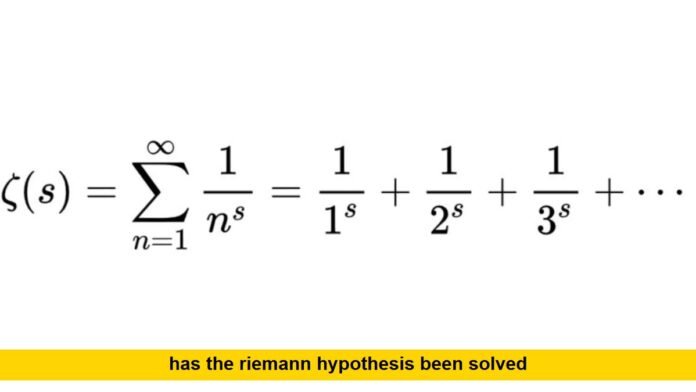

Has the riemann hypothesis been solved is a question drawing renewed attention on November 20, 2026, after mathematician Levent Alpöge reportedly announced that he had developed a proof with assistance from artificial intelligence model Claude. The claim involves one of mathematics’ most famous unsolved problems and could represent an extraordinary development if independent experts confirm its validity. For now, the mathematical community has not officially declared the conjecture solved.
The announcement has placed artificial intelligence, formal mathematics, and the limits of computer-assisted research at the center of an increasingly important scientific discussion. The reported proof has been released in a computer-verifiable format, but verification remains the critical step separating a major claim from an accepted mathematical discovery.
A New Proof Claim Brings the 167-Year-Old Problem Back Into Focus
The Riemann hypothesis was introduced by German mathematician Bernhard Riemann in 1859. It has remained a central challenge in number theory because it offers a possible explanation for the deeper patterns governing prime numbers.
The latest claim reportedly comes from Levent Alpöge, a mathematician associated with Anthropic, who says he worked with Claude to establish the hypothesis. The announcement has attracted attention because the proposed result reportedly goes beyond the original conjecture and addresses the Generalized Riemann Hypothesis as well.
The generalized version applies to a broader family of mathematical functions and represents an even wider collection of related statements. If the claimed proof is correct, its implications could extend far beyond the original problem.
However, a public announcement alone does not establish mathematical correctness. The argument must be independently checked, and researchers must determine whether the formalized result matches the precise statement mathematicians have studied for generations.
Why the Proof Is Being Presented Through Computer Code
One unusual feature of the announcement is its reliance on Lean, a formal proof-assistant system used to verify mathematical reasoning.
Instead of presenting only a traditional written argument, the reported work includes a large collection of formal code. Lean checks whether the logical steps in a proof follow from the mathematical definitions, established results, and permitted assumptions.
This approach could be particularly useful for a problem as complicated as the Riemann hypothesis. Long mathematical arguments can contain subtle gaps that are difficult to detect through ordinary reading. Formal verification offers a way to examine the logical structure with a computer.
The reported archive is substantial, and the claim has generated discussion about whether AI systems may increasingly contribute to mathematics at a level that goes beyond calculations, summaries, and routine assistance.
Still, computer verification is not the end of the review process. Experts must ensure that the theorem encoded in the system is the actual Riemann hypothesis and that the definitions and assumptions used in the proof are appropriate.
What the Riemann Hypothesis Actually Says
The conjecture concerns the zeros of a mathematical function known as the Riemann zeta function.
In simple terms, the zeta function is closely connected to the distribution of prime numbers. Primes such as 2, 3, 5, 7, 11, and 13 appear irregularly along the number line, but mathematicians have discovered that their distribution follows patterns that can be studied through advanced mathematical tools.
The Riemann hypothesis predicts that every nontrivial zero of the zeta function lies on a particular vertical line in the complex plane. That line is known as the critical line, where the real part of the complex number equals one-half.
The statement is deceptively simple, but proving it requires establishing that the condition holds for every relevant zero, extending infinitely far.
Why a Confirmed Solution Would Be So Important
A successful proof would represent a landmark achievement in mathematics. The hypothesis is connected to the distribution of prime numbers, making it relevant to a wide range of results in number theory.
Many mathematical theorems have been developed under the assumption that the Riemann hypothesis is true. These are known as conditional results because their conclusions depend on the conjecture being correct.
A verified solution could strengthen the mathematical foundation behind numerous findings and help researchers better understand the behavior of primes.
The implications would primarily be mathematical rather than an immediate change to everyday technology. Nevertheless, prime-number theory has connections to areas including computational mathematics, cryptography, and the study of mathematical structures used in modern science.
AI Has Already Demonstrated Mathematical Research Potential
The new claim arrives during a period of growing interest in AI-assisted mathematical discovery.
In August 2026, Claude was reported to have helped establish a stronger result involving the proportion of zeros of the Riemann zeta function that lie on the critical line and are simple. The reported improvement raised a longstanding lower bound substantially, demonstrating that AI could contribute to advanced mathematical research.
That achievement was significant, but it did not prove the complete Riemann hypothesis. Showing that a large proportion of zeros satisfy the expected condition is fundamentally different from demonstrating that every nontrivial zero does.
The latest claim is therefore receiving attention because it reportedly attempts to address the entire conjecture rather than a partial result.
The $1 Million Millennium Prize Remains at Stake
The Riemann hypothesis is one of seven Millennium Prize Problems selected by the Clay Mathematics Institute. Each problem carries a $1 million prize for an accepted solution.
The award is not granted simply because a mathematician announces a proof. A solution must meet publication and acceptance requirements, including extensive review by the mathematical community.
Even if the new claim eventually proves correct, the recognition process would take time. Independent experts would need to examine the argument, confirm its validity, and establish broad mathematical acceptance.
What Happens After the Announcement?
The immediate priority is independent verification. Researchers will need to examine the formal proof, test the Lean files, inspect the mathematical definitions, and confirm that no unsupported assumptions undermine the conclusion.
The process could take considerable time, particularly given the reported scale of the formal archive and the importance of the result.
Until experts confirm the proof, the safest description is that a major solution claim has been made—not that the Riemann hypothesis has definitively been solved.
If the verification succeeds, the discovery could become a defining moment in the history of mathematics and artificial intelligence. If problems are found, the episode will still provide valuable insight into the capabilities and limitations of AI-assisted mathematical research.
For now, mathematicians and readers around the world are watching closely as one of the most famous questions in mathematics faces a potentially historic new test.
The Riemann hypothesis may be approaching a turning point, but independent verification will determine whether this claim truly changes mathematical history.