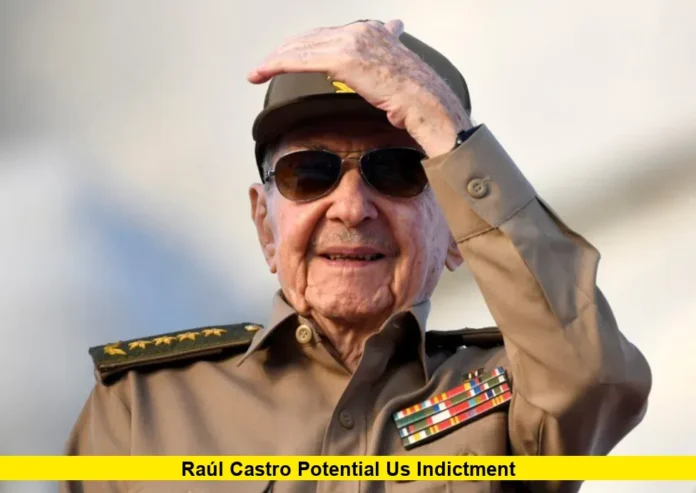

The United States government is moving toward what could become one of the most historically significant legal actions in the long and turbulent history of US-Cuba relations. According to breaking reports, the Department of Justice is preparing to indict former Cuban President Raúl Castro — a development that, if it proceeds, would mark an extraordinary escalation in Washington’s pressure campaign against the communist island nation.
Breaking: DOJ Confirms Indictment Plans Are Imminent
According to Reuters, citing a US Department of Justice official who spoke on condition of anonymity, the United States plans to indict Cuba’s Raúl Castro. As per the DOJ official, the timing of the potential indictment — which would need to be approved by a grand jury — was not immediately clear, but the official characterized it as sounding imminent.
The potential indictment targets the 94-year-old former president of Cuba and brother of the late revolutionary leader Fidel Castro. According to the DOJ official, the charges are expected to focus on the downing of aircraft — a reference to one of the most controversial and emotionally charged incidents in the history of US-Cuba relations.
As per CBS News, which was among the first major outlets to report the development, the case centers specifically on Cuba’s deadly 1996 shootdown of planes operated by the Miami-based humanitarian group Brothers to the Rescue — an event that killed four people and stunned the international community nearly three decades ago.
The 1996 Brothers to the Rescue Shootdown: What Happened
To fully understand the significance of the Raúl Castro potential US indictment, one must revisit the events of February 24, 1996 — a date etched permanently into the memory of the Cuban exile community in South Florida.
According to Wikipedia and multiple verified historical records, on that day, a Cuban Air Force MiG-29UB fighter jet, supported by a MiG-23ML, fired air-to-air missiles at and destroyed two unarmed, US-registered Cessna 337 civilian aircraft operated by Brothers to the Rescue while they were flying over the Straits of Florida in international airspace. All four occupants were killed: Armando Alejandre Jr. (45), Carlos Costa (29), Mario de la Peña (24), and Pablo Morales (29). A third aircraft, piloted by group founder José Basulto, managed to escape.
As per the Organization of American States (OAS), which investigated the incident, no warning was given to the civilian planes before they were fired upon. According to radar data confirmed by the US Customs Service, the shootdowns took place in international airspace — the first aircraft was struck approximately 18 nautical miles north of Cuba’s territorial limit, and the second about 30.5 nautical miles north.
According to the Cuba Center, in a recording that has since become a key piece of evidence, Raúl Castro can allegedly be heard discussing the planning and execution of the shootdown before the incident took place. Additionally, according to WLRN, Fidel Castro himself stated in a 1996 interview with Time magazine that “We discussed it with Raúl,” acknowledging that both brothers were involved in authorizing the attack. “We gave the order to the head of the air force,” Fidel was quoted as saying. “They shot the planes down.”
The mission of Brothers to the Rescue, as per their own founding records, was humanitarian in nature: volunteer pilots flew over the Florida Straits to spot Cuban rafters fleeing the communist regime and relay their coordinates to the US Coast Guard. According to survivor Sylvia G. Iriondo, who was aboard one of the planes that escaped, the group had saved more than 5,000 lives across over 2,000 flights before the fatal shootdown.
The four victims’ bodies were never recovered.
Decades of Demands for Justice: The Long Road to Potential Indictment
The call for accountability in the Brothers to the Rescue case is not new — it has echoed through South Florida’s Cuban American community for nearly thirty years.
According to WLRN, in 2003, a Cuban general and two fighter pilots were indicted for their role in the incident. General Ruben Martinez Puente, who was then head of the Cuban air force, and pilots Lorenzo Alberto Perez-Perez and Francisco Perez-Perez were named in that indictment, which included charges of murder, conspiracy to kill US citizens, and destruction of aircraft. However, the Castro brothers themselves were never charged.
As per Axios, four Cuban American members of Congress — Miami Republicans Mario Díaz-Balart, Carlos Giménez, and María Elvira Salazar, along with New York Republican Nicole Malliotakis — formally wrote to President Trump and Attorney General Pam Bondi on February 13, requesting that the Justice Department pursue an indictment of Raúl Castro. In that letter, as reported by Axios, the lawmakers wrote: the request was for the DOJ to consider indicting Raúl Castro, who they described as responsible for what they called the cold-blooded murders of three Americans and a US permanent resident in the 1996 shootdown.
According to Representative María Elvira Salazar, as quoted by WLRN: “For decades, Raúl Castro and the regime officials who ordered this vile attack have hidden behind the protection of a brutal dictatorship, escaping justice while the families of the victims were left to carry the pain alone. Now we have a real chance to correct this historic injustice.”
According to NBC Miami, Mario de la Peña’s mother, Miriam de la Peña, captured the sentiment of many families when she said: “It’s been 30 years of a constant search — a painful search for justice.”
In March, as per CBS News, Florida Attorney General James Uthmeier announced at a Miami news conference that a state-level criminal investigation into Raúl Castro’s role in the shootdown would be reopened, noting that a previous investigation had been shut down during the Biden administration.
The Legal Architecture: How a Grand Jury Indictment Would Work
The mechanics of indicting a foreign head of state — even a former one — are complex and legally unprecedented at this scale. According to US legal experts cited across multiple reports, the case would begin at the US Attorney’s Office level, move to the Attorney General’s Office in Washington DC, and ultimately require authorization from President Trump.
As per Reuters, the potential indictment would need to be approved by a grand jury. The US Attorney’s Office for the Southern District of Florida has been overseeing an effort to examine potential criminal charges against senior Cuban government officials. According to CBS News, that initiative involves federal and local law enforcement along with the US Treasury Department, and is pursuing prosecutions covering economic crimes, drugs, violent crimes, and immigration-related violations — with a deliberate focus on those holding positions within Cuba’s Communist Party leadership.
According to NBC Miami, a critical evidentiary challenge exists: prosecutors would need a witness to authenticate a 12-minute recording that allegedly features Raúl Castro discussing the planning of the shootdown. “They would need someone to tell a jury that the recording is real and that the person speaking is Raúl Castro,” a legal expert told NBC Miami.
Trump’s Broader Cuba Strategy: Pressure, Diplomacy, and Power
The Raúl Castro indictment effort does not exist in a vacuum. It is part of a sweeping and aggressive posture toward Cuba under the Trump administration — one that combines economic pressure, diplomatic signaling, and now potential criminal accountability.
As per Reuters, President Trump has effectively imposed a blockade on Cuba by threatening sanctions on any country that supplies the island with fuel. According to Reuters, this has led to severe energy shortages, widespread power outages, and serious economic damage to an already struggling Cuban economy.
According to Axios, the administration’s Cuba strategy fits into a broader Western Hemisphere focus. As per Axios, on January 3, the US military seized Venezuelan leader Nicolás Maduro — a close ally of Cuba — who had previously been indicted in the United States on drug trafficking charges. That seizure, according to Axios, came on the 36th anniversary of the US capture of Panama’s Manuel Noriega, himself a former indictee. After Maduro’s removal, the US successfully pressured Venezuela to stop sending oil to Cuba, compounding the island’s energy crisis.
As per CBS News, CIA Director John Ratcliffe met with Raúl Guillermo Rodríguez Castro — known as “Raulito,” the 94-year-old’s grandson and an increasingly important point of contact between Washington and Havana — on the same day the DOJ indictment news broke. According to a CIA official, Ratcliffe personally delivered President Trump’s message that the US is prepared to engage on economic and security issues, but only if Cuba makes fundamental changes. The CIA official also stated that Cuba can no longer be a safe haven for adversaries in the Western Hemisphere.
According to CBS News, despite ongoing diplomatic contacts — both countries acknowledged earlier this year that they were in negotiations — those talks appeared to stall amid the continuing fuel blockade. Trump’s administration has publicly called Cuba’s communist-run government corrupt and incompetent, and has stated its intent to seek its replacement.
Raúl Castro: Who Is He Today?
Raúl Castro, now 94 years old, has officially stepped back from formal leadership roles. According to CBS News, he formally stepped down as the leader of Cuba’s Communist Party in 2021. However, as per CBS News, he is still widely seen as one of the most powerful figures in the country, with the Trump administration viewing him as the true power center in Cuba.
As per Axios, while Fidel Castro died in 2016 at age 90, Raúl has survived to witness a rapidly shifting geopolitical landscape — one in which the US government is now reportedly moving to hold him criminally accountable for decisions he made nearly three decades ago as head of Cuba’s military.
International and Diplomatic Implications
An indictment of a living former head of state by the United States would be an event without modern parallel in US-Cuba relations, and arguably rare in modern international law. Legal scholars and foreign policy analysts are watching closely.
The move is likely to further isolate Cuba diplomatically, though Havana has shown little sign of capitulating to US pressure so far. Cuba’s foreign ministry did not immediately respond to requests for comment, as per Reuters. The situation also raises complex questions about extradition — Raúl Castro, based in Havana, is highly unlikely to ever face a US courtroom in person, making any indictment largely symbolic in practical legal terms, while carrying enormous weight geopolitically and emotionally for the families of the victims.
According to the Cuba Center, this was described at the time as a premeditated act of state terrorism. Then-Secretary of State Madeleine Albright released transcripts of Cuban pilot radio communications that she said demonstrated the pilots knew the Brothers to the Rescue planes were unarmed. According to Cuba Center, Albright stated she was struck by the joy of the pilots, calling it cold-blooded murder.
What Comes Next: The Road Ahead
According to the DOJ official cited by Reuters, while the timing remains uncertain, the indictment sounds imminent. The grand jury process in the Southern District of Florida would be the next formal step, followed by approval from the Attorney General’s Office and authorization from President Trump.
Whether or not Raúl Castro ever faces trial, a formal federal indictment would be a watershed moment — a signal that the United States is no longer content to let the Brothers to the Rescue case fade into historical memory. For the families of Carlos Costa, Armando Alejandre Jr., Mario de la Peña, and Pablo Morales, it would represent something even more profound: the possibility that justice, however long delayed, is not dead.
The Raúl Castro indictment story is unfolding in real time — share your thoughts below, and follow this page to stay updated as this historic legal and diplomatic confrontation develops.
Disclaimer: This article is intended for general informational and news purposes only. The content is based on publicly available reporting from established news sources and does not represent the views, opinions, or positions of this website or its publishers. All information was accurate at the time of publication and is subject to change as this is an ongoing, developing news story. Readers are encouraged to consult primary sources and official statements for the most current and complete information.