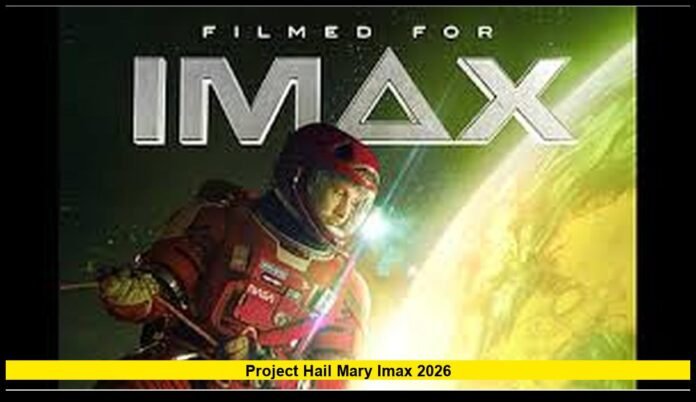

Project Hail Mary IMAX screenings are generating strong interest among moviegoers as the highly anticipated science-fiction film starring Ryan Gosling approaches its planned U.S. theatrical release on March 20, 2026. The film adapts Andy Weir’s bestselling novel Project Hail Mary and brings a large-scale space story to theaters through advanced visual effects and cinematic presentation. Because much of the film takes place in outer space and features expansive cosmic imagery, many audiences are eager to see how it will look on premium large-format screens.
IMAX theaters are known for their immersive viewing environment. They use oversized screens, specialized projection systems, and powerful sound design that can transform the way audiences experience visually ambitious movies. For a story centered on interstellar travel and scientific discovery, this format could enhance the sense of scale that defines the film’s narrative.
A Major Sci-Fi Story Heads to The Big Screen
The upcoming movie adapts the 2021 novel written by Andy Weir. The author gained global recognition for his earlier book The Martian, which also became a successful film adaptation.
Project Hail Mary quickly earned attention among science-fiction readers because of its detailed scientific ideas and suspenseful storytelling.
The story follows Ryland Grace, a middle school science teacher who wakes up alone aboard a spacecraft far from Earth. At first, he cannot remember how he arrived there. As his memory slowly returns, he realizes that humanity faces a crisis involving a mysterious astronomical phenomenon affecting the sun.
Grace becomes the only person capable of solving the problem.
The mission requires him to travel deep into space, conduct experiments, and find a solution before Earth faces catastrophic consequences.
The scale of the narrative makes the film particularly suited to a large theater format.
Why Large-Format Presentation Matters
Many modern science-fiction films rely on visually striking environments. Space travel, star systems, and distant planets all require advanced visual effects.
Large-format cinema enhances these details.
IMAX theaters offer several technical features designed to create a more immersive experience:
- Extra-large screens that extend beyond the viewer’s field of vision
- High-resolution digital projection systems
- Brighter images and improved contrast
- Surround sound designed to fill the entire auditorium
These elements allow audiences to see more visual detail compared with standard theater formats.
Space movies often benefit greatly from this technology because they feature enormous environments and sweeping visuals.
For viewers interested in a cinematic experience that highlights every visual element, the Project Hail Mary IMAX format could provide a more immersive perspective.
Ryan Gosling Stars as Ryland Grace
Ryan Gosling plays the film’s central character, Ryland Grace.
Gosling has built a reputation as one of Hollywood’s most versatile actors. Over the years he has appeared in musicals, comedies, dramas, and science-fiction films.
Some of his most recognized roles include:
- La La Land
- Drive
- Blade Runner 2049
- Barbie
- The Fall Guy
His role in Blade Runner 2049 demonstrated his ability to lead visually ambitious science-fiction stories.
In Project Hail Mary, Gosling portrays a character who must rely on intelligence and creativity to survive alone in space.
The role demands a combination of humor, determination, and emotional depth.
The Directors Behind the Film
The movie is directed by Phil Lord and Christopher Miller, a filmmaking duo known for their energetic storytelling style.
Their previous work includes several widely recognized films:
- The Lego Movie
- 21 Jump Street
- 22 Jump Street
- Cloudy with a Chance of Meatballs
They also served as producers for the animated film Spider-Man: Into the Spider-Verse, which won an Academy Award.
Lord and Miller often combine humor with innovative visual techniques. Their creative approach aligns well with the tone of Andy Weir’s writing, which blends scientific detail with moments of humor.
This directing team brings experience in both large-scale visual storytelling and character-driven narratives.
Screenplay Adaptation
The screenplay for the movie was written by Drew Goddard.
Goddard previously adapted Andy Weir’s novel The Martian into the 2015 film starring Matt Damon.
That film earned critical acclaim and performed strongly at the global box office.
Goddard’s background in adapting science-heavy material helped translate the complex concepts of Project Hail Mary into a cinematic story.
The script focuses on balancing technical explanations with emotional storytelling.
Audiences will see scientific challenges presented through the perspective of a single character facing enormous pressure.
Production Timeline
Turning a bestselling novel into a film requires several stages of development and production.
The journey of Project Hail Mary from book to screen followed this timeline:
| Year | Development Stage |
|---|---|
| 2020 | Film rights acquired by the studio |
| 2021 | Andy Weir’s novel released |
| 2023 | Phil Lord and Christopher Miller confirmed as directors |
| 2024 | Principal photography begins |
| Late 2024 | Filming completed |
| 2025 | Visual effects and post-production |
| March 20, 2026 | Scheduled theatrical release in the United States |
Post-production required significant time because the story depends heavily on visual effects.
Space environments, spacecraft interiors, and astronomical visuals required detailed digital creation.
Visual Effects and Space Environments
Modern science-fiction movies depend heavily on visual effects teams.
These artists design digital environments that bring cosmic settings to life.
In Project Hail Mary, visual effects contribute to several elements:
- Interstellar travel sequences
- Detailed spacecraft design
- Cosmic phenomena affecting the sun
- Scenes depicting distant star systems
Creating believable space environments requires advanced animation, lighting, and simulation techniques.
Filmmakers often collaborate with scientific consultants to ensure visual realism.
The goal is to present space in a way that feels both spectacular and believable.
Large-format screens can display these details more clearly, allowing audiences to appreciate the complexity of the imagery.
The Popularity of Andy Weir’s Novel
Andy Weir built a strong following among readers who enjoy science-driven stories.
His novels often focus on problem-solving and scientific reasoning.
Readers praised Project Hail Mary for several qualities:
- A compelling central mystery
- Detailed scientific explanations
- Humor mixed with suspense
- A protagonist who relies on knowledge rather than physical strength
The novel’s popularity created immediate interest in a film adaptation.
Fans of the book often look forward to seeing how filmmakers visualize the story’s complex concepts.
Comparisons to Other Space Films
Large-scale science-fiction movies often become popular in premium theater formats.
Several well-known space films have benefited from IMAX presentations.
Examples include:
| Film | Year Released |
|---|---|
| Interstellar | 2014 |
| The Martian | 2015 |
| Gravity | 2013 |
| Ad Astra | 2019 |
These films feature expansive visuals that work especially well on large screens.
Audiences often report feeling more immersed in the story when viewing such movies in IMAX.
Because Project Hail Mary takes place primarily in space, many fans expect a similar cinematic effect.
Theatrical Release Strategy
Amazon MGM Studios plans a wide theatrical release across the United States.
Large-scale science-fiction films often perform best when audiences experience them in theaters rather than on smaller screens.
Premium formats such as IMAX and other large-format presentations help attract viewers who want the most immersive viewing experience.
The theatrical release strategy reflects the studio’s expectation that the film’s visuals will benefit from big-screen presentation.
Why Audiences Are Excited
Several factors contribute to the growing anticipation surrounding the movie.
Key reasons include:
- A bestselling novel with a large fan base
- Ryan Gosling in the lead role
- A directing team known for creative storytelling
- High-quality visual effects
- A space adventure designed for large-screen viewing
Science-fiction films often appeal to audiences who enjoy imaginative storytelling combined with realistic scientific ideas.
This combination makes Project Hail Mary one of the most talked-about upcoming releases.
The Future of Space Movies in Theaters
Space exploration stories remain a popular theme in modern cinema.
Audiences continue to respond to films that combine human drama with cosmic scale.
Large-format technology has helped bring these stories to life in ways that were not possible in earlier decades.
As theater technology evolves, filmmakers design movies that take full advantage of these capabilities.
The growing interest in Project Hail Mary IMAX presentations shows how viewers value immersive experiences that place them inside the story.
Are you planning to watch Project Hail Mary on the biggest screen available? Share your thoughts and join the conversation about one of the most anticipated sci-fi films arriving in theaters.