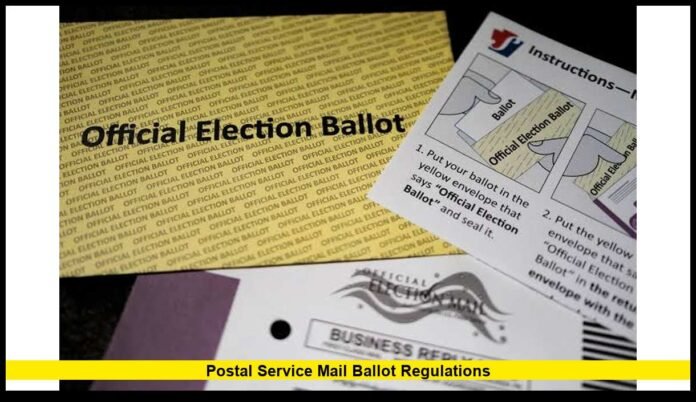

The latest postal service mail ballot regulations have put the U.S. Postal Service at the center of a major legal and political dispute over how federal election ballots are mailed, tracked and delivered. USPS has finalized a new 95-page rule that would impose additional requirements on states using the Postal Service to transmit federal mail-in and absentee ballots, but federal court injunctions currently prevent the disputed changes from being implemented for the November 2026 congressional elections.
The new framework comes from an executive order issued by President Donald Trump in March 2026 directing USPS to establish uniform standards for federal mail-in and absentee ballots. The Postal Service proceeded with rulemaking during the summer, receiving substantial public comment before finalizing the regulation.
The final rule is now ready to take effect if the courts remove the existing restrictions. That does not mean voters must immediately follow a new national mail-ballot system. For now, state election laws and existing election-mail procedures remain critically important.
Why the New USPS Ballot Rules Matter
Mail voting has become an increasingly important part of the American election system. Millions of voters use absentee or mail ballots, making the Postal Service an essential link between election offices and voters.
The new federal framework would change how that process operates for federal elections.
Under the proposed and finalized system, states using USPS to send federal ballots would provide information about voters receiving those ballots. USPS would use that information to establish state-specific participation lists and match ballot mail against the information supplied by election officials.
The system would also rely heavily on unique Intelligent Mail barcodes.
Supporters of the rule say these measures would improve ballot-mail security, tracking and accountability. Opponents argue that the federal government is attempting to impose election-administration requirements that traditionally belong to Congress and the states.
That disagreement is now being decided in federal court.
USPS Has Finalized the New Rule
The rule was developed in response to the March executive order directing USPS to create uniform standards for federal ballot mail.
The executive order instructed the Postal Service to consider requirements involving official election markings, automation-compatible envelopes, unique Intelligent Mail barcodes and state-specific lists identifying voters expected to receive federal mail ballots.
The final USPS regulation incorporates those concepts into a detailed framework governing the handling and transmission of federal ballot mail.
USPS has emphasized that it prepared the final regulation so that it could move quickly if the legal barriers are removed.
However, the agency has also indicated that it will not implement the disputed provisions for the 2026 election while the applicable injunctions remain in force.
That distinction is extremely important for voters.
A regulation can be finalized while still being prevented from taking effect because of a court order.
What Would States Have to Do?
One of the most consequential parts of the proposed system involves information supplied by state election officials.
A state planning to use USPS for federal mail-in or absentee ballots would have to participate in the federal process under the new framework.
The system would require states to provide information identifying voters who are expected to receive federal ballots through the mail.
The information would be used to create what USPS has described as a state-specific Mail-In and Absentee Participation List.
The purpose would be to allow USPS to compare ballot mail against information provided by the relevant election authority.
The new framework would therefore introduce an additional administrative layer between election officials and the Postal Service.
States would also have procedures for updating or correcting their participation information before a federal election.
The federal government says this could help ensure that USPS delivers ballots intended for voters who have been properly identified by state election authorities.
Critics say the system could give the federal government an unprecedented role in controlling the transmission of election ballots.
The Role of Intelligent Mail Barcodes
Unique barcodes are another major part of the new framework.
USPS already uses Intelligent Mail barcodes throughout its mail-processing system. Barcodes allow mailpieces to be identified and tracked as they move through the postal network.
The new federal ballot system would make unique barcode information an important part of the ballot-mail process.
Under the framework, ballot envelopes would carry identifying information that could be connected to the appropriate state participation list.
The Postal Service has said the purpose is to improve the ability to identify and process legitimate federal ballot mail.
The barcode system does not mean USPS would open ballot envelopes and examine how individual voters voted.
The distinction is important because the proposed system concerns external mailpiece information rather than the contents of a sealed ballot envelope.
USPS has also said the framework is not designed to track political party affiliation.
A New Federal Ballot Mail Portal
The rule also provides for a federal system through which states could provide ballot-mail information to USPS.
The proposed Federal Ballot Mail Portal would become a central component of the process.
Instead of relying solely on traditional election-mail coordination, states would provide information through a standardized federal mechanism.
The portal would allow USPS to receive, manage and use the relevant information associated with federal ballot mail.
The administration argues that a centralized system could provide greater consistency and improve the Postal Service’s ability to process election mail.
Opponents remain concerned about the collection and handling of voter information, particularly because election administration is generally divided among federal, state and local authorities.
Privacy protections are therefore an important part of the debate.
The rule contemplates the use of voter information under applicable privacy requirements and existing legal restrictions. Nevertheless, critics argue that the new system creates questions about how much voter information should be held by a federal agency that traditionally serves as the nation’s mail carrier.
Why the Courts Have Blocked the Changes
The most important development surrounding the new regulation is the litigation challenging the underlying federal policy.
Federal courts have issued injunctions preventing the administration and USPS from implementing key provisions of the March executive order.
One of the major rulings came from a federal judge in Massachusetts, who blocked implementation of provisions affecting federal mail voting ahead of the November 2026 election.
Other litigation has also challenged the Postal Service’s authority to impose the proposed requirements.
The central legal questions include whether the executive branch and USPS have sufficient authority to establish these election-related requirements and whether the changes interfere with powers assigned by federal law to Congress or reserved to states.
The courts have not simply been asked whether the new system is good or bad election policy.
They are being asked whether the federal government has the legal authority to create and enforce it.
That distinction could determine whether the regulation ever becomes operational.
What the Rule Means for Voters Right Now
For voters preparing for the 2026 midterm elections, the immediate situation is more straightforward than the broader legal controversy might suggest.
The court injunctions currently prevent the disputed USPS changes from being implemented.
Voters should therefore continue to follow the instructions provided by their state or local election authority.
Those instructions generally explain:
- Whether a voter qualifies for a mail or absentee ballot.
- How a ballot must be requested.
- When the request must be submitted.
- When the completed ballot must be returned.
- Whether the ballot must be received by Election Day.
- Whether a postmark deadline applies.
- What postage is required.
- Whether voters can track their ballots.
- What alternatives exist if a ballot is not received in time.
There is no single nationwide USPS deadline that automatically determines whether every ballot will count.
Election deadlines vary by state.
That means voters should not rely on a generic national deadline when deciding when to mail a ballot.
Why Mailing Early Is Important
USPS recommends that domestic, nonmilitary voters return completed ballots well before Election Day.
Allowing additional transit time can reduce the risk that a ballot arrives after a state’s receipt deadline.
This is particularly important because postal delivery can take longer during periods of heavy election-mail volume.
Voters should also avoid waiting until the final day simply because their state permits ballots to be postmarked on Election Day.
A state may require a ballot to arrive by a particular date even if it was mailed earlier.
Other states permit ballots arriving after Election Day to be counted under specific circumstances.
The controlling rules depend on state law.
Postmarks Can Make a Difference
Postmarks remain an important part of election mail.
A postmark provides evidence concerning when a piece of mail entered the postal system, although the precise rules governing whether that date makes a ballot timely depend on state law.
USPS has warned that voters should not assume that every ballot deposited in a mailbox will immediately receive the date on which it was deposited.
Voters who need a specific postmark can take their ballot to a USPS retail facility and ask for a manual postmark when submitting the ballot.
That can provide additional certainty in situations where state law makes the postmark date relevant.
However, voters should remember that a USPS postmark cannot change the election deadline established by state law.
Military and Overseas Voters Are Different
Military and overseas voters operate under special federal election protections.
The Uniformed and Overseas Citizens Absentee Voting Act provides special procedures for eligible military and overseas voters, and USPS has dedicated procedures for election materials moving through military and diplomatic postal channels.
These voters often need to allow substantially more time for ballots to travel.
The special system is particularly important for voters stationed overseas or deployed with the military because international delivery times can be significantly longer than ordinary domestic mail.
Military and overseas voters should therefore follow the instructions provided by their election authority and the applicable federal voting procedures rather than relying on ordinary domestic mail-ballot timelines.
USPS Already Has Election-Mail Procedures
The new federal regulation should not be confused with USPS’s existing election-mail system.
The Postal Service has handled election mail for many years.
Existing procedures include specialized markings, ballot-mail processing standards, barcode systems and operational coordination with election officials.
USPS also provides guidance to election authorities on preparing ballot mail so that it can move efficiently through automated processing equipment.
The new federal regulation would build a more formal federal framework around certain ballots used in federal elections.
That is why the dispute is more significant than a normal USPS mailing-standard adjustment.
It concerns the relationship between postal operations and election administration.
The Biggest Question: Will the Rules Apply in November?
At present, that remains uncertain because of the ongoing court battles.
USPS has finalized the regulation, but the agency has said it will not implement the disputed requirements for the 2026 election while the injunctions remain in place.
The Trump administration has challenged the court restrictions, creating the possibility that additional appellate or Supreme Court action could change the legal situation before Election Day.
If the injunctions remain in effect, the new requirements would not become the governing system for November’s federal elections.
If the courts ultimately allow the administration to proceed, USPS could be positioned to implement the finalized requirements rapidly.
That possibility is one reason election officials, voting organizations and legal experts are watching the cases closely.
What Election Officials Are Watching
State election officials are facing several important questions.
They need to know whether the new federal requirements will become effective, whether their existing ballot-envelope systems will need modification and whether additional voter information will have to be supplied to USPS.
Timing is particularly significant.
The closer the country gets to Election Day, the more difficult it becomes for states to make major operational changes without creating confusion or additional administrative burdens.
Federal elections are conducted through thousands of state and local election offices.
A nationwide change to ballot-mail procedures therefore has consequences far beyond USPS headquarters.
It could affect ballot printing, envelope production, voter communications, election-management systems and postal coordination.
What Voters Should Watch Next
The most important developments will come from the courts and from USPS.
Voters should watch for decisions concerning the injunctions, appeals involving the executive order and any official USPS announcement concerning implementation.
State election officials will also remain an essential source of information.
If the legal situation changes, states will need to communicate whether voters must do anything differently.
Until then, voters should continue using the established procedures supplied with their ballots.
The broader dispute over federal control of mail voting is likely to remain one of the most closely watched election-law issues heading into the 2026 midterms.
The finalized regulation creates a potential new system, but the courts currently stand between that system and actual implementation.
The Bottom Line
The latest postal service mail ballot regulations represent a significant proposed shift in how federal mail ballots would be transmitted through USPS.
The framework would introduce state-specific voter participation lists, unique ballot-envelope identifiers, additional information-sharing requirements and a federal portal designed to coordinate ballot mail.
But voters should not confuse a finalized rule with an active requirement.
Federal court injunctions currently prevent the disputed changes from being implemented for the 2026 election. The final outcome will depend on ongoing litigation and any subsequent appellate or Supreme Court decisions.
For voters, the safest course remains following the official instructions supplied by their state or local election authority, mailing ballots as early as practical and paying close attention to the applicable receipt and postmark deadlines.
As the midterm election approaches, the legal status of the USPS rules could change quickly, making continued attention to official election guidance especially important.
Follow the latest court decisions and election guidance closely, and share your view on how the changing USPS ballot rules could affect voters in 2026.