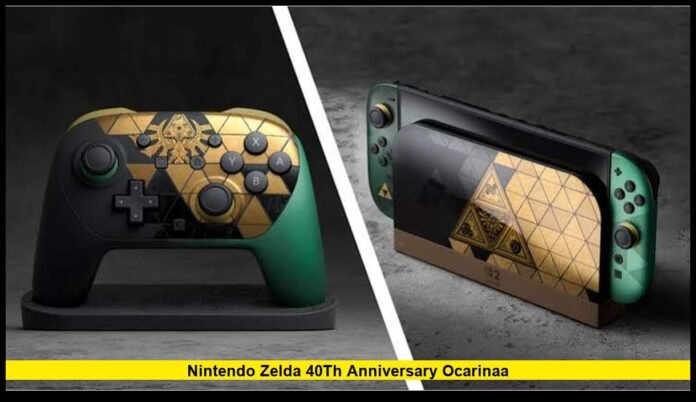

The nintendo zelda 40th anniversary ocarina celebration is shaping up to be one of the biggest moments in the franchise’s history, with Nintendo confirming that The Legend of Zelda: Ocarina of Time is returning exclusively on Nintendo Switch 2. The remake will launch on November 5, 2026, bringing one of gaming’s most influential adventures into a new generation with redesigned visuals, modern controls, voiced story sequences, orchestral music and several new gameplay features.
Nintendo used its September 8 Zelda 40th Anniversary Direct to provide the most substantial look yet at the project. The presentation also introduced anniversary hardware, accessories, new amiibo, music events, companion features and further information about the upcoming live-action Zelda movie.
For fans who grew up with the Nintendo 64 original, the remake represents a major opportunity to experience the legendary adventure in a substantially different technical environment. For newer players, it provides a modern entry point into one of the most important chapters in Zelda history.
Ocarina of Time Gets a November 2026 Release Date
Nintendo has officially scheduled The Legend of Zelda: Ocarina of Time for November 5, 2026.
The release is significant because this will be the first main Zelda title to launch exclusively for Nintendo Switch 2. Nintendo originally introduced the project with limited information, but the anniversary presentation provided a much clearer picture of how the company is approaching the remake.
Rather than simply increasing the resolution of the Nintendo 64 game, Nintendo has rebuilt major parts of the presentation. Textures have been redesigned, environments contain substantially more detail, characters have been remodeled and lighting and visual effects have been modernized.
The remake also promises faster loading and smoother overall performance. These improvements should make the transition between different areas of Hyrule considerably more seamless than it was on the original hardware.
The digital edition is priced at $59.99, while the physical version is priced at $69.99.
A Familiar Adventure With a Modern Visual Identity
The original Ocarina of Time arrived in 1998 and established a blueprint for 3D action-adventure games.
Its interpretation of Hyrule, dungeon design, combat system, targeting mechanics and time-travel storyline became enormously influential. More than two decades later, Nintendo is attempting to preserve that foundation while giving the game a presentation that matches contemporary expectations.
The difference is immediately apparent in the new footage.
The Great Deku Tree, Hyrule environments and major characters have all received significant visual upgrades. Materials have more detail, environments appear more expansive and character models have been redesigned for the new presentation.
The goal is not simply to make the game sharper. Nintendo is attempting to make the world feel more alive.
Environmental details have been added to locations, while camera movement can now provide perspectives that were impossible or impractical in the original release.
Link Gets More Flexible Movement and Camera Controls
One of the biggest gameplay changes involves Link’s movement.
The original game relied heavily on the control conventions of the Nintendo 64 era. The Switch 2 version modernizes those systems with new button commands.
Link can now jump using a dedicated button, giving players greater freedom when navigating the environment. Camera control has also been redesigned around the right stick, allowing players to move the viewpoint more freely.
These changes could have a significant effect on exploration and combat.
The original Ocarina of Time was built around a fixed-camera philosophy combined with the Z-targeting system. While those mechanics remain important to the game’s identity, modern camera control gives players more direct control over how they view Hyrule.
The updated movement should also make the adventure more accessible to players who have become accustomed to modern third-person games.
Fully Voiced Scenes Change the Story Presentation
Nintendo is also making major changes to storytelling.
The new version includes fully voiced cutscenes and expanded character dialogue. Instead of relying almost entirely on text boxes and short sound effects, important characters will have substantially more dialogue during story sequences.
This gives the familiar story a different rhythm.
Players will once again follow Link’s journey from his early days in Kokiri Forest through his encounters with Princess Zelda, the rise of Ganondorf and the transformation of Hyrule. However, the additional dialogue gives Nintendo more opportunities to develop the personalities and relationships between characters.
Locations have also been remodeled to support the updated presentation.
The day-and-night cycle is another notable improvement. Time can continue moving even while Link is visiting towns, creating a more consistent sense of a living world.
The Ocarina Remains at the Heart of the Experience
Music has always been one of the defining features of Ocarina of Time, and Nintendo is giving the instrument itself new significance in the Switch 2 version.
Players will be able to hum learned melodies into the console’s built-in microphone. The game can recognize the tune and have Link perform the corresponding song using his in-game ocarina.
The feature is a clever connection between the original gameplay concept and modern hardware.
In the Nintendo 64 version, players memorized combinations of buttons to perform songs. The new system provides another way to interact with the same mechanic, making the player physically contribute to the musical experience.
Nintendo is also planning dedicated ocarina-related products as part of the anniversary campaign, including a playable ocarina and an electronic version being developed by HORI.
That combination of game functionality and physical merchandise reinforces how important the instrument remains to the identity of the title.
Threads of Time Could Make Progress Easier to Follow
Another new feature is called Threads of Time.
The system is designed to help players understand where they are in the story and what they should pursue next. A visual tapestry gradually develops as players progress through the adventure.
This addition could be particularly useful for modern audiences.
The original Ocarina of Time expects players to remember conversations, locations and objectives while moving through a large world. While that design remains part of its charm, players can sometimes lose track of what they were supposed to do next.
Threads of Time provides additional guidance without fundamentally changing the adventure.
It can show story progress and upcoming objectives, giving players a convenient reference point when returning to the game after a break.
ZELDA NOTES Adds a Companion Experience
Nintendo is also connecting the remake with its Nintendo Switch App through ZELDA NOTES.
The companion service is designed to provide additional information and activities for players while they progress through the game.
One feature allows players to review their daily accomplishments and statistics. Another, called Gossip Quest, presents visual clues that encourage players to locate particular places in Hyrule.
The service also includes a virtual ocarina experience.
Players can interact with the virtual instrument on a compatible smart device, with options for guided playing and automatic playback. Custom musical scores can also be shared using QR codes.
Nintendo is further adding a large quiz focused on Ocarina of Time. The quiz contains more than 2,000 questions and includes images and other material related to the game.
Together, these features make the companion app more than a basic information service. It becomes another way for players to interact with the world of Hyrule.
A Zelda-Themed Switch 2 Arrives Before the Game
Nintendo is marking the anniversary with special hardware as well.
The Nintendo Switch 2 – The Legend of Zelda – 40th Anniversary Edition is scheduled to launch on October 29, 2026, one week before the remake.
The system features Zelda-inspired designs, including Triforce motifs on the console, dock and Joy-Con 2 controllers. Matching accessories are also being released, including a special Pro Controller and carrying case.
The anniversary system does not include a copy of Ocarina of Time, meaning players who want both the collectible hardware and the game will need to acquire the title separately.
The timing nevertheless makes the hardware an attractive option for collectors who want a system specifically associated with Zelda’s 40th anniversary.
New Amiibo Extend the Celebration Into 2027
Nintendo has also revealed new Zelda amiibo based on Young Link and Young Zelda.
The figures are expected in 2027 and will provide additional in-game functionality. Their connection to the younger versions of the characters makes them especially appropriate for an anniversary centered partly on Ocarina of Time.
The figures are also part of a larger collection of Zelda merchandise planned around the milestone year.
For Nintendo, anniversary celebrations have increasingly combined software with physical products, and Zelda’s 40th anniversary is following that model on a particularly large scale.
Concerts Will Celebrate Four Decades of Zelda Music
Music will have a major role in the anniversary year.
Nintendo has announced a global The Legend of Zelda 40th Anniversary Concert series for 2027, bringing Zelda music to audiences in multiple regions.
The schedule begins in Tokyo in January, followed by North American performances beginning in Chicago in February. European performances are scheduled for April, with Australia following in May.
The concerts are particularly meaningful for Ocarina of Time because the game’s music helped redefine how players experienced Zelda.
Songs performed through the ocarina are not simply background material. They are directly connected to puzzles, progression and the game’s story.
That makes the music an essential part of the game’s identity rather than an optional soundtrack.
LEGO and Collectibles Keep Ocarina of Time in the Spotlight
Nintendo’s anniversary plans also extend beyond games and consoles.
A LEGO The Legend of Zelda: Ocarina of Time – Link & Epona set is planned for spring 2027. The set contains 1,750 pieces and is designed as a collectible display model for adult fans.
Hasbro is also preparing an electronic Master Sword product for the same period.
These products demonstrate the continuing commercial strength of the Zelda brand. The franchise has developed well beyond its original identity as a video game series and now encompasses music, collectibles, toys, apparel, hardware and film.
The Live-Action Zelda Movie Moves Closer
Nintendo’s anniversary presentation also confirmed the official title and release date for the upcoming live-action movie.
The film is simply titled The Legend of Zelda and is scheduled to arrive in theaters worldwide on April 30, 2027.
Nintendo is developing the project with Sony Pictures Entertainment and Arad Productions.
The movie will draw from the world and concepts established throughout the Zelda franchise rather than serving as a direct adaptation of only one game.
Its planned release adds another major milestone to an already busy period for Zelda. By 2027, fans will have seen the arrival of the Switch 2 remake, anniversary hardware, new merchandise and concerts before the movie reaches theaters.
Why the 40th Anniversary Matters for Ocarina of Time
The choice of Ocarina of Time as a major anniversary centerpiece is understandable given its historical importance.
The game was released at a moment when Nintendo was transitioning Zelda from two-dimensional adventures into fully realized 3D environments. That transition could easily have gone wrong, but Nintendo created a game that became a benchmark for the industry.
Its targeting system influenced combat design. Its lock-on camera helped solve the challenges of fighting enemies in 3D. Its dungeons demonstrated how exploration and puzzle solving could work in a three-dimensional environment.
The remake therefore carries a responsibility beyond nostalgia.
Nintendo is bringing one of its most influential games to a generation that may never have played the original Nintendo 64 release.
That makes the new version an introduction as much as a celebration.
What the Nintendo Zelda 40th Anniversary Ocarina Plans Mean for Fans
The anniversary plans show that Nintendo is treating Ocarina of Time as one of the central pillars of Zelda’s 40-year history.
The remake is not arriving alone. It is surrounded by themed hardware, accessories, amiibo, companion software, musical instruments, concerts, LEGO merchandise and a major movie project.
For longtime fans, the appeal will largely come from seeing familiar characters and locations rebuilt with modern technology.
For new players, the attraction may be different. The updated controls, clearer progression tools, modern presentation and voiced scenes could make a game from 1998 feel considerably more approachable.
Nintendo’s challenge will be balancing those improvements with the elements that made the original so memorable.
If the remake succeeds, it could introduce Ocarina of Time to millions of new players while giving longtime fans a fresh reason to return to Hyrule.
Release Date and What to Expect
The most important date is November 5, 2026, when The Legend of Zelda: Ocarina of Time arrives exclusively on Nintendo Switch 2.
The Zelda 40th Anniversary Edition Switch 2 launches earlier on October 29. Matching accessories arrive at the same time.
Additional anniversary products and events will continue into 2027, including new amiibo, concerts, LEGO merchandise and the live-action movie.
The anniversary campaign therefore represents more than a single release window. Nintendo is using the milestone to connect the franchise’s past, present and future.
For a series that has survived four decades of changing hardware and gaming trends, bringing Ocarina of Time into the Switch 2 era is a fitting centerpiece.
The original adventure helped define 3D gaming when it arrived in 1998. Its return in 2026 gives Nintendo the opportunity to show how that same adventure can evolve while retaining the elements that made it an enduring classic.