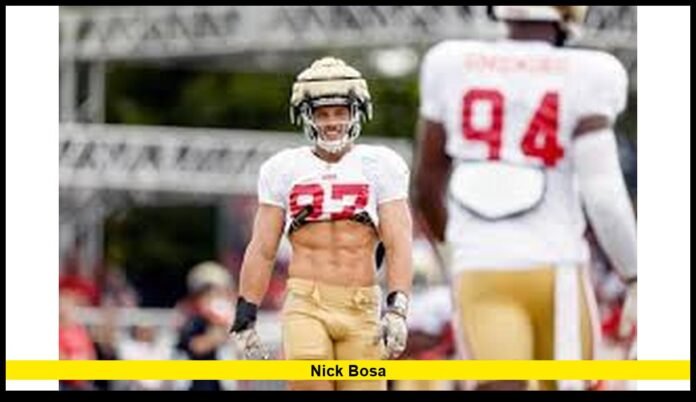

Nick Bosa continues to dominate NFL discussion as one of the most important defensive players in football, even while sidelined. As of today, the San Francisco 49ers’ franchise pass rusher is deep into rehabilitation from a torn ACL suffered early in the 2025 season, an injury that ended his year and reshaped the team’s defensive identity. His progress, health outlook, and long-term role remain central storylines for the organization and for fans across the United States.
The former Defensive Player of the Year is not expected to return until the 2026 season, but every stage of his recovery is being closely monitored. For a team built around a dominant defensive front, the absence of Bosa has affected strategy, personnel usage, and postseason preparation. His eventual return is viewed as one of the most impactful developments on the 49ers’ future calendar.
The Injury That Changed the 2025 Season
Bosa suffered a torn anterior cruciate ligament during Week 3 of the 2025 regular season in a game against the Arizona Cardinals. The injury occurred on a pass-rush snap when his planted leg absorbed contact, causing the knee to buckle. He was helped off the field and later underwent imaging that confirmed the ACL tear.
Surgery followed soon after, and the 49ers placed him on season-ending injured reserve. The diagnosis ruled him out not only for the remainder of the regular season but also for any potential playoff appearance. From that moment, the team had to prepare for the long road ahead without its most disruptive defender.
ACL reconstruction for elite NFL edge rushers typically involves a nine-to-twelve-month rehabilitation window. Given Bosa’s power-based playing style and reliance on explosive change of direction, medical staff opted for a careful, structured plan rather than an accelerated timeline.
Rehabilitation and Physical Progress
Bosa’s recovery program has followed the standard phases used for high-performance athletes, with added emphasis on lower-body strength balance and joint stability.
The early stage focused on swelling reduction, range of motion, and restoring normal walking mechanics. This was followed by progressive strength training for the quadriceps, hamstrings, glutes, and core, all essential for knee protection during high-speed pass-rush movements.
As the months progressed, his work shifted toward:
- Single-leg power development
- Lateral cutting and deceleration drills
- Hip and ankle mobility for force transfer
- Controlled on-field movement without contact
By the start of 2026, he had advanced into football-specific conditioning. This includes sprint mechanics, hand-fighting while moving, and simulated pass-rush angles. Contact work will come later in the offseason, once full structural strength and confidence in the knee are confirmed.
The organization’s goal is clear: ensure that when Bosa returns, he does so at full functional capacity, not merely cleared to play.
How the 49ers Adjusted Without Their Defensive Anchor
Few players in the league influence opposing game plans like Bosa. Offensive coordinators routinely slide protections in his direction, keep tight ends in to chip, and alter quarterback launch points to avoid his side of the field.
Without him, San Francisco’s defensive approach changed in several key ways.
The coaching staff increased the use of:
- Stunt and twist concepts to create interior pressure
- Linebacker blitz packages on passing downs
- Rotational edge usage to maintain fresh legs
- Zone coverage shells designed to force quicker throws
While the defense remained competitive, the unit lacked the consistent one-on-one win rate that Bosa provides. His ability to collapse the pocket in under three seconds is a rare trait, and replacing that production required collective effort rather than individual dominance.
Contract Structure and Organizational Commitment
Bosa is in the early stages of a five-year, $170 million extension signed in 2023, a deal that made him the highest-paid defensive player at the time. The contract includes significant guaranteed money and long-term protections, reflecting the franchise’s belief that he is a generational talent around whom championships can be built.
The season-ending injury triggered insurance provisions that provide salary cap relief while he recovers. This financial flexibility helps the front office manage roster depth and future extensions without altering its long-term commitment to Bosa.
There has been no indication of renegotiation, role modification, or reduced status. Internally, he remains the centerpiece of the defensive rebuild for 2026 and beyond.
Leadership Beyond the Field
Even while unable to suit up, Bosa’s presence has remained felt. He has continued attending meetings, participating in film study, and working with younger linemen on technique and preparation.
Teammates often point to his attention to detail, particularly in:
- Offensive tackle tendencies
- Snap timing recognition
- Hand placement strategies
- Counter-move sequencing
This involvement has helped maintain continuity in the defensive room and ensured that his voice remains part of weekly game planning.
Career Context and Elite Production
Before the injury, Bosa had already established himself as one of the most dominant defenders of his generation. His resume includes:
- NFL Defensive Player of the Year honors
- Multiple Pro Bowl selections
- Consistent double-digit sack seasons
- League-leading pressure rates
- A reputation for game-changing strip sacks and third-down stops
What separates him from many edge rushers is efficiency. He does not rely solely on speed. His power, leverage, and hand technique allow him to win against both athletic and heavy-set tackles. That versatility makes him effective in any down-and-distance situation.
Why His Return Is Critical for 2026
The 49ers’ defensive identity has long been built around winning in the trenches. A healthy Bosa restores the foundation of that philosophy.
His presence allows:
- The interior line to face fewer double teams
- Linebackers to attack downhill more aggressively
- Defensive backs to play tighter coverage due to faster pressure
- The coaching staff to reduce blitz frequency and maintain coverage integrity
Simply put, his return elevates every level of the defense.
From a strategic standpoint, it also gives San Francisco flexibility in late-game situations. With Bosa closing from the edge, the team can protect leads more effectively and force hurried throws in critical moments.
Offseason Timeline Toward Full Clearance
The projected sequence for Bosa’s return includes:
- Completion of strength symmetry benchmarks
- Full-speed sprinting and directional change
- Controlled contact drills
- Team practice participation
- Preseason game clearance
If all benchmarks are met, he is expected to be active during organized team activities and fully involved by training camp. Final clearance will depend on medical evaluations, functional testing, and confidence in the knee’s response to repeated high-load movements.
The Broader Impact on the NFC Landscape
A fully healthy Nick Bosa alters the balance of power in the conference. Opposing offenses must allocate resources to neutralize him, which often opens opportunities elsewhere on the field. For playoff-bound teams, facing a pass rusher of his caliber in January changes protection schemes and play-calling tendencies.
His return also strengthens San Francisco’s ability to compete against mobile quarterbacks, where edge containment and closing speed are critical.
Mental Resilience and Competitive Drive
Recovering from an ACL injury is as much psychological as physical. Trusting the repaired knee during explosive movements takes time, repetition, and confidence. By all accounts, Bosa has approached the process with the same intensity that defines his playing style.
He has spoken in team settings about the importance of patience, discipline, and long-term vision. Those traits are vital for a player whose game depends on planting, driving, and bending at full speed.
What Fans Can Expect Going Forward
As the offseason progresses, updates on Bosa’s participation level will be among the most watched developments in Santa Clara. Training camp reps, preseason workload, and early practice footage will offer the first real indications of how close he is to his pre-injury form.
The organization’s priority remains clear: return him to the field only when he is fully prepared to perform at the elite standard that defines his career.
Nick Bosa’s journey back from a season-ending knee injury is shaping one of the most important storylines ahead of the 2026 NFL season, and his return could once again place the 49ers’ defense among the league’s most feared units. Share your thoughts on his comeback and keep following for the latest developments.