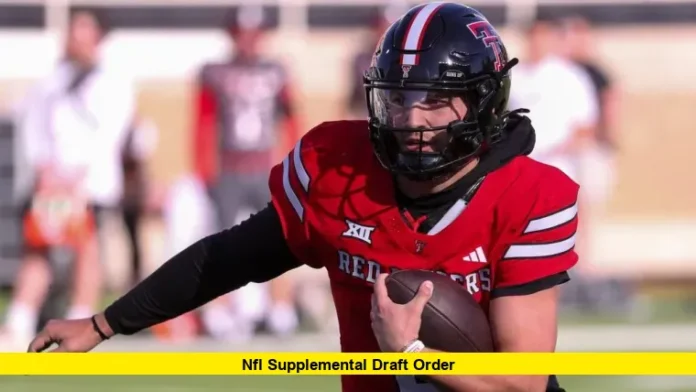

The 2026 NFL Supplemental Draft order is determined by a weighted lottery that prioritizes teams with the fewest wins from the previous season, and eligible players are typically those who lose their remaining college eligibility after the regular NFL Draft deadline, with teams forfeiting a corresponding 2027 draft pick if they successfully select a player.
The NFL supplemental draft has spent years in near-total obscurity — a footnote in the league calendar that most fans had completely forgotten about. That’s all changed in 2026, as Texas Tech quarterback Brendan Sorsby’s dramatic eligibility saga has thrust the supplemental draft back into the spotlight. With his application now filed just ahead of the June 22 deadline, NFL teams are scrambling to understand how the supplemental draft order works and whether a 2027 pick is worth burning on a player who never played a snap under his new coaching staff.
What Is the NFL Supplemental Draft?
The NFL Supplemental Draft is a special player acquisition process that allows eligible prospects to enter the league outside of the regular NFL Draft. It was created to accommodate players who become unexpectedly eligible after the deadline for the annual draft, often because of academic issues, disciplinary matters, or other circumstances that prevent them from returning to college football.
First introduced in 1977, the supplemental draft has existed for nearly five decades, though it is used far less frequently than the NFL’s main draft. Unlike the highly publicized three-day NFL Draft held every spring, the supplemental draft takes place during the summer and only occurs when there are approved players available for selection. In some years, the event generates little attention because no prospects are chosen.
The process differs significantly from the traditional draft format. Rather than selecting players in a predetermined order, teams submit confidential bids indicating the round in which they would be willing to draft a player. If a team’s bid is successful, it acquires that player but must forfeit its corresponding draft pick in the same round of the following year’s NFL Draft.
Several notable NFL players have entered the league through the supplemental draft, including Josh Gordon, Terrelle Pryor, and Jalen Thompson. Thompson was the most recent player selected when the Arizona Cardinals used a fifth-round bid in 2019.
Although selections are rare, the supplemental draft remains an important mechanism that gives overlooked or unexpectedly eligible players a second chance to reach the NFL and begin their professional careers.
How the Supplemental Draft Order Is Determined
One of the most unique aspects of the NFL Supplemental Draft is the way the selection order is established. Unlike the regular NFL Draft, which follows a straightforward reverse-order format based on the previous season’s standings, the supplemental draft uses a tiered lottery system designed to give struggling teams a better chance of obtaining available talent while still maintaining an element of randomness.
The process begins by dividing all NFL teams into three separate groups based on their performance during the previous season:
- Tier 1: Non-playoff teams that finished with six or fewer wins
- Tier 2: Non-playoff teams that finished with more than six wins
- Tier 3: Teams that qualified for the playoffs
Once teams are placed into these tiers, the NFL conducts a weighted lottery within each group. Teams with poorer records receive more favorable odds of securing an earlier position in the order, but no club is guaranteed a specific spot.
This system differs from the regular NFL Draft in several important ways:
- The team with the worst record does not automatically receive the first selection.
- Lottery results determine the order within each tier.
- Non-playoff teams are prioritized ahead of playoff teams.
- Teams with weaker records still receive the strongest odds of landing an earlier position.
For the 2026 NFL Supplemental Draft, the order is based on the results of the 2025 NFL season. As a result, the New York Jets, who finished with only three victories, enter the process with the most favorable positioning and the first opportunity to submit a successful bid on an eligible prospect.
Because supplemental draft selections require teams to surrender a corresponding pick in the following year’s NFL Draft, clubs carefully weigh both the player’s potential value and the long-term cost before placing a bid. This makes the supplemental draft a strategic and often unpredictable event despite its relatively small size.
How the Bidding System Works
The NFL Supplemental Draft uses a unique bidding process that differs significantly from the traditional NFL Draft. Rather than taking turns making selections, teams submit confidential or “blind” bids for players they are interested in acquiring. Each bid specifies the round in which the team is willing to select that player.
Once all bids are submitted, the NFL reviews them and determines the winner. The player is awarded to the team that placed the highest-round bid. If multiple teams submit bids in the same round, the supplemental draft order is used as the tiebreaker, giving priority to the team with the higher position in that year’s supplemental draft order.
The system carries an important cost. Any team that successfully acquires a player must surrender its corresponding draft pick in the following year’s NFL Draft. For example:
- First-round bid: Team loses its next first-round pick.
- Second-round bid: Team forfeits its next second-round pick.
- Fifth-round bid: Team gives up its next fifth-round selection.
Because of this penalty, teams must carefully evaluate whether a prospect is worth sacrificing future draft capital.
The supplemental draft consists of seven rounds, mirroring the structure of the regular NFL Draft. If a player receives no bids during any round, he is not selected. Instead, he becomes an undrafted free agent and is free to negotiate and sign with any NFL team, providing another path into the league.
The Brendan Sorsby Situation: Why the Supplemental Draft Is Back in the News
Interest in the 2026 NFL Supplemental Draft has surged largely because of the unusual case involving quarterback Brendan Sorsby. In a process that often receives little national attention, Sorsby’s situation has suddenly placed the supplemental draft back in the spotlight.

Sorsby, a former highly regarded recruit who spent time at Indiana Hoosiers football before transferring to Cincinnati Bearcats football and later committing to Texas Tech Red Raiders football, appeared poised for another collegiate season. However, an NCAA gambling investigation dramatically altered those plans.
Reports indicate that Sorsby placed online sports wagers while enrolled as a college athlete, including bets connected to Indiana football games during his time with the program. NCAA rules strictly prohibit active student-athletes from betting on sports, making the allegations a serious eligibility issue.
Several key developments pushed Sorsby toward the supplemental draft route:
- His request for reinstatement was denied.
- Legal challenges emerged regarding his eligibility status.
- A temporary court injunction briefly restored his ability to play.
- The Big 12 Conference challenged that ruling through legal action.
- The NCAA appealed the injunction, creating further uncertainty.
- A looming deadline left little time to resolve the dispute before the upcoming season.
Facing an increasingly uncertain college future, Sorsby chose to apply for the NFL Supplemental Draft. Before doing so, he completed a 35-day inpatient treatment program addressing gambling addiction, an important step in demonstrating accountability and rehabilitation.
His application, however, does not guarantee participation. The NFL reviews supplemental draft requests individually and retains the authority to approve or deny entry. As a result, the league’s decision on Sorsby’s eligibility remains one of the most closely watched developments surrounding the 2026 Supplemental Draft.
What Round Could Sorsby Be Selected?
The stakes for any team selecting Sorsby are significant. Selecting him in the 2026 supplemental draft means giving up the corresponding pick in the 2027 NFL Draft — a class that scouts and executives are already calling one of the strongest in years. According to CBS Sports, only one team traded a top-three-round pick during the entire 2026 draft weekend, underscoring just how much value teams place on their 2027 capital.
Despite that, NFL insider Tony Pauline of Essentially Sports reported that if Sorsby enters the supplemental draft, he is likely to be taken with a late first-round or early second-round bid. A first-round bid in the supplemental draft has not been used since 1992, and the last time a second-round pick was spent was in 2012 when the Cleveland Browns selected Josh Gordon.
Teams widely viewed as potential suitors include:
- New York Jets — Hold the top spot in the supplemental draft order with the worst record from 2025. Their quarterback depth behind Geno Smith is limited, making Sorsby an intriguing option.
- Miami Dolphins — Did not select a quarterback in the 2026 NFL Draft, leaving a developmental need that Sorsby could theoretically fill.
- Arizona Cardinals — A franchise in rebuild mode with a new head coach looking for long-term answers at quarterback.
- Cleveland Browns — Carrying ongoing uncertainty at the position despite adding Taylen Green and retaining Shedeur Sanders and Dillon Gabriel in the room.
- Pittsburgh Steelers and Indianapolis Colts — Both cited as teams that may not have clear routes to a top quarterback in the next couple of drafts and could view a mid-round 2027 bid on Sorsby as worthwhile.
Historical Context: Notable Supplemental Draft Picks
The supplemental draft has produced some genuinely significant NFL careers over the decades, even if it has largely faded from relevance in the era of NIL and expanded college eligibility:
- Cris Carter (1987) — Perhaps the greatest supplemental draft success story ever. The Ohio State wide receiver was ruled ineligible before his senior year after signing with an agent. The Philadelphia Eagles took him in the fourth round of the 1987 supplemental draft, and Carter went on to become a Pro Football Hall of Famer and eight-time Pro Bowler.
- Bernie Kosar (1985) — The Cleveland Browns maneuvered to select the quarterback out of Miami, helping spark one of the franchise’s most successful periods.
- Josh Gordon (2012) — The Browns used a second-round bid to land Gordon, who became one of the most electric receivers of his era before off-field issues derailed his career.
- Terrelle Pryor (2011) — The Ohio State quarterback entered the supplemental draft following an NCAA suspension, landing with the Raiders. The NFL mirrored his five-game NCAA suspension that same season.
- Jalen Thompson (2019) — The most recent player actually selected. The Cardinals bet a fifth-round pick and got strong value in return: Thompson has started 72 of 84 career games, recording 483 tackles and nine interceptions over six seasons.

Only 46 players in total have ever been selected in the supplemental draft since 1977.
Why the Supplemental Draft Has Faded — Until Now
For much of its history, the NFL Supplemental Draft served as a safety net for talented players who unexpectedly lost their college eligibility and needed an alternative route to professional football. However, the event has become increasingly rare in recent years, reflecting major changes across the college sports landscape.
Several developments have significantly reduced the need for a supplemental draft:
- Name, Image, and Likeness (NIL) opportunities now allow athletes to earn money while remaining in college.
- The transfer portal gives players greater freedom to change schools rather than ending their collegiate careers.
- Courts have increasingly sided with athletes in eligibility disputes, creating additional avenues for appeals and legal challenges.
- Universities and conferences have become more flexible in handling complex eligibility situations.
As a result, many players who might have been forced into the supplemental draft a decade ago can now continue their college careers and enter the NFL through the traditional April draft process.
The decline in supplemental draft activity is reflected in the numbers. Over the past decade, only a handful of players have been selected, including Adonis Alexander in 2018, Sam Beal in 2018, and Jalen Thompson in 2019. The NFL did not hold a supplemental draft in 2025 because no eligible prospects applied.
That is why the case involving Brendan Sorsby has attracted so much attention. Unlike previous supplemental draft entrants whose issues centered on academics or eligibility technicalities, Sorsby’s situation stems from a gambling investigation and his battle with gambling addiction. The combination of NCAA sanctions, legal disputes, and uncertainty about his collegiate future has created one of the most unusual supplemental draft stories in years, bringing renewed attention to a process that many football fans had nearly forgotten existed.
What Happens Next
With Sorsby’s application submitted before the June 22 deadline, the NFL must now review his case and determine whether to approve his entry into the supplemental draft. That review will examine the extent of his gambling conduct, his progress in treatment, and whether any NFL suspension — similar to the five-game ban applied to Terrelle Pryor in 2011 — would be imposed alongside his selection.
If approved, a supplemental draft will be scheduled for sometime in July, giving teams a brief window to evaluate Sorsby and submit their blind bids. If not approved, Sorsby would need to wait until the 2027 NFL Draft to enter the league through standard channels — which, ironically, might end up being the better outcome for his draft stock given how highly regarded that class already is.
Are you keeping a close eye on the Brendan Sorsby supplemental draft saga? Drop your predictions in the comments — which NFL team do you think will make the bid?