
The Nolan Wells autopsy has become the center of national attention as investigators, forensic experts, and the teenager’s grieving family search for answers about how the 18-year-old died on a remote Mississippi barrier island. Weeks after his body was recovered near Horn Island, both the independent autopsy commissioned by his family and the official examination conducted by the state have failed to produce a clear cause or manner of death, leaving the case open to continued scrutiny and public concern.
Who Was Nolan Wells
Nolan Xavier Wells was an 18-year-old from Ocean Springs, Mississippi, remembered by loved ones as warm, encouraging, and community-minded. He had recently played football for Ocean Springs High School, where he was a senior during the 2024 season, and was described by those close to him as someone who lifted others up. At his funeral, his mother, Christine Wonsley, said he “had a way of making people feel seen, welcomed and valued” and could “lift your confidence with just a few words.” The service, held at Center Pointe Church, drew public figures including civil rights attorney Ben Crump and the Rev. Al Sharpton, underscoring how quickly the case had drawn national interest.
What Happened on Horn Island
Wells went missing on July 4, 2026, after a boating trip to Horn Island, a barrier island roughly ten miles off the Mississippi Gulf Coast, with a group of friends. According to authorities, the group did not return with him, and he was reported missing that night. Search efforts, including multiple drone flights by the Mississippi Department of Marine Resources, faced technical setbacks in the following hours, including a software malfunction and a drone battery failure attributed to excessive heat.
On the morning of July 6, 2026, a United States Park Service ranger discovered a body in the water off the western end of Horn Island. The Jackson County Sheriff’s Department later confirmed the discovery, and the Jackson County Coroner’s Office matched the remains to Wells through DNA testing and dental records. Investigators initially indicated they suspected drowning, but they stopped short of officially closing the case, noting that a full investigation was still underway. In the weeks since, roughly 60 witnesses have reportedly been interviewed as authorities work to reconstruct Wells’ final hours on the island.
The Nolan Wells Autopsy Process
Two separate autopsies have been conducted in connection with Wells’ death. The first was performed by the Mississippi State Medical Examiner’s Office on July 7, 2026, shortly after his body was recovered. That official report has not been publicly released, and Jackson County Coroner Bruce Lynd Jr. has said it remains pending, with results to be shared with the local coroner once finalized.
Because the family felt the pace of the investigation and the flow of information from officials were insufficient, Wells’ parents, Christine and Elmore Wonsley, arranged for a second, independent autopsy. The body was sent to Washington, D.C., where forensic pathologist Dr. Roger Mitchell Jr., president of the National Medical Association and former chief medical examiner for the District of Columbia, performed the private examination on July 10, 2026. The independent autopsy was privately funded, with civil rights activist Colin Kaepernick reportedly covering the cost.
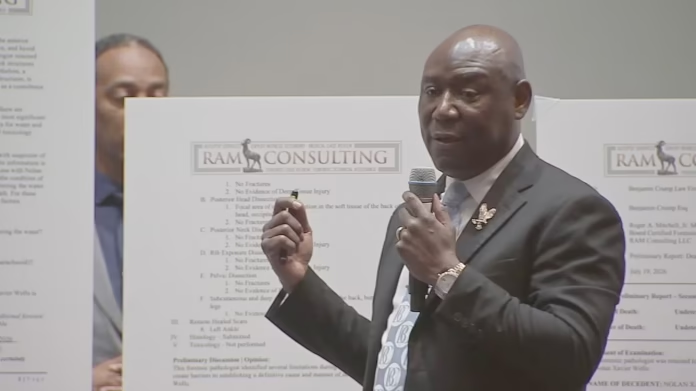
Attorney Ben Crump announced the preliminary findings of the independent Nolan Wells autopsy on July 22, 2026, during a news conference at the NAACP National Convention in Chicago. According to the report, Wells’ cause and manner of death were listed as “undetermined pending investigation.” Dr. Mitchell noted that the examination faced multiple limitations that created barriers to reaching a definitive conclusion.
Among the key findings and complications outlined in the report:
- Examiners observed red discoloration in the soft tissue at the back of Wells’ head, though it remains unclear what caused it or whether it is connected to his death.
- The report noted marked decompositional changes to the body by the time the second autopsy was performed.
- No fractures or deep tissue injuries were identified during additional dissections.
- Mitchell said he was unable to directly examine the airway and lungs for water or the stomach for gastric contents, both of which are typically important in evaluating a possible drowning.
- Internal neck structures, including the trachea, were reportedly missing from what was provided for the second autopsy, which forensic experts say is significant when trying to rule out or confirm potential strangulation.
- Toxicology results from the original examination had not yet been received at the time the preliminary report was written.
Forensic pathologist Dr. Michelle DuPre, who was not involved in either autopsy but has commented publicly on the case, said the second examination was inherently “hampered” by these limitations. She noted that performing a follow-up autopsy after a body has already been examined once is inherently more difficult, and she cautioned that authorities describing the death as accidental so early may have been premature given the equivocal nature of the findings.
No Official Confirmation of Foul Play
Local authorities have said there is currently no evidence suggesting foul play was involved in Wells’ death, with one search and rescue official telling reporters there is no indication he was intentionally left on the island. However, Dr. Mitchell’s preliminary report stated that he could not rule out the possibility that non-accidental factors contributed to or caused Wells’ death. Crump has emphasized that the independent findings raise more questions than they answer.
It is important to note that neither autopsy has produced a confirmed cause of death, and there is no official confirmation of what specifically caused Wells to die or become separated from his friends on Horn Island. Claims circulating online about the circumstances of his death remain unverified, and officials have not substantiated theories beyond stating that an investigation is ongoing.
Public Interest and Community Response
The case has generated significant public interest, partly because of the unanswered questions surrounding Wells’ final hours and partly because of the broader context in which it unfolded. Photos from the trip reportedly showed Wells, who is Black, surrounded primarily by white friends, which some observers have noted given Mississippi’s complex racial history, though officials have not confirmed race played any role in his death. Sports commentator Stephen A. Smith has publicly pushed for more transparency in the investigation, and members of the Black community have expressed suspicion about how the case has been handled.
Conflicting accounts have also emerged regarding Wells’ final hours on the island. One account suggests he chose to stay behind on Horn Island to talk with a 19-year-old identified as Katie McCormack. Investigators have asked the public and those who were present to submit original, unedited photos and videos from July 4, particularly any that may depict altercations or show Wells directly, as they work to establish a clearer timeline.
The family of Jackson County Chancery Court Judge Ashlee Cole was also drawn into public discussion after their son, who was reportedly present on the island, was interviewed by investigators. Judge Cole publicly stated that neither she nor her husband were on Horn Island and said she feared for her children’s safety after their images were widely circulated online.
Latest Updates on the Investigation
As of late July 2026, the case is reportedly heading toward a Mississippi grand jury. A former FBI agent who has reviewed public details of the case has suggested the available evidence may point toward an accidental death, while cautioning that more information could still emerge before a final determination is made. The official autopsy from the Mississippi State Medical Examiner’s Office remains sealed and has not been released to the public. Until that report is completed and shared, and until toxicology results are finalized, the full picture of what happened to Nolan Wells will likely remain incomplete.
Investigators have not announced an expected timeline for when the official autopsy or a final ruling on cause and manner of death will be released. Crump and the family have continued to call for transparency, stating they will not rest until all facts surrounding Wells’ death are made public.
Final Thoughts
The Nolan Wells autopsy findings, both the private examination and the still-pending official report, illustrate just how complicated forensic investigations can become when a body is recovered days after death and examined more than once. With decomposition, missing tissue samples, and incomplete toxicology all cited as complicating factors, medical experts agree that a conclusive answer may take time. For now, Wells’ cause and manner of death remain officially undetermined, and no evidence of foul play has been confirmed by authorities, even as the family’s independent pathologist has said he cannot rule it out. As the case moves toward potential grand jury review, the community, the family, and the public will be watching closely for the release of the official autopsy and any new developments that could bring clarity to what happened on Horn Island.
Stay tuned for continuing coverage of the Nolan Wells case, and share your thoughts in the comments below as new details emerge.