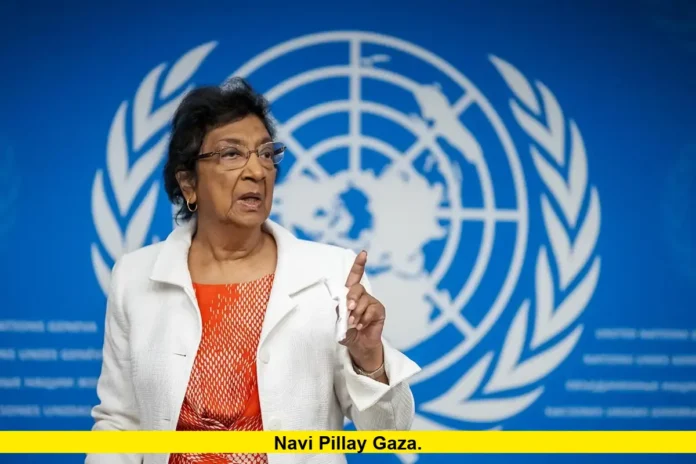

The connection between Navi Pillay Gaza has attracted renewed international attention following the announcement that South African jurist Navanethem “Navi” Pillay has won the 2026 Nobel Peace Prize. Pillay, a former United Nations High Commissioner for Human Rights and an experienced international judge, led a UN Commission of Inquiry that examined alleged violations of international law in Gaza and the broader Israeli-Palestinian conflict. In September 2025, the commission concluded that Israel had committed genocide in Gaza, a finding rejected by the Israeli government. Her work has brought renewed attention to civilian protection, international accountability, and the role of legal institutions in addressing armed conflict.
Why Is Navi Pillay Associated With Gaza?
Navi Pillay became a prominent figure in international discussions about Gaza through her leadership of the Independent International Commission of Inquiry on the Occupied Palestinian Territory, including East Jerusalem, and Israel.
The United Nations Human Rights Council established the commission to investigate alleged violations of international humanitarian law and international human rights law in the occupied Palestinian territory and Israel. Its work included examining events surrounding the October 7, 2023, Hamas-led attacks on Israel and Israel’s subsequent military operations in Gaza.
As chair, Pillay helped oversee investigations into alleged war crimes, crimes against humanity, attacks affecting civilians, forced displacement, and other serious violations. The commission’s findings addressed conduct by Israeli authorities as well as Hamas and other Palestinian armed groups.
Her involvement made her a central figure in the legal examination of the conflict. Rather than serving as a political negotiator, Pillay approached the situation through evidence gathering, legal analysis, and the international standards governing armed conflict.
The commission’s findings have also generated substantial controversy, particularly its conclusion that genocide occurred in Gaza. Israeli officials rejected that conclusion, disputing the report’s methodology and allegations.
Navi Pillay’s Gaza Genocide Report: What Did the UN Commission Find?
In September 2025, the commission led by Pillay published a report concluding that Israel had committed genocide against Palestinians in Gaza.
The report identified four categories of genocidal acts that the commission said had occurred: killing members of a protected group, causing serious bodily or mental harm, deliberately imposing conditions of life calculated to bring about the group’s physical destruction, and measures intended to prevent births within the group.
The commission stated that its assessment was based on the evidence it examined and its interpretation of the 1948 Convention on the Prevention and Punishment of the Crime of Genocide.
It also alleged that statements by senior Israeli officials provided evidence of incitement to genocide. These were serious legal conclusions, and Israel strongly rejected the allegations.
An important legal distinction: The commission’s report represents the findings of an independent UN investigative body. It is not the same as a final judgment by an international court establishing state responsibility for genocide. The International Court of Justice handles legal disputes between states, including the separate case brought by South Africa against Israel under the Genocide Convention.
The commission’s conclusion intensified international debate over the conduct of the war, the protection of Palestinian civilians, and the obligations of governments under international law.
What Did Navi Pillay Say About the Humanitarian Crisis in Gaza?
Pillay’s public statements about Gaza have focused on the scale of civilian suffering, the destruction of essential infrastructure, displacement, and the need for accountability.
In a statement to the United Nations General Assembly’s Third Committee in October 2025, she described the extensive damage to Gaza and the devastating effects of the conflict on Palestinian and Israeli communities. She argued that a ceasefire alone could not resolve the consequences of the war or eliminate the need for justice.
Her remarks also addressed the risk of permanent territorial changes and the displacement of Palestinians. The commission expressed concern about statements by Israeli officials concerning military control, population transfer, and the future of the territory.
Pillay urged governments to use available legal and diplomatic mechanisms to support accountability. She also emphasized Palestinian self-determination and statehood, alongside the importance of protecting victims and preventing further violations.
Her position reflects a broader principle of international humanitarian law: all parties to an armed conflict must comply with applicable legal obligations, including rules protecting civilians and restricting the methods and means of warfare.
The commission’s investigations also considered alleged crimes committed by Hamas and other Palestinian armed groups. Pillay’s work therefore extended beyond one incident or one category of alleged violation to a wider assessment of conduct during the conflict.
Navi Pillay and the 2026 Nobel Peace Prize
On October 9, 2026, Navi Pillay was announced as the winner of the Nobel Peace Prize.
The Norwegian Nobel Committee recognized her efforts to promote peace and international law. The award has brought fresh attention to her career in human rights, international criminal justice, and efforts to strengthen legal accountability.
Her Gaza investigations form a significant part of the recent public discussion surrounding the prize. However, the stated basis for the award is her broader contribution to peace and international law, rather than a single report or political position.
Pillay’s recognition highlights the relationship between justice and peace. International legal institutions investigate serious crimes, clarify legal obligations, and provide mechanisms for accountability. Their work can contribute to peace by establishing that grave violations should not go unexamined.
The Nobel Peace Prize ceremony is scheduled for December 10, 2026, in Oslo, Norway.
Her award has also renewed debate about the pressures faced by international institutions investigating allegations involving powerful governments. Supporters view her career as evidence of the importance of independent legal scrutiny, while critics have challenged aspects of the commission’s conclusions concerning Israel.
The central issue remains how international law can be applied consistently and credibly in conflicts where civilian suffering, competing narratives, and political disagreements make accountability especially difficult.
How Did Navi Pillay’s Commission Investigate the Gaza Conflict?
The commission’s work involved examining information about events in Israel and Gaza, evaluating alleged violations, and applying relevant international legal standards.
Its investigations considered the October 7, 2023, attacks by Hamas and other Palestinian armed groups, including killings and hostage-taking, as well as Israel’s military operations in Gaza.
Earlier commission findings in 2024 identified war crimes and other serious violations by both Israeli authorities and Palestinian armed groups. In relation to Israeli military operations, the commission reported alleged crimes including attacks against civilians, starvation as a method of warfare, forcible transfer, torture, and sexual and gender-based violence.
The commission also examined attacks and abuses attributed to Hamas and other Palestinian armed groups. It emphasized that the taking of hostages is prohibited under international law.
In 2025, its work expanded into a specific legal assessment of whether conduct in Gaza met the definition of genocide under the Genocide Convention.
That determination required more than establishing that large numbers of civilians had died or that extensive destruction had occurred. The legal definition of genocide also requires specific intent to destroy, in whole or in part, a protected national, ethnic, racial, or religious group.
The commission concluded that the necessary elements were present. Israel rejected the allegation, maintaining that its military campaign was directed against Hamas following the October 7 attacks.
These competing positions underline why the report has become a major subject of international legal and diplomatic debate.
What Is the Difference Between Navi Pillay’s Report and the ICJ Case?
The distinction between a UN Commission of Inquiry report and a ruling by the International Court of Justice is essential to understanding the Gaza controversy.
The commission that Pillay chaired was an investigative body tasked with examining alleged violations and reporting its findings. Its conclusions can inform international debate, accountability efforts, and further investigations, but they do not automatically constitute a binding court judgment.
The International Court of Justice, by contrast, settles disputes between states under international law. South Africa brought a case against Israel under the Genocide Convention, alleging that Israel’s conduct in Gaza violated its obligations under that treaty.
The ICJ has issued provisional measures in the case. Such measures are intended to protect rights that may be at risk while proceedings continue. They are not, by themselves, a final determination that genocide has occurred.
Separately, the International Criminal Court investigates and prosecutes individuals accused of crimes within its jurisdiction. It is not the same institution as the ICJ, and its proceedings address individual criminal responsibility rather than disputes between states.
Keeping these institutions and their different legal functions separate helps readers understand what has been alleged, what investigators have concluded, and what courts have formally decided.
Why Has Navi Pillay’s Work on Gaza Generated Controversy?
The genocide finding has produced sharply divided reactions.
Supporters of the commission’s work argue that international investigations are necessary to document alleged abuses, protect civilians, and establish accountability regardless of the identity of the accused. They emphasize the need to examine evidence and apply international law consistently.
Israeli officials have rejected the genocide allegations and criticized the commission’s conclusions. Israel has maintained that its military operations are aimed at defeating Hamas and responding to the October 7 attacks.
The dispute reflects broader disagreements about military necessity, civilian casualties, humanitarian access, the interpretation of genocidal intent, and the responsibilities of parties to an armed conflict.
A careful account should distinguish documented events, allegations, investigative findings, government responses, and final judicial determinations. These categories are not interchangeable.
Pillay’s work has nevertheless ensured that the legal questions raised by the Gaza war remain prominent in international discussions about human rights and accountability.
Navi Pillay Religion: Her Family Background and Personal Beliefs
Navi Pillay’s religious background is another subject of public interest following her Nobel Peace Prize recognition. She was born in Durban, South Africa, to a family of Indian Tamil heritage, and biographical accounts describe her family background as Hindu. However, her current personal religious affiliation and private religious practices have not been clearly established in authoritative public biographies. Her professional record focuses primarily on legal justice, human rights, equality, and international accountability rather than religious identity. Her family heritage may help explain aspects of her cultural background, but it should not be treated as proof of her present-day beliefs. Her work on Gaza and international law is assessed on its evidence and legal reasoning, not on an assumed religious affiliation.
Navi Pillay’s Wider Human Rights Legacy
Pillay’s work on Gaza is part of a career spanning several decades and multiple international institutions.
She became a lawyer in South Africa during apartheid and represented people affected by racial discrimination. In 1995, she became the first non-white woman appointed to South Africa’s High Court.
She later served as a judge at the International Criminal Tribunal for Rwanda, where landmark proceedings helped establish the legal recognition of sexual violence as a possible instrument of genocide. She also served as a judge at the International Criminal Court.
From 2008 to 2014, Pillay was the United Nations High Commissioner for Human Rights. In that role, she advocated for the protection of fundamental rights and greater accountability for serious abuses.
Her experience across national courts, international tribunals, and UN institutions informs her approach to the Gaza conflict. Her work demonstrates how legal analysis and investigations can shape international responses to allegations of atrocities.
The 2026 Nobel Peace Prize has brought these contributions into renewed focus, while the controversy surrounding the Gaza report continues to illustrate the challenges of applying international law amid an active and deeply contested conflict.
Frequently Asked Questions About Navi Pillay and Gaza
Who is Navi Pillay?
Navi Pillay is a South African jurist, former UN High Commissioner for Human Rights, and experienced international judge known for her work on human rights and international criminal justice.
Why is Navi Pillay connected to Gaza?
She chaired a UN Commission of Inquiry that investigated alleged violations of international law in the occupied Palestinian territory, including Gaza, and Israel.
Did Navi Pillay’s UN commission conclude that genocide occurred in Gaza?
Yes. In September 2025, the commission concluded that Israel had committed genocide in Gaza. Israel rejected the finding. The commission’s conclusion should be distinguished from a final judgment by an international court.
Did Navi Pillay win the 2026 Nobel Peace Prize?
Yes. She was announced as the 2026 Nobel Peace Prize laureate on October 9, 2026, in recognition of her efforts to promote peace and international law.
Is Navi Pillay’s Nobel Peace Prize specifically for her Gaza report?
The stated basis for the award is her broader contribution to peace and international law. Her work on Gaza is an important part of the recent discussion about her career, but the award should not be reduced to a single investigation.
What is Navi Pillay’s religion?
Biographical accounts describe her family background as Hindu, but her current personal religious affiliation has not been clearly established in authoritative public biographies.
Conclusion
Navi Pillay’s involvement in Gaza has placed international law and accountability at the center of a major global debate. Her commission’s 2025 genocide finding against Israel, the Israeli government’s rejection of that conclusion, and the distinctions between investigative reports and court judgments are essential to understanding the controversy. Her 2026 Nobel Peace Prize has further highlighted her decades of work defending human rights and strengthening international justice. The continuing significance of her work lies in the questions it raises about civilian protection, legal responsibility, and the role of independent institutions in addressing conflicts.
What is your view of Navi Pillay’s Gaza investigation and its impact on international justice? Share your thoughts in the comments and stay tuned for the latest verified updates.