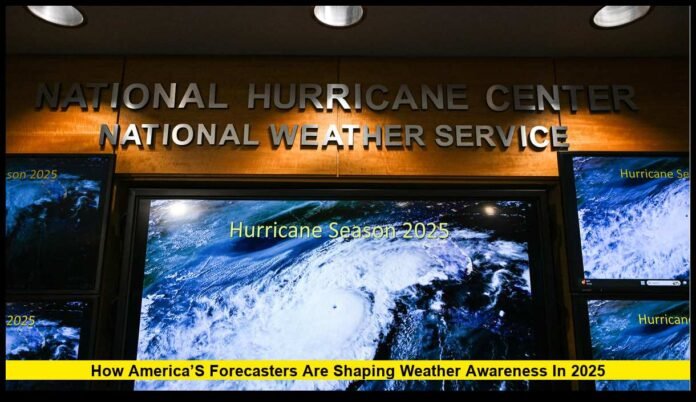

When severe storms, hurricanes, or wildfires threaten the United States, millions of Americans turn to one reliable source for updates — the National Weather Service. In 2025, as climate extremes become more common, this government agency stands at the center of the nation’s weather forecasting and public safety efforts.
From advanced satellite systems to artificial intelligence-driven predictions, the National Weather Service continues to evolve, offering the most accurate and timely weather alerts in its 155-year history.
What Is the National Weather Service?
The National Weather Service (NWS) operates under the National Oceanic and Atmospheric Administration (NOAA), part of the U.S. Department of Commerce. Its mission is simple but vital: to protect lives, property, and the economy by providing reliable weather forecasts and warnings.
Founded in 1870 as the Weather Bureau, the agency began with just a few dozen observers. Today, it has grown into a sophisticated network of meteorologists, hydrologists, and scientists who monitor weather patterns 24 hours a day across land, air, and sea.
Currently, the NWS operates:
- 122 local forecast offices
- 13 river forecast centers
- 9 national centers including the National Hurricane Center and the Storm Prediction Center
These offices work in sync to issue alerts, analyze atmospheric data, and communicate weather risks to the public through TV, radio, and digital platforms.
2025: A Year of Upgrades and Innovation
In 2025, the National Weather Service has entered a new era of modernization. Responding to both technological advances and climate challenges, it has rolled out several groundbreaking tools and systems designed to improve accuracy and accessibility.
Key developments include:
- Next-Generation Radar (NEXRAD) Enhancements
- The NEXRAD radar system, in operation since the 1990s, has received hardware and software upgrades that allow faster detection of severe storms, tornado rotation, and hail formation.
- AI-Driven Forecast Modeling
- Machine learning tools now assist forecasters by identifying subtle atmospheric trends that traditional models might miss, improving tornado and flash flood warnings.
- GOES-R Satellite Expansion
- The latest GOES weather satellites provide high-resolution images every 30 seconds, tracking hurricanes, wildfires, and atmospheric changes across the Western Hemisphere.
- Public Alert Improvements
- Wireless Emergency Alerts (WEA) now reach 98% of U.S. mobile devices, ensuring people receive immediate notifications about tornadoes, hurricanes, and flash floods.
These technological advancements give meteorologists more confidence and citizens more time to act when severe weather strikes.
Recent National Weather Service Highlights (2025)
The past year has been one of the most active in recent memory for the National Weather Service. Between January and October 2025, the agency has issued thousands of critical alerts across multiple regions.
Notable events include:
- Hurricane Milton (September 2025):
The NWS National Hurricane Center tracked Milton for 12 days, issuing early evacuation alerts across Louisiana, Mississippi, and Florida. The storm caused major flooding but far fewer casualties than expected — a testament to timely warnings. - Midwest Tornado Outbreak (May 2025):
More than 50 tornadoes swept through parts of Missouri and Illinois. Thanks to enhanced radar and AI models, the NWS provided lead times of up to 25 minutes, allowing residents to seek shelter. - Western Wildfires (Summer 2025):
Persistent drought and high winds fueled fires across California and Oregon. The NWS Fire Weather Program worked with local agencies to forecast fire behavior and issue Red Flag Warnings that helped limit damage. - Record-Breaking Heatwaves (July 2025):
The NWS Heat Risk Index was deployed nationwide to alert Americans to dangerous temperature levels, leading to new cooling center initiatives in several states.
These examples underscore how deeply integrated the National Weather Service has become in both emergency management and community resilience planning.
How the National Weather Service Forecasts the Weather
Behind every forecast lies an enormous network of data, science, and expertise.
- Observation – Thousands of instruments collect data on temperature, humidity, and wind from satellites, weather balloons, ocean buoys, and radar towers.
- Analysis – Supercomputers at NOAA’s data centers in Maryland and West Virginia process billions of data points daily.
- Prediction – Models simulate how the atmosphere will behave, producing forecasts from hours to weeks ahead.
- Communication – Local forecast offices tailor the data for their regions, issuing specific alerts for cities, counties, and coastlines.
This structured approach ensures that every NWS forecast combines global-scale modeling with community-level precision.
Local Forecast Offices: The Frontline of Public Safety
The heart of the National Weather Service’s operations lies in its local offices, which cover every state and U.S. territory. These offices are staffed by forecasters who know their regions’ unique weather patterns — from lake-effect snow in Michigan to flash floods in Arizona.
Each office operates 24/7, monitoring local conditions and communicating directly with emergency managers, schools, and news outlets.
Example roles by office type:
- National Hurricane Center (Miami, FL): Tracks and forecasts tropical storms and hurricanes.
- Storm Prediction Center (Norman, OK): Monitors severe thunderstorms and tornado outbreaks.
- Weather Prediction Center (College Park, MD): Focuses on rainfall, snowfall, and large-scale storm systems.
- Space Weather Prediction Center (Boulder, CO): Watches for solar flares that could disrupt power grids or satellites.
This decentralized structure helps ensure that forecasts are not just accurate — they’re relevant to local communities.
The National Weather Service and Emergency Management
When disasters strike, coordination becomes critical. The National Weather Service plays a central role in emergency response alongside FEMA, state agencies, and local first responders.
During hurricanes, for instance, NWS meteorologists are embedded in emergency operation centers, providing real-time data that helps determine evacuation zones and resource deployment.
Similarly, the National Tsunami Warning Center in Alaska monitors seismic activity and ocean levels to issue tsunami warnings along the Pacific and Atlantic coasts.
This collaboration between meteorology and emergency management is what transforms forecasts into life-saving action.
Public Communication and Outreach
The NWS has become more proactive than ever in engaging directly with the public. Its social media teams provide live updates on X (formerly Twitter), Facebook, and Instagram, using plain-language explanations and visuals.
It also runs education initiatives such as:
- SKYWARN® Storm Spotter Training – Teaching citizens how to identify and report severe weather.
- Weather-Ready Nation Ambassadors – A network of organizations helping communities prepare for disasters.
- Flood Safety Campaigns – Promoting the “Turn Around, Don’t Drown” message nationwide.
By merging technology with community engagement, the NWS builds a stronger connection with the people it serves.
Funding, Staffing, and Future Goals
Running a nationwide weather infrastructure is no small feat. The National Weather Service employs around 4,800 personnel, including meteorologists, hydrologists, IT specialists, and engineers.
In its 2025–2026 budget, NOAA allocated more than $1.3 billion to support modernization efforts, including new radar installations and data science initiatives. A portion of this funding will also go toward recruiting younger meteorologists as veteran forecasters retire.
Long-term goals include:
- Expanding predictive accuracy for 14-day forecasts.
- Integrating oceanic and atmospheric data for better climate modeling.
- Strengthening cybersecurity to protect the national forecast infrastructure.
With these priorities, the NWS aims to remain the gold standard for weather prediction through 2030 and beyond.
Public Trust and the Challenge of Misinformation
In a digital world overflowing with content, the National Weather Service remains one of the most trusted sources of weather data in the U.S. Surveys conducted this year show over 85% of Americans consider NWS alerts credible and essential.
However, the agency faces new challenges — especially the spread of misinformation on social platforms, where unverified “forecast” accounts can circulate false data.
To combat this, the NWS has increased its visibility through official verification labels, community partnerships, and easy-to-understand graphics that make real alerts stand out from speculation.
The National Weather Service and Climate Preparedness
Beyond daily forecasts, the NWS also contributes heavily to understanding long-term climate patterns. Its collaboration with NOAA’s Climate Prediction Center supports seasonal outlooks for droughts, floods, and heatwaves.
These forecasts are used by:
- Farmers planning crop cycles.
- Energy companies managing power grids.
- Local governments preparing for flood mitigation and wildfire control.
As the climate crisis intensifies, the NWS’s role in predicting and mitigating future risks becomes increasingly vital.
Looking Ahead: The Future of U.S. Weather Forecasting
The National Weather Service is preparing for a new chapter in American weather science. By 2026, the agency expects to deploy fully integrated AI systems capable of issuing predictive warnings for tornadoes up to 45 minutes in advance — double the current lead time.
Additionally, the upcoming Next-Gen Weather Radar Network promises enhanced coverage for rural areas that have historically lacked real-time alerts.
The agency also plans to expand its collaboration with universities and private-sector partners to accelerate innovation while maintaining public trust and transparency.
Conclusion: America’s Lifeline in a Changing Climate
For more than a century, the National Weather Service has helped Americans stay safe, informed, and prepared. In 2025, it continues that mission with greater precision and urgency than ever before.
Through modern technology, dedicated scientists, and strong partnerships, the NWS stands as a symbol of national readiness — one that touches every state, every forecast, and every family.
Have you received an alert from the National Weather Service that helped you prepare for severe weather? Share your experience below and join the conversation on how weather awareness saves lives.