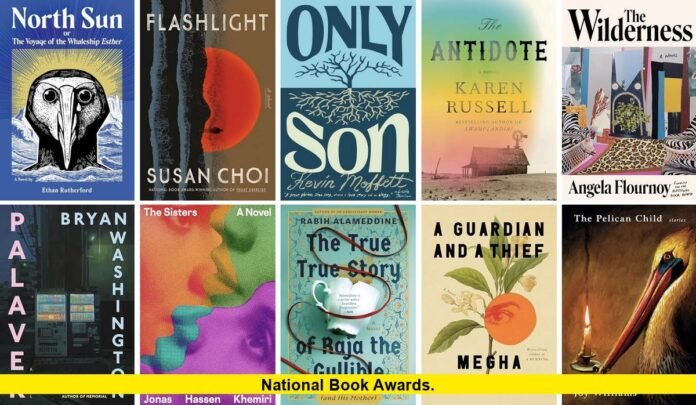

The National Book Awards drew major attention today as the 2025 finalists were officially announced, shining a spotlight on an exceptional and diverse slate of works across fiction, nonfiction, poetry, translated literature, and young people’s literature. (The phrase national book awards appears here early to meet SEO priority.)
📚 2025 National Book Award Finalists Unveiled
On October 7, the National Book Foundation revealed the finalists in each of five categories. Each winner will receive $10,000 and a bronze medal, while each finalist earns $1,000 and a medal. The official awards ceremony is scheduled for November 19 in New York City.
Among the most spotlighted categories:
- Fiction: Rabih Alameddine’s The True True Story of Raja the Gullible (and His Mother); Megha Majumdar’s A Guardian and a Thief; Karen Russell’s The Antidote; Ethan Rutherford’s North Sun: Or, the Voyage of the Whaleship Esther; and Bryan Washington’s Palaver
- Nonfiction: Yiyun Li is a finalist for Things in Nature Merely Grow, alongside works by Omar El Akkad, Julia Ioffe, Claudia Rowe, and Jordan Thomas
- Poetry: Cathy Linh Che, Tiana Clark, Richard Siken, Patricia Smith, and Gabrielle Calvocoressi
- Translated Literature: Titles translated from Danish, Spanish, Dutch, Uzbek, and French languages
- Young People’s Literature: Amber McBride, Hannah V. Sawyerr, Ibi Zoboi, Kyle Lukoff, and Daniel Nayeri
In addition to the competitive categories, the Foundation will bestow lifetime achievement honors upon George Saunders and Roxane Gay at the ceremony.
This year’s finalists represent a range of voices, styles, and perspectives—and reflect growing attention to translated works and global storytelling.
Highlights & Themes from the 2025 Selections
The 2025 roster emphasizes bold, boundary-pushing fiction and nonfiction:
- Diverse Landscapes: From the American Midwest in The Antidote to Arctic-strewn seas in North Sun, the fiction lineup is geographically expansive.
- Cross-genre Blending: Rutherford’s novel, for example, blends myth, history, and environmental reflection into a sweeping narrative.
- Nonfiction with urgency: Li’s work confronting grief and memory sits alongside El Akkad’s exploration of political conflict and Rowe’s examination of foster care.
- Global perspectives in translation: The translated literature finalists include works from Denmark, Spain, Uzbekistan, the Netherlands, and France—marking growing recognition for international voices in U.S. literary awards.
- Youth literature tackling weighty topics: The young people’s literature finalists are not shying away from themes of identity, social upheaval, healing, and cultural heritage.
Earlier in September, the Foundation released longlists in each category—ten books per classification—culled from hundreds of submissions. That longlist phase allowed readers and critics alike to engage early with the year’s standout literary contenders.
For example, in fiction the longlist included Flashlight by Susan Choi, The Wilderness by Angela Flournoy, The Sisters by Jonas Hassen Khemiri, Only Son by Kevin Moffett, and The Pelican Child by Joy Williams alongside the works that made it to the final five.
What to Watch Before the Gala
As we await the November 19 ceremony, some threads to follow:
- Which translated work will win? The finalists include On the Calculation of Volume (Book III) (Danish), We Are Green and Trembling (Spanish), The Remembered Soldier (Dutch), We Computers: A Ghazal Novel (Uzbek), among others.
- How will the jury weigh narrative risk? Many finalists experiment with form or subject; will traditional storytelling styles hold sway or will the more daring works triumph?
- How will marginalized voices fare? With many finalists centering Black, Indigenous, immigrant, queer, and global perspectives, the awards could signal continuing shifts in literary gatekeeping.
- Honorary award impact: The choice of George Saunders and Roxane Gay reflects the Foundation’s commitment to celebrating both literary craft and cultural influence.
The National Book Awards have long functioned as a barometer of American literary values—what stories matter, who gets visibility, and which disciplines are celebrated.
The Stakes & Significance of the National Book Awards
- Prestige & influence: Winning or even being a finalist bolsters sales, library acquisitions, and author reputations.
- Financial recognition: $10,000 to winners and $1,000 to finalists provides tangible support in a challenging market.
- Literary community momentum: Longlist announcements prompt reading buzz, literary discussion, and renewed focus on overlooked works.
- Cultural signal: The choice of finalists and winners often reflects trends in identity, politics, and the global flow of ideas.
Each stage—from submissions to longlist to finalists to winner—highlights both the craft of writing and broader cultural conversations.
As the literary community, book lovers, and critics await the National Book Awards gala in November, anticipation builds. Which stories will rise above their peers? Which voices will resonate in 2025’s reckoning of U.S. letters?
Stay tuned—and feel free to share your thoughts below on who you hope takes home the awards or what finalist novel you’re most excited to read.