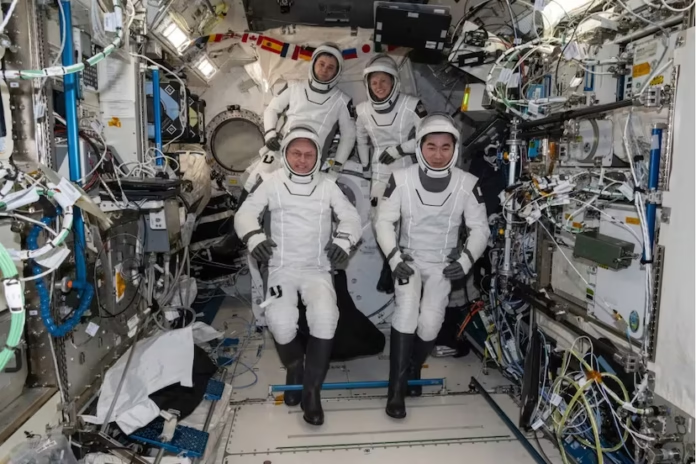

In an extraordinary milestone for human spaceflight, the nasa astronauts space station evacuation mission concluded this week with four crew members safely back on Earth after leaving the International Space Station (ISS) earlier than planned following a health issue aboard the orbiting laboratory. This event marks the first time NASA has executed a medical return from the ISS, highlighting how far space operations have evolved in managing astronaut health beyond Earth’s atmosphere.
Space agencies design missions assuming crews will remain aboard the ISS for about six months. But when a medical concern arose in early January involving a Crew-11 astronaut — one serious enough to require more comprehensive care than could be provided aboard the station — mission leaders opted for a preemptive return that prioritized health and safety without compromising mission integrity.
A Historic Evacuation From Low Earth Orbit
SpaceX’s Crew Dragon spacecraft Endeavour departed the ISS on the evening of January 14, carrying NASA astronauts and international partners back to Earth. Roughly 10 hours later, the capsule splashed down in the Pacific Ocean off the California coast in the early morning hours of January 15, bringing an end to a mission that had lasted around 167 days. This represented a controlled, well-planned response to an unforeseen medical event — something that, until now, had been a feature of Earth-based emergency systems but never space operations at this level.
The safe return of the crew demonstrated the operational maturity of NASA’s protocols for in-orbit health monitoring and evacuation procedures, showing that even in space, human wellbeing is placed above all mission goals.
Who Was on Board and What Happened
The Crew-11 mission launched on August 1, 2025, carrying four astronauts: two from NASA, one from the Japan Aerospace Exploration Agency (JAXA), and one from Roscosmos. Over their months aboard the ISS, they conducted scientific research, maintained station hardware, and supported experiments spanning biology, physics, and technology development.
In early January, one of the crew members developed a medical issue serious enough to prompt a reassessment of the mission timeline. NASA canceled planned spacewalks and began evaluating the options. Although the specific condition and identity of the affected astronaut remain confidential, officials confirmed the individual was stable and that returning them to Earth for advanced medical evaluation was the best course of action.
Officials described the decision as deliberate rather than urgent, with mission planners opting for a measured response that allowed for safe planning and execution of the evacuation.
Execution of the Evacuation
Undocking from the ISS occurred without incident on January 14, with the Crew Dragon Endeavour performing a precise deorbit burn that set it on a path for re-entry into Earth’s atmosphere. Parachutes deployed as planned, and the capsule touched down in the ocean near San Diego in the early hours of January 15.
Recovery teams were on standby and quickly brought the spacecraft aboard a recovery vessel. The astronauts exited the capsule in good spirits and underwent initial medical evaluations on site before transfer to a local medical facility for more extensive checks.
All four crew members were reported in stable condition following splashdown, with the astronaut at the center of the medical concern being closely monitored by medical specialists. The early conclusion to the mission allowed the entire team to begin post-flight procedures on Earth rather than continuing in orbit under the constraint of limited medical resources.
ISS Operations After the Crew Departure
With the departure of the Crew-11 team, the ISS temporarily operates with a smaller complement of astronauts. Remaining station personnel include a mix of U.S. and Russian spacefarers who will continue essential station operations, research, and system maintenance.
NASA and its partners are planning to send a replacement crew (Crew-12) to the station. That launch is expected later this winter, helping restore full staffing levels once the new team arrives. In the interim, mission control centers on Earth continue to support daily science activities and station upkeep with a reduced crew aboard.
Why This Matters for Space Health and Safety
This controlled evacuation highlights the importance of advanced medical planning for missions beyond Earth. Even with state-of-the-art medical equipment and telemedicine support aboard the ISS, there are limits to what can be treated in microgravity. By bringing the crew member back to Earth, NASA ensured that access to comprehensive medical facilities could be provided without delay.
The event underscores the necessity of robust health monitoring systems, emergency planning, and crew readiness for unexpected situations. It elevates confidence in current protocols and demonstrates that the tools and training are in place to protect astronauts’ health even when they are hundreds of miles above Earth.
As human spaceflight ambitions grow — from extended stays on the lunar surface under the Artemis program to future missions to Mars — the need to manage medical contingencies remotely will only become more critical. Lessons learned from this event will inform future strategies for deep-space missions where evacuation may not be as straightforward.
The Role of Commercial Crew Vehicles in Safety Operations
The Crew Dragon spacecraft has now proven its value not just as a transport vehicle for astronauts to and from low Earth orbit, but as a dependable lifeboat in time-sensitive situations such as this evacuation. Its ability to remain docked to the ISS for months and then support a safe return with minimal risk exemplifies the advances in commercial crew technology.
SpaceX’s collaboration with NASA has expanded the agency’s capacity to respond rapidly to dynamic challenges, reinforcing the value of public-private partnerships in human space exploration.
Global Collaboration in Space Medical Response
One of the defining features of ISS missions is international cooperation. Astronauts from multiple nations work and live together aboard the station, sharing responsibilities and research goals. In this evacuation, all partners worked seamlessly to manage the situation, prioritizing the health of one of their own while ensuring station operations continued without compromise.
This event underscores the essential nature of international collaboration in space exploration — not only for scientific and technological progress, but for supporting human life wherever it travels.
Looking Ahead: Future Missions and Medical Preparedness
With NASA preparing for the Artemis II mission to orbit the Moon — the first crewed lunar stay since Apollo — the success of this evacuation reinforces the agency’s readiness to handle medical challenges in diverse environments. The upcoming Artemis flight will carry a separate crew on a mission that takes them around the Moon, presenting its own unique set of risks and requirements.
Technology and protocols developed for ISS health monitoring and emergency response will be applied and adapted for these more distant missions, furthering the safety framework for astronauts venturing deeper into space.
Medical emergency planning will remain a central aspect of mission design. As agencies consider longer stays on the Moon or voyages to Mars, the capacity to diagnose, treat, and, if necessary, evacuate astronauts will shape how crews are selected, trained, and supported over years rather than months.
Conclusion: Milestone for Spaceflight and Human Safety
The first successful medical evacuation from the International Space Station stands as a major achievement for space agencies and their partners. By returning four astronauts safely to Earth and ensuring comprehensive medical evaluation for one crew member, this mission demonstrated that human spaceflight operations now include responsive health care contingencies.
This event inspires confidence in how space explorers can be protected during extended missions and reminds the world that the health and safety of those who go beyond Earth remains a top priority.