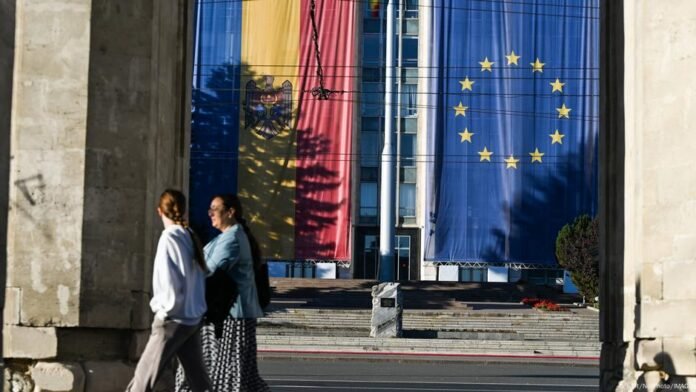

The Moldovan parliamentary elections held on September 28, 2025, have placed the country at a decisive crossroads between Europe and Russia. With almost all votes counted, the pro-European Party of Action and Solidarity (PAS) has emerged as the frontrunner, winning close to half of the national vote and securing a lead that could determine Moldova’s political direction for years to come.
Pro-European Party of Action and Solidarity Leads
Preliminary results show that PAS captured nearly 48% of the vote, translating into about 54 seats in the 101-seat Parliament. This puts the party ahead of its rivals but leaves it just short of an outright majority. Even so, PAS remains the strongest political force and is best positioned to shape the next government.
Trailing in second place is the Patriotic Electoral Bloc, a coalition with a pro-Russian stance, which secured around 26–27% of the vote and approximately 27 seats. A smaller contender, the centrist Alternative bloc, won about 8–9% of the vote, giving it 8 seats. Other minor parties also gained representation, though their influence will depend on coalition talks.
Voter turnout was reported at just over 52%, surpassing the legal threshold required to validate the election. This reflects strong public engagement despite the tense and polarized atmosphere.
A Choice Between Europe and Russia
These elections were more than a domestic contest — they represented a geopolitical test for Moldova. PAS has championed a path toward deeper integration with the European Union, promising reforms and alignment with Western standards. In contrast, the Patriotic Bloc has campaigned on neutrality and closer relations with Russia, appealing to voters skeptical of Moldova’s westward orientation.
Moldova currently holds EU candidate status, and the outcome of these elections will influence how quickly and decisively it moves forward in accession talks. The vote highlights a nation divided between aspirations for European integration and lingering ties to Moscow.
Election Day Marked by Allegations and Crackdowns
The campaign and election day were marked by unprecedented levels of tension, reflecting the high stakes:
- Authorities announced the detention of dozens of individuals suspected of involvement in a Russia-backed plan to incite unrest during the vote.
- Raids were carried out across the country to disrupt what officials described as destabilization plots.
- A key pro-Russian party, Heart of Moldova, was barred from participation by court ruling, with dozens of its candidates removed from ballots.
- Disinformation campaigns, bomb threats, and accusations of vote-buying circulated widely, adding to public unease.
Officials described these tactics as part of hybrid interference designed to undermine trust in Moldova’s institutions.
How the Election Was Organized
The 2025 parliamentary elections were conducted using a nationwide proportional representation system. Key features included:
- 101 total seats in Parliament.
- 51 seats required for a majority.
- 301 polling stations abroad, ensuring participation from Moldova’s large diaspora.
- Mail voting introduced for the first time in a parliamentary election, broadening access for overseas citizens.
The diaspora’s vote is particularly influential, with many Moldovans abroad traditionally supporting PAS. Final tallies from these ballots could play a decisive role in whether PAS secures a slim majority.
Coalition Building Now in Focus
While PAS appears to have secured the largest share of power, the absence of an outright majority means coalition negotiations are likely. Potential scenarios include:
- PAS forming a minority government, relying on support from smaller blocs on an issue-by-issue basis.
- PAS negotiating a coalition with the Alternative bloc or other centrist forces.
- Opposition backlash, as the Patriotic Bloc has already called for demonstrations in the capital city to protest alleged irregularities.
The coming weeks will determine whether PAS can govern firmly or must compromise with other forces in Parliament.
International and Domestic Reactions
Globally, the elections are being closely watched. For the European Union, a PAS-led government signals continued momentum toward eventual membership. For Russia, the results represent a setback to its influence in a country it considers within its sphere.
Domestically, the results have sparked both celebration and anger. Pro-European supporters see the outcome as a mandate for reform, while opposition figures argue the vote was marred by unfair practices. The risk of protests remains high, though so far the atmosphere has been relatively calm compared to earlier fears of violent unrest.
The Road Ahead for Moldova
Beyond geopolitics, Moldova still faces daunting internal challenges:
- Economic pressures, including high inflation and energy costs.
- Corruption concerns, with voters demanding greater accountability from all parties.
- Regional security, as the conflict in neighboring Ukraine continues to create uncertainty.
For PAS, success will depend on its ability not only to steer Moldova toward the EU but also to deliver improvements in daily life for ordinary citizens. For the opposition, the challenge will be to regroup and remain relevant in a political landscape increasingly dominated by the European integration debate.
Why This Matters for U.S. Viewers
For audiences in the United States, these elections underscore the broader struggle playing out across Eastern Europe. Moldova’s future direction will affect the balance between Western democratic values and Russian influence in a region already destabilized by war. The U.S. has long supported Moldova’s democratic development, and the outcome of this vote could shape how Washington engages with Chisinău in the years ahead.
The Moldovan parliamentary elections mark a defining moment in the nation’s history. With PAS leading and coalition talks now underway, Moldova’s path toward Europe seems clearer than ever, though challenges remain. Share your thoughts below on whether you believe Moldova can sustain its European trajectory in the face of mounting pressures.