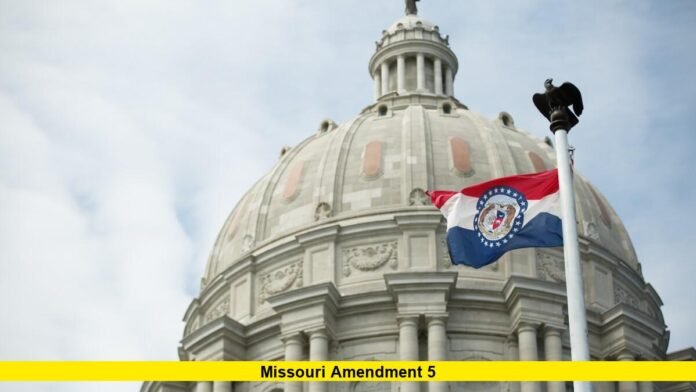

Missouri Amendment 5 went down to defeat on Tuesday, Aug. 4, 2026, as voters statewide rejected the proposal to gradually eliminate Missouri’s individual income tax and hand lawmakers broad new power to raise sales taxes. The Associated Press called the race at 8:12 p.m., closing out one of the most heavily advertised and closely watched ballot fights in this year’s primary election.
The outcome marks a significant setback for Republican Gov. Mike Kehoe, who made the income tax phase-out his top legislative priority for 2026. It also leaves Missouri’s tax structure unchanged for now, even as several other states continue to experiment with shifting away from income-based taxation toward consumption-based systems.
What Missouri Amendment 5 Would Have Done
Amendment 5 asked voters whether the Missouri General Assembly should be required to phase out the state’s individual income tax over time, with reductions triggered by revenue growth rather than a fixed timeline. Instead of eliminating the tax immediately, the measure would have set up a gradual mechanism: as sales and use tax collections rose, the income tax rate would fall in stages, starting at the top bracket, until it eventually reached zero.
To offset the lost revenue, the amendment would have given state lawmakers five years of expanded authority to impose new sales and use taxes or raise existing ones on a wide range of goods and services. Notably, the ballot language did not list which specific goods or services would become newly taxable, leaving that decision entirely to the legislature. Most services in Missouri currently go untaxed, so the scope of any future expansion remained an open question heading into the vote.
The proposal, formally advanced through House Joint Resolution 173, cleared the Missouri legislature in April before Kehoe placed it on the August ballot alongside three other constitutional amendments in late May.
Why the Income Tax Debate Mattered So Much
Income taxes are not a minor line item in Missouri’s budget. They accounted for roughly 61% of the state’s general revenue in the fiscal year that ended in June, making the tax one of the single largest funding sources for schools, health programs and other core state services. Supporters argued that phasing it out gradually, and tying reductions to actual revenue growth, would protect the budget from sudden shortfalls while still delivering long-term relief to taxpayers.
Missouri currently applies a near-flat income tax structure, with residents paying the top rate of 4.7% on every dollar earned above $9,191 a year. The base state sales tax rate sits at 4.225%, though local add-ons push the real number higher in most communities. In Columbia, for example, combined sales taxes typically run close to 8%, depending on the part of the city where a purchase is made.
Kehoe and other backers of Amendment 5 framed the trade-off as a way to make Missouri more competitive for businesses and workers, arguing that eliminating income tax would help the state attract residents who might otherwise settle in states with no income tax at all. Aaron Hedlund, chief economist for domestic policy at the Council of Economic Advisers and a Columbia resident, was among those who publicly supported that argument during the campaign.
Opposition Built Around Fairness and Uncertainty
Resistance to Missouri Amendment 5 came from multiple directions. The most prominent media campaign against the measure came from the Missouri REALTORS, an organization that raised concerns about handing the legislature such broad, largely unchecked authority to expand sales taxes on goods and services without further voter approval.
Scott Charton, spokesperson for the No on Amendment 5 campaign, described the measure bluntly during the run-up to the vote, calling it a shift in the tax burden away from higher earners and onto everyday purchases through an expanded sales tax base. Critics argued that swapping income tax revenue for sales tax revenue would ultimately raise costs for a broader swath of Missourians, since income taxes scale with earnings while sales taxes apply more uniformly regardless of income level.
The Missouri Budget Project, a nonpartisan research and advocacy group, was another vocal opponent. The organization pointed to what it called the regressive nature of states that lean heavily on sales taxes, noting that lower-income residents in those states tend to pay a larger share of their earnings in state and local taxes compared with wealthier residents. The group also warned that Amendment 5 lacked specific guardrails to account for inflation, population growth or economic downturns that could strain state services during a prolonged phase-out period.
Some Republican officials themselves stopped short of embracing the measure. When a local Missouri outlet asked the three Republican candidates running for St. Charles County executive whether they supported Amendment 5, none of them committed to a yes vote, an indication that the proposal’s coalition was not unified even within Kehoe’s own party.
How Missouri Amendment 5 Fit Into a Bigger Ballot
Amendment 5 wasn’t decided in isolation. Missouri voters faced four constitutional amendments on the same Aug. 4 ballot, and the results were mixed:
- Amendment 1, renewing the state’s long-standing one-tenth-of-one-percent sales tax for parks, soil and water conservation, passed. The tax, first approved in 1984 and last renewed in 2016, helps keep admission free at Missouri’s state parks and historic sites and generates roughly $140 million a year.
- Amendment 2, requiring Jackson County and other charter counties to elect their property assessors rather than appoint them, also passed.
- Amendment 4, which would have made it significantly harder for citizens to change the state constitution through the initiative petition process, was rejected alongside Amendment 5. That measure would have required citizen-led amendments to win majority support in each of Missouri’s eight congressional districts, rather than a simple statewide majority.
- Amendment 5, the income tax overhaul, failed as well.
Both Amendment 4 and Amendment 5 carried Kehoe’s imprint and were widely viewed as the first major statewide tests of his political agenda since taking office. Losing both on the same night represents a notable blow to his legislative priorities heading into the second half of his term.
Kehoe’s Response After the Loss
Gov. Kehoe addressed the defeat directly in a statement posted to social media Tuesday night. He acknowledged that Amendment 5 “did not earn the support it needed” but framed the effort as part of a longer-term push rather than a closed chapter. Kehoe said the campaign had made the case that Missouri should “think boldly about its future, challenge the status quo, and pursue policies that make our state more competitive,” and he pledged to keep working with the General Assembly on future tax-cutting proposals aimed at helping Missouri families keep more of what they earn.
The governor’s comments suggest that some version of an income tax reduction effort could resurface in future legislative sessions, even though this specific constitutional path has been closed off by voters for now.
Legal Challenges and Campaign Spending
Amendment 5 also faced scrutiny before voters ever cast a ballot. In June 2026, the Cole County Circuit Court ruled that the measure could remain on the ballot as written, rejecting a legal challenge to its language. Campaign finance reports filed close to the election showed significant spending from out-of-state interest groups on both sides of the fight, underscoring how closely national tax-policy advocates were watching the Missouri vote.
Religious leaders and community advocacy organizations also held rallies across the state in the final days before the election, many of them focused on how a sales-tax-heavy system might affect lower-income and vulnerable residents. Critics frequently pointed to Kansas’ tax overhaul during the 2010s, which led to significant revenue volatility and budget shortfalls, as a cautionary example of what an aggressive income-tax phase-out can do to state finances if consumption tax revenue doesn’t keep pace.
What Happens Next
With Missouri Amendment 5 rejected, the state’s individual income tax structure remains unchanged for the immediate future. There is no new mandate for the legislature to expand sales taxes, and the existing income tax brackets and rates stay in place under current law.
That said, tax policy in Missouri is unlikely to stay static for long. Similar movements toward eliminating state income taxes are underway in Mississippi and Oklahoma, and Kehoe’s own statement after the vote signaled continued interest in pursuing tax cuts through other legislative avenues, even without a constitutional amendment. Lawmakers could still pursue smaller, incremental tax changes during future sessions of the Missouri General Assembly, though any effort to revisit a full income tax phase-out through the constitution would likely require another statewide vote.
For now, Missouri taxpayers can expect their income tax obligations to continue as they have, while the broader national conversation over income tax versus sales tax models continues to play out state by state.
What do you think about Missouri’s decision to keep its income tax in place? Share your thoughts in the comments below.