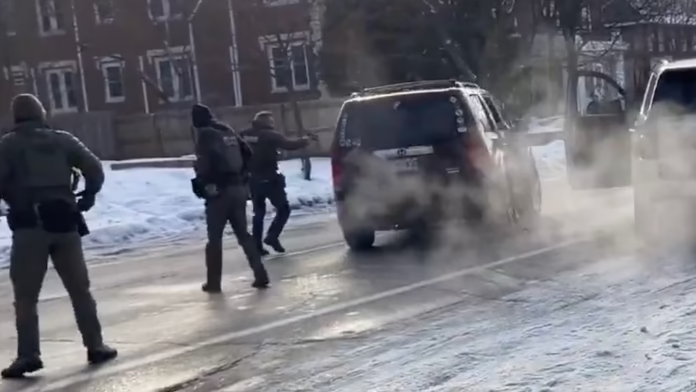

The case now drawing national attention centers on a deadly encounter between federal immigration agents and a Minneapolis resident, an incident that has ignited protests, political debate, and urgent questions about the use of force. According to confirmed medical and law-enforcement records, Renee Nicole Good was struck by gunfire during an enforcement operation, suffering wounds to the chest, forearm, and possibly the head, injuries that ultimately proved fatal. The shooting has become a flashpoint in the broader discussion over federal authority, community safety, and accountability.
What Happened
The confrontation unfolded during a federal immigration action in a residential area of Minneapolis. Agents were attempting to carry out an arrest when a rapid sequence of events led to the discharge of a firearm. Emergency calls reported multiple shots and a person down. Within minutes, paramedics arrived and began life-saving efforts.
Medical assessments later confirmed that Good had been hit in the upper torso and arm, with trauma consistent with a head wound also documented. The severity of the injuries prompted an immediate transport to a nearby trauma center. Despite intensive treatment, she was pronounced dead.
Officials described the situation as fast-moving and chaotic. The exact timeline, the perceived threat level, and the actions taken in the seconds before the shots were fired are now under detailed review.
The Victim and Her Community
Renee Nicole Good was a 37-year-old Minneapolis resident, a mother, and a familiar presence in her neighborhood. Friends and relatives describe her as deeply involved in her community and devoted to her family. News of her death spread quickly, triggering grief and anger across the city.
Within hours, neighbors gathered near the scene, leaving flowers and candles. By nightfall, hundreds had assembled for a vigil, calling for transparency and justice. Community leaders emphasized that beyond the legal process, the human loss must remain central to the conversation.
Immediate Federal Response
The agent involved in the shooting was placed on administrative leave, a standard procedure in officer-involved shootings. Federal authorities announced parallel internal and criminal investigations to determine whether the use of deadly force complied with policy and law.
Officials stated that body-worn cameras and surveillance footage are being reviewed, along with witness statements and forensic evidence. Ballistics testing, trajectory analysis, and medical reports are expected to play a crucial role in reconstructing the encounter.
City and State Reaction
Minneapolis leaders called for calm while insisting on a thorough, independent review. The mayor and police chief both acknowledged the community’s pain and said transparency would be essential in restoring trust.
State officials echoed those sentiments, noting that while federal agencies operate independently, any incident resulting in death within Minnesota’s borders warrants full scrutiny under state investigative standards.
Protests and Public Demonstrations
As details emerged, protests spread across Minneapolis and later to other cities. Demonstrators demanded the release of video evidence and accountability for the shooting. Marches remained largely peaceful, though tensions rose near federal buildings, prompting increased security.
Organizers framed the incident as part of a broader pattern of concern over aggressive enforcement tactics and their impact on immigrant communities and residents of color. Chants, signs, and speeches focused on civil rights, due process, and the sanctity of life.
National Political Impact
The shooting quickly entered the national political arena. Lawmakers from both parties issued statements, some defending federal agents’ right to protect themselves, others calling for independent oversight and potential legislative reforms.
The event has intensified debate over immigration enforcement priorities, the role of federal agents in local communities, and the boundaries between local and federal authority. Discussions in Congress now include proposals for clearer rules on the use of force, expanded body-camera requirements, and strengthened civilian review mechanisms.
Legal and Investigative Path Ahead
Several parallel processes are now underway:
Criminal Review
Prosecutors will examine whether the shooting violated any state or federal laws. This includes evaluating whether the agent reasonably perceived an imminent threat and whether deadly force was justified.
Civil Rights Inquiry
Attorneys for the family are preparing potential civil action, focusing on constitutional protections and the circumstances surrounding the use of lethal force.
Administrative Proceedings
The agency involved will conduct its own internal review, which could result in disciplinary action, retraining, or policy changes, depending on the findings.
Broader Context of Enforcement Operations
The incident comes at a time of heightened immigration enforcement activity across several U.S. cities. Operations have expanded in scope, often bringing federal agents into densely populated neighborhoods. Supporters argue these actions are necessary to uphold the law. Critics contend they create fear, disrupt communities, and increase the risk of violent encounters.
In Minneapolis, long-standing tensions between residents and outside law-enforcement agencies have made the situation particularly sensitive. Local officials have previously expressed concerns about coordination, communication, and community trust.
Community Healing and Demands for Change
In the days following the shooting, faith leaders, activists, and neighborhood organizations organized forums and town halls. The focus has been on grief counseling, legal education, and calls for reform.
Key demands include:
- Public release of all available video and audio recordings
- An independent investigative body with subpoena power
- Clearer federal guidelines on use of force during civil enforcement actions
- Expanded mental health and de-escalation training for agents
Many speakers stressed that accountability is not about vengeance but about ensuring such a tragedy does not happen again.
Why This Case Matters
The death of Renee Nicole Good is not being viewed in isolation. It has become a symbol of broader concerns about how law enforcement, particularly federal agencies, operate within civilian neighborhoods. It raises fundamental questions about proportionality, transparency, and the balance between security and civil liberties.
For Minneapolis, the incident has reopened conversations about trust in institutions and the importance of community-centered policing. For the nation, it underscores the ongoing struggle to define the limits of force in a democratic society governed by the rule of law.
Continuing Developments
Investigators are expected to release preliminary findings in the coming weeks, followed by more detailed reports. Court filings, possible grand jury proceedings, and civil lawsuits could shape the legal landscape for months, if not years.
As the process unfolds, the case will likely remain a focal point in discussions about immigration policy, law-enforcement accountability, and the protection of human life.