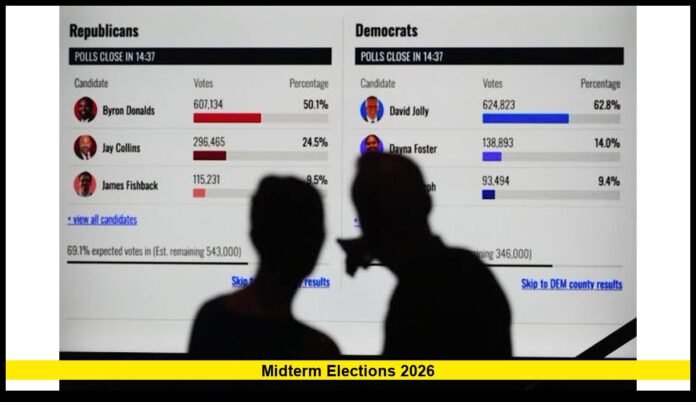

The midterm elections 2026 are taking place on November 3, with voters across the United States deciding the future balance of power in Congress and choosing governors, state legislators, and local officials. The election is a major political test for President Donald Trump and both major political parties as Republicans defend their congressional majorities and Democrats seek to regain control of one or both chambers.
Unlike presidential elections, midterm elections do not determine who occupies the White House. Instead, they determine which lawmakers will shape federal legislation, approve government spending, oversee executive branch activities, and influence policy debates during the second half of the president’s term.
This year’s contests include all 435 voting seats in the U.S. House of Representatives, 35 Senate elections, gubernatorial races in 36 states, and numerous state and local contests. Economic affordability, healthcare, immigration, taxes, government spending, and political accountability are among the issues attracting national attention.
With early voting already completed in many jurisdictions and Election Day voting underway, the national focus is on turnout, competitive districts, and the eventual congressional balance. Final results will depend on the ballots cast and the completion of each state’s election procedures.
What Are the Midterm Elections 2026?
The midterm elections occur halfway through a four-year presidential term. They give voters an opportunity to elect members of Congress and choose state and local officials without voting for president.
The 2026 election is particularly significant because Republicans entered Election Day controlling both the House and Senate. Democrats are attempting to win enough seats to change that balance, while Republicans are seeking to retain their legislative advantage.
Control of Congress affects more than which party holds leadership positions. The majority party has substantial influence over committee assignments, legislative priorities, federal budget negotiations, investigations, and the scheduling of votes.
A change in congressional control could also alter the relationship between the legislative and executive branches. A Congress controlled by the president’s political opponents may place greater emphasis on oversight and challenge parts of the administration’s legislative agenda.
However, the election does not automatically determine whether a particular proposal becomes law. Legislation must still pass the required procedures in Congress and satisfy any applicable constitutional requirements.
Election Day 2026: Important Dates and Developments
Election Day is Tuesday, November 3, 2026. Voters are participating through in-person voting and other voting methods available under their state and local rules.
Early voting has been a significant part of this election cycle. More than 57 million people had already cast ballots by November 2, according to reporting published before Election Day. That figure demonstrates the importance of advance voting, although early-voting totals alone do not determine the final outcome.
Several important milestones define the election process:
- November 3, 2026: Election Day for congressional, gubernatorial, and other contests.
- Election Night and the following days: Election officials continue counting eligible ballots and reporting unofficial results.
- Following weeks: States complete their required canvassing, reconciliation, recounts where applicable, and certification procedures.
- January 3, 2027: The next Congress is scheduled to begin its term.
Voting hours, ballot-processing rules, and certification deadlines vary by state. Some contests may be resolved relatively quickly, while others may remain undecided until additional ballots are counted.
As of Election Day, the final nationwide outcome has not been established. Early leads and candidate projections should not be confused with certified results.
U.S. House Elections 2026: The Fight for a Majority
All 435 voting seats in the U.S. House of Representatives are on the ballot. House members serve two-year terms, meaning every district has a congressional election during the 2026 midterms.
Republicans entered the election with a narrow majority. That limited margin makes competitive districts especially important because a relatively small number of seat changes can determine which party controls the chamber.
Democrats need a net gain of four seats based on the pre-election House alignment to secure a majority under the current configuration. Republicans, meanwhile, must defend vulnerable districts and prevent enough losses to preserve control.
House elections are decided individually across congressional districts rather than through a single national vote. As a result, national polling cannot by itself establish which party will win the chamber.
Several competitive districts are receiving attention because of their recent voting patterns, local economic conditions, open seats, and the strength of individual candidates. Races in Pennsylvania, New Jersey, New York, and other closely divided areas are part of the broader battle for control.
The result will influence the selection of the House speaker, committee leadership, legislative scheduling, federal spending negotiations, and investigations involving the administration.
If Democrats gain control, they would have greater power to block Republican legislative proposals and conduct congressional oversight. Republicans retaining the chamber would be better positioned to continue advancing their priorities.
U.S. Senate Elections 2026: States That Could Determine Control
The Senate is another central focus of the 2026 midterm elections. Thirty-five seats are being contested, including regular elections and special elections to fill vacancies.
Senators serve six-year terms, so only a portion of the chamber is elected during each midterm cycle. Each state has two senators, making statewide campaigns important even in states with relatively small populations.
Republicans entered Election Day with a 53-47 Senate majority. Democrats need a net gain of four seats to secure a majority under the current party alignment.
That goal requires Democrats to win several competitive contests while defending seats they already hold. Republicans are attempting to retain their advantage in states where the results may be close.
States attracting particular attention include Alaska, Georgia, Iowa, Kansas, Maine, Michigan, Nebraska, North Carolina, Ohio, South Carolina, and Texas. The competitiveness of individual races varies, and no contest should be treated as decided before the available evidence supports that conclusion.
Florida and Ohio are also holding special Senate elections following the departures of Marco Rubio and JD Vance, who left their Senate seats to take positions in the executive branch.
Senate control matters because the chamber votes on federal legislation, considers presidential nominations, and exercises responsibilities involving treaties and impeachment trials. A change in the majority could significantly influence judicial confirmations and the administration’s ability to fill federal positions.
Even a narrow shift in Senate membership can have consequences when parties are closely divided.
Governor Elections 2026 and State-Level Contests
The midterm elections extend well beyond the federal government. Voters in 36 states are choosing governors, while numerous state legislative and local races are also taking place.
Governors have significant responsibilities involving state budgets, executive agencies, emergency management, economic development, and the implementation of state laws. Their decisions can affect public education, transportation, healthcare programs, public safety, and other services.
State legislative elections are equally important. State lawmakers may influence taxes, housing regulations, environmental policy, school funding, abortion laws, and election administration, depending on their authority under state law.
Local ballots can include county commissioners, mayors, school board members, judges, and ballot initiatives. These contests sometimes receive less national coverage than congressional elections, but their results can have an immediate impact on residents.
Because ballot choices differ by jurisdiction, voters should review their own sample ballot and confirm which candidates and measures appear in their area.
The outcomes of gubernatorial and state legislative races may also shape how federal policies are implemented locally and how states respond to national political developments.
Major Issues Influencing the 2026 Midterm Elections
The Economy and Household Affordability
The cost of living is one of the most prominent concerns in the 2026 election. Voters are evaluating the prices of groceries, housing, gasoline, utilities, and healthcare, along with wages and employment opportunities.
Economic concerns can influence how people judge the party controlling the White House and the lawmakers responsible for economic legislation.
Candidates are offering different approaches to taxes, government spending, business regulation, energy policy, and economic growth. Voters may compare those proposals according to their potential impact on household finances.
However, economic conditions differ across regions, and individual voters may prioritize different concerns. The election outcome will reflect a range of national and local issues rather than one factor alone.
Healthcare and Insurance Costs
Healthcare remains an important issue because federal and state decisions can affect insurance premiums, prescription drug expenses, Medicare, Medicaid, and access to medical services.
Candidates may disagree over the role of government in healthcare, insurance regulation, public benefits, and efforts to reduce medical costs.
Congress can influence federal healthcare legislation and funding, while state governments administer programs and regulate certain aspects of healthcare delivery. The results may therefore affect policy at multiple levels.
Immigration and Border Security
Immigration policy continues to shape national political debate. Campaigns are addressing border security, asylum procedures, deportation policy, legal immigration, and the economic effects of immigration enforcement.
Congress has authority to enact federal immigration legislation and approve related funding. The executive branch implements federal policy within the limits of applicable law, while states have responsibilities in certain areas that intersect with immigration enforcement.
The election could influence congressional oversight and future legislative negotiations, but specific changes will depend on the decisions made after the results are known.
Taxes, Federal Spending, and Government Accountability
Federal spending and tax policy are also important considerations. The next Congress will face decisions involving government funding, national priorities, public programs, defense spending, and the federal debt.
The majority party will have considerable influence over which proposals receive attention and how congressional committees conduct oversight.
Voters may also consider the effectiveness of federal agencies, transparency in government, and the balance of power between Congress and the president.
The final policy direction will depend on election outcomes, negotiations among lawmakers, and the legal requirements governing each proposal.
How to Vote in the 2026 Midterm Elections
Voting procedures depend on state and local election laws. Eligible voters may be able to vote in person on Election Day, participate in early voting, or use absentee or mail ballots where permitted.
Before voting, residents should verify their polling location, operating hours, registration status, and identification requirements with their local election authority.
Voters returning mail ballots should follow their state’s rules regarding deadlines, ballot envelopes, drop boxes, and delivery methods. These requirements are not identical nationwide, so instructions for one state may not apply in another.
People who encounter long lines should follow directions from election officials. In many jurisdictions, eligible voters who are in line before polls officially close are permitted to vote, subject to local procedures.
Anyone experiencing a problem at a polling place should contact election officials for assistance. Accurate information from the relevant jurisdiction is particularly important when deadlines and voting requirements differ.
When Will the Midterm Election Results Be Final?
There is no single time when every result across the United States becomes final. Election officials count eligible ballots, reconcile voting records, conduct canvasses, and certify results according to state law.
Some races may be projected on Election Night if the available vote count establishes that the remaining ballots cannot change the outcome. Other contests may remain too close to call.
Mail ballots and provisional ballots can affect the timing of results, depending on state rules and how many ballots remain to be processed. Recounts may also be required or requested under specific legal conditions.
A media organization’s projection is not the same as official certification. Projections are based on available information and assessments of whether trailing candidates still have a realistic path to victory.
Voters should therefore distinguish between a candidate leading in unofficial returns, a race being projected by news organizations, and an election result being formally certified.
The newly elected members of Congress are scheduled to take office on January 3, 2027. By that time, the election process is expected to have progressed through the required legal procedures, although particular disputes can sometimes extend beyond ordinary timelines.
How the 2026 Midterms Could Affect President Trump
The election results could influence President Trump’s ability to advance his legislative agenda during the remainder of his term.
If Republicans retain both chambers, they would preserve their existing congressional advantage, although internal party disagreements could still affect legislation.
If Democrats gain control of the House, they would have greater authority over committee investigations, oversight hearings, and the consideration of legislation. They could also use their position to challenge parts of the administration’s agenda.
A change in Senate control would affect the consideration of presidential nominees and the prospects for legislation that requires Senate approval.
Even if Democrats win both chambers, President Trump would remain in office. The president’s veto authority and other constitutional powers would continue to apply, and overriding a veto requires a two-thirds vote in each chamber.
Consequently, the midterms can change the political environment without automatically determining every policy outcome.
Final Thoughts on the Midterm Elections 2026
The midterm elections 2026 are a major test of political leadership in the United States, with congressional contests, gubernatorial races, and local elections shaping the direction of government.
Control of the House and Senate is central to the national outcome, but state and local results will also influence policies affecting education, healthcare, public safety, taxation, and community services.
Election Day reporting should be interpreted carefully because early returns, projections, and certified results represent different stages of the election process. The final balance of power will become clearer as officials count ballots and complete the procedures required by law.
For voters and readers, following individual races and confirmed developments provides a clearer picture of the election’s consequences than relying on national headlines alone.
Share your views on the 2026 midterm elections in the comments and stay updated as verified election results and important developments emerge.