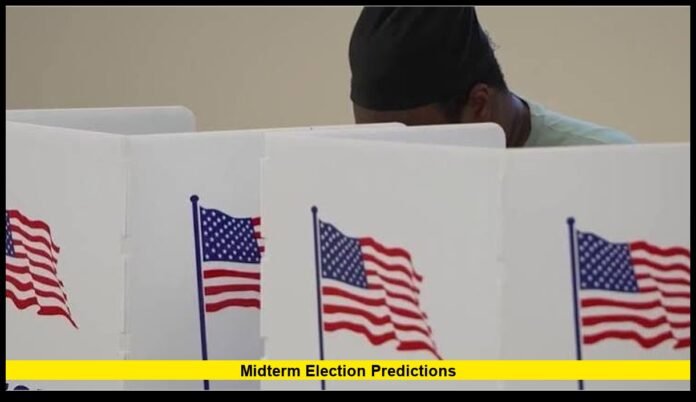

midterm election predictions are drawing growing attention as the 2026 congressional campaign enters its final weeks, with national polling, state surveys and updated race ratings showing a competitive fight for control of Congress. The major party primaries are now complete, early voting has begun in some states, and campaigns are moving into the final stretch before Election Day on November 3.
The latest data does not establish a guaranteed result. Instead, it identifies the House and Senate contests receiving the most attention and shows how voter preferences have changed during September.
The Current Congressional Balance
Republicans currently control both chambers of Congress. The House has a narrow Republican majority, while Republicans hold a 53-47 advantage in the Senate.
That starting point is important when examining the 2026 races. Democrats need a net gain of only a few House seats to change control of the chamber. The Senate requires a larger shift because Republicans currently hold 53 seats.
All 435 House seats are on the ballot this year. Thirty-five Senate seats are also being contested, including special elections in Florida and Ohio.
The final result will depend on individual contests rather than the national vote alone. House elections are decided district by district, while Senate elections are decided statewide.
Latest National Polling
Recent national polling has shown Democrats holding an advantage in the generic congressional ballot.
The Silver Bulletin polling average showed Democrats with a 7.5-point lead among all respondents in its September 16 update. Its likely-voter adjustment placed the Democratic advantage at 8.2 points.
The generic ballot asks voters which party they would prefer to control Congress. It does not ask voters to choose a specific candidate.
That distinction matters because a national party preference does not translate directly into a specific number of House seats. District boundaries, turnout and local candidates can produce different results.
Recent polling therefore provides an important measure of the national environment, but it does not determine which individual candidates will win.
House Control Remains a Major Focus
The House is receiving particular attention because the current majority is so narrow.
The Republican conference holds 219 seats compared with 214 for Democrats, according to the latest congressional breakdown reported in September. Several vacancies and changes in membership can affect the exact day-to-day balance.
With all 435 seats contested, only a relatively small number of competitive races could determine control of the chamber.
CBS News has identified dozens of battleground districts across states including California, Arizona, Iowa, Michigan, New Jersey, New York, Pennsylvania, Texas, Virginia and Wisconsin.
The competitive map includes both Democratic-held and Republican-held districts. That means the final House balance will depend on which party successfully protects vulnerable incumbents while gaining seats elsewhere.
House Race Ratings Continue to Shift
Race-rating organizations have continued updating their assessments as new polling becomes available.
The Cook Political Report’s September House ratings included 21 races in its Toss Up category. Its ratings also placed additional contests in Lean, Likely and Solid categories for both parties.
These classifications measure competitiveness. They are not election results.
A Toss Up designation means the race currently has no clear advantage large enough for the organization to place it in another category. Ratings can change when new polls, campaign developments or other relevant information emerge.
Roll Call also reported in September that several House and Senate contests had moved toward Democrats in its latest rating changes. The report highlighted Republican candidates underperforming in some traditionally Republican areas.
Those assessments show that the competitive map remains fluid even after the primary season has ended.
Early Voting Has Started
The campaign has now entered a new phase as voters begin casting ballots.
Virginia began in-person early voting on September 18. Other states have also opened absentee or early-voting opportunities, while additional states will begin their voting periods in the coming weeks.
The start of voting reduces the amount of time campaigns have to change voter preferences.
It also means election analysts will increasingly examine turnout data alongside traditional polling. Early voting numbers can provide information about participation levels, although they do not by themselves establish which party or candidate will win.
Senate Control Requires Multiple Competitive Races
The Senate map presents a different challenge from the House.
Republicans hold 53 seats, while Democrats and two independents who caucus with Democrats hold 47. Democrats therefore need a net gain of four seats to reach a majority.
Twenty-two Republican-held seats and 13 Democratic-held seats are among the 35 Senate contests this cycle.
That structure places several Republican-held seats under particular scrutiny while also requiring Democrats to protect their own competitive seats.
The most closely watched contests include races in Maine, North Carolina, Michigan, Georgia, Iowa, Ohio, Texas, Alaska and New Hampshire.
Each state has a different political history and candidate field, making the Senate contest a collection of individual statewide races rather than one national contest.
North Carolina Draws Major Attention
North Carolina has become one of the most closely watched Senate races.
Republican Michael Whatley is facing Democrat Roy Cooper for the open seat. The contest became especially important after Republican Sen. Thom Tillis decided not to seek another term.
Recent surveys have shown Cooper leading in several polls.
A September Carolina Journal poll of likely voters reported Cooper at 49.2% and Whatley at 34.1%. Another September survey from InsiderAdvantage showed Cooper at 48% and Whatley at 43%.
Individual polls can differ significantly because of methodology, sample composition and timing. The broader polling picture is therefore more useful when several surveys point in a similar direction.
North Carolina remains one of the states analysts are watching closely as the Senate campaign enters its final phase.
Michigan Is Another Key Senate Contest
Michigan’s open Senate race is also receiving significant national attention.
Democrat Abdul El-Sayed and Republican Mike Rogers are competing for the seat being vacated by Democratic Sen. Gary Peters.
Recent polling has produced a competitive picture.
An InsiderAdvantage poll conducted September 18 showed El-Sayed at 47% and Rogers at 45% among likely voters. A Washington Post/SSRS survey from September 14 placed El-Sayed at 48% and Rogers at 45%.
The small differences in these surveys illustrate why the Michigan race remains closely watched.
The final campaign period will include additional advertising, voter outreach and efforts to mobilize supporters before voting concludes.
Texas Has Become a Closely Watched Race
Texas is another major Senate contest.
Republican Ken Paxton and Democrat James Talarico are competing for the seat. Recent surveys have shown a close contest.
An Emerson poll conducted in September showed Talarico at 47% and Paxton at 46%. A September Trafalgar Group survey showed Talarico at 46% and Paxton at 45%.
Other surveys have produced wider margins.
The variation demonstrates why individual polls should not be treated as definitive evidence of an eventual result. Polling averages and trends provide a broader picture, while individual surveys capture voter preferences at specific points in time.
Texas remains an important race because of its size and the national attention surrounding the contest.
Georgia Remains on the Senate Map
Georgia is also being closely monitored.
Democratic Sen. Jon Ossoff is seeking reelection in a state that has become highly competitive in recent federal elections.
September polling has shown Ossoff holding an advantage over Republican Mike Collins in several surveys.
A Rasmussen Reports poll released September 14 showed Ossoff at 51% and Collins at 42%. A September Trafalgar Group poll also placed Ossoff ahead.
Georgia’s recent electoral history has made the state particularly important in Senate discussions. The state has moved between closely contested presidential and Senate elections, making turnout and voter participation especially significant.
Maine Is Another Important Senate Contest
Maine Republican Sen. Susan Collins is facing a competitive reelection campaign against Democrat Troy Jackson.
The contest has attracted national attention because Collins is one of the Republican incumbents defending a seat in a state that has regularly produced competitive statewide elections.
A September 15 Quantus Insights survey showed Jackson at 47% and Collins at 48%. A September SSRS poll had Jackson at 48% and Collins at 45%.
The different results demonstrate the narrow margins found in some recent Senate polling.
Maine is therefore among the states receiving close attention as campaigns move toward November.
New Hampshire Has Become More Competitive
New Hampshire has also moved into the center of Senate coverage.
Democrat Chris Pappas and Republican John Sununu are competing for the open seat.
The Cook Political Report moved the contest into its Toss Up category on September 15.
A September 18 InsiderAdvantage poll showed Pappas at 48% and Sununu at 40% among likely voters.
The rating change and recent polling illustrate how race assessments can shift during the final weeks.
New Hampshire is also significant because it represents one of the Democratic-held Senate seats that Republicans could target while Democrats attempt to gain Republican-held seats elsewhere.
Iowa and Ohio Add to the Senate Competition
Iowa and Ohio are also part of the national Senate discussion.
Iowa’s race is open following Republican Sen. Joni Ernst’s decision not to seek another term. Republican Ashley Hinson and Democrat Josh Turek are competing for the seat.
A September Emerson poll showed Hinson at 50% and Turek at 45%.
Ohio features Republican Sen. Jon Husted and Democratic former Sen. Sherrod Brown. The contest is another important Republican-held seat on the national map.
The Senate outcome will depend on how these individual races develop alongside contests in North Carolina, Maine, Georgia, Michigan, Texas and Alaska.
Alaska Has a Different Election Structure
Alaska presents a distinctive situation because of its voting system.
The state uses an open primary and ranked-choice voting for its general election. The Senate race has attracted additional attention because of multiple candidates and the state’s separate debate over its election system.
Republican Sen. Dan Sullivan is seeking another term, while Democrat Mary Peltola is among the candidates competing for the seat.
Alaska’s system means national race comparisons can be difficult. The final result depends not only on first-choice support but also on how votes are redistributed under ranked-choice rules.
Why Polls and Ratings Can Change
The current campaign data should be treated as a snapshot.
Several developments can alter a competitive race during the final weeks.
These include:
- New state-level polling
- Candidate debates
- Major campaign advertising
- Changes in voter turnout enthusiasm
- Independent voter movement
- Economic developments
- National political events
- Candidate statements and campaign controversies
- Changes in early-voting participation
A race can also move because pollsters change their likely-voter models as Election Day approaches.
That is why major race-rating organizations update their classifications rather than leaving their assessments unchanged throughout the campaign.
What Voters Should Watch Before Election Day
The most important indicators during the final stretch will be new polling and changes in competitive race ratings.
House watchers will be looking closely at districts where the margin between the parties is small. Senate watchers will focus on the handful of states that could determine whether the current 53-47 balance changes.
National polling will remain useful for measuring the broader political environment.
State polling will provide more direct information about individual Senate races.
District-level polling and campaign developments will be especially important for the House.
Early voting data will also receive increased attention as more Americans cast ballots before November 3.
The Final Picture Is Still Developing
The latest data provides a detailed view of a competitive congressional campaign, but it does not establish the final outcome.
Democrats currently hold a notable advantage in several national generic-ballot measures. At the same time, Republicans continue to hold the congressional majorities they won in the previous election.
The House remains highly sensitive to a relatively small number of competitive districts. The Senate presents an even more complicated map because Democrats need a net gain of four seats while defending several closely watched contests.
Current race ratings and polling identify states such as North Carolina, Michigan, Maine, Georgia, Texas, Ohio, Iowa, Alaska and New Hampshire as important parts of the Senate landscape.
The final weeks will bring more polling, more early voting and more campaign activity. Those developments will provide additional information before Americans cast the votes that determine the next Congress.
Stay informed as new polling, race ratings and verified 2026 election developments continue to shape the congressional campaign, and share your thoughts in the comments.