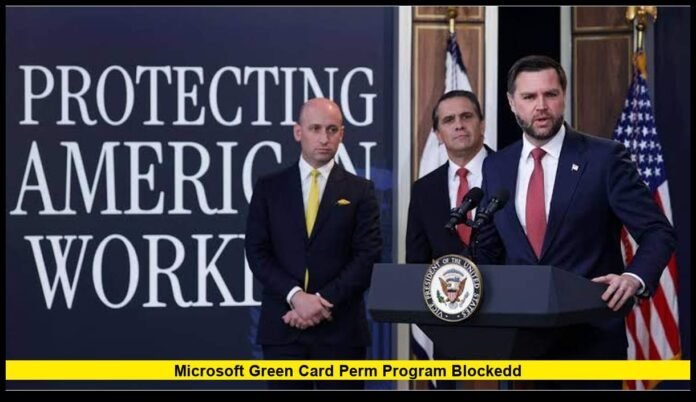

The microsoft green card perm program blocked development has emerged as one of the biggest U.S. employment-immigration stories of the latest update, after the Trump administration suspended Microsoft and several other major technology companies from the federal Permanent Labor Certification Program, commonly known as PERM. The action means the affected companies cannot submit or have pending PERM applications processed while the government investigates alleged abuse of foreign-worker programs.
The decision is significant because PERM is an important gateway to employment-based permanent residency for many highly skilled foreign workers. Microsoft employs thousands of professionals who use H-1B status and other employment-based immigration pathways, making the suspension potentially consequential for workers who were preparing for or already moving through the green card process.
However, the development does not mean that all Microsoft employees with H-1B visas have lost their immigration status, nor does it represent a nationwide suspension of the PERM system.
Why Microsoft Has Been Suspended From PERM
Vice President JD Vance and Labor Secretary Keith Sonderling announced the suspension as part of a broader federal crackdown on alleged fraud and misuse involving employment-based immigration programs.
The administration has accused several large technology companies and IT outsourcing firms of using foreign-worker programs in ways that can disadvantage American workers.
Microsoft has received particular attention because of its size, its use of the H-1B program and its role as one of the largest employers participating in employment-based immigration.
Vance criticized Microsoft’s immigration practices in connection with workforce reductions at the company. The administration argues that employers should not reduce American employment while simultaneously using foreign-worker programs to fill positions that could potentially be occupied by U.S. workers.
The government has characterized the latest move as an enforcement action rather than a general change eliminating the PERM system.
Which Companies Are Affected?
Microsoft is part of a group of major technology and IT companies that have been suspended from the PERM program.
The companies identified by federal officials include:
- Microsoft
- Adobe
- Cognizant
- Infosys
- Tata Consultancy Services
- Wipro
- HCL
- Capgemini
The government said it would not accept new permanent labor certification applications involving the affected companies and would not process pending applications covered by the suspension.
That means the impact can extend beyond workers who were planning to begin the green card process. Employees whose PERM applications were already pending may also face uncertainty.
The exact effect on an individual employee depends heavily on where that person’s immigration case is in the employment-based green card process.
What Is PERM and Why Is It Important?
PERM is short for Program Electronic Review Management, the Department of Labor’s system for processing permanent labor certification applications.
For many employer-sponsored employment-based green cards, PERM is an important preliminary stage.
The basic purpose of the process is to determine whether an employer can permanently hire a foreign worker for a particular position without adversely affecting qualified U.S. workers.
Before filing a PERM application, an employer generally has to complete required recruitment and labor-market testing procedures. The employer must establish the requirements for the position, obtain a prevailing wage determination and conduct recruitment under applicable rules.
If the employer successfully completes the process and the labor certification is approved, the case can generally move toward the next stages of employment-based immigration.
PERM itself is not a green card.
It is a labor-certification step that can lead to an employer’s immigrant petition and, eventually, permanent residency if all other immigration requirements are satisfied and a visa number is available.
What the Microsoft Suspension Means for Green Card Applicants
The biggest immediate consequence for affected Microsoft employees is the potential interruption of their employment-based green card timeline.
A worker who was waiting for Microsoft to begin PERM sponsorship may not be able to move forward as originally planned.
Someone whose PERM application was already submitted may also encounter a pause because the Labor Department has said it will not process pending applications involving the suspended companies.
This creates uncertainty for workers who have already spent months or years preparing for permanent residency.
The timing can be especially important for H-1B employees approaching the end of their normal authorized period of stay. Employment-based immigration rules provide certain protections in qualifying circumstances, but those protections depend on the specific stage of a worker’s case.
Consequently, an employee should not assume that a delayed PERM automatically results in a loss of H-1B status, nor should an employee assume that an existing green card filing remains unaffected.
Does the Decision Cancel Microsoft Employees’ H-1B Visas?
No.
The PERM suspension and H-1B status are separate parts of the U.S. immigration system.
An H-1B visa allows an eligible foreign professional to work temporarily for a qualifying employer. PERM, by contrast, is associated with the permanent labor certification process used by employers seeking permanent residency for foreign workers.
The latest government action is directed at the permanent labor certification process.
Therefore, a Microsoft employee who currently has valid H-1B status does not automatically lose that status simply because Microsoft’s PERM participation has been suspended.
The more immediate concern is the employee’s future green card pathway.
An H-1B worker may remain legally employed under valid H-1B authorization while the PERM situation develops, provided all applicable immigration and employment requirements continue to be met.
What Happens to Pending PERM Applications?
This is one of the most important unanswered questions for affected workers.
Labor Secretary Keith Sonderling said the Department of Labor would not accept new or process pending permanent labor certification applications involving the companies covered by the suspension.
That language creates a significant impact for employees whose PERM applications had already entered the government system but had not yet received a final determination.
The suspension could therefore affect both future and existing cases.
However, workers should not assume that every employee at an affected company is in exactly the same immigration position.
For example, an employee with an approved PERM is at a different stage from someone whose employer has not yet started the labor-certification process. Similarly, a worker who has already progressed to the I-140 stage may have a different set of options from someone still waiting for PERM recruitment to begin.
The specific status of each case matters.
Why the Timing Is Especially Important
PERM processing was already taking substantial time before the latest suspension.
The Department of Labor’s latest published processing information showed an average PERM determination time of roughly 336 calendar days for cases in analyst review during August 2026.
That means a normal PERM case could already take close to a year before a determination.
A government suspension involving major employers therefore introduces another layer of uncertainty for foreign workers who are already navigating lengthy employment-based immigration timelines.
For some workers, even a temporary interruption could affect strategic immigration planning.
This is particularly important for professionals from countries with large employment-based green card backlogs, where the overall process can take considerably longer after PERM approval.
Microsoft’s Position on H-1B Workers
The administration’s allegations have been met with a different characterization from Microsoft.
The company has emphasized that most of its U.S. employees are American workers and that much of its H-1B activity involves employees who are already working in the United States.
Microsoft has said that roughly 80% of the approximately 6,000 H-1B applications it filed during the most recent fiscal year involved extensions or changes of status for existing employees.
The company has also indicated that new H-1B applications represented a relatively small share of its U.S. workforce and involved people who were already legally present in the country.
These figures are relevant because the government and Microsoft are presenting different interpretations of the company’s use of employment-based immigration programs.
The administration argues that immigration programs have been abused in ways that harm American workers. Microsoft has maintained that its immigration filings primarily support a highly skilled workforce and comply with applicable requirements.
The suspension is connected to the government’s allegations and investigations; the announcement itself should not be treated as a final judicial finding that Microsoft committed immigration fraud.
Why Indian Technology Workers Are Watching Closely
The decision has particular significance for Indian professionals working in the United States.
Indian nationals account for a substantial share of H-1B workers, particularly in technology and IT services. Several companies included in the latest PERM suspension are also major Indian IT firms.
The companies affected include Infosys, Tata Consultancy Services, Wipro and HCL, along with Cognizant and Capgemini.
Many foreign technology professionals use H-1B status as part of a longer-term plan to obtain permanent residency.
A delay at the PERM stage can therefore have consequences beyond a single application. It can affect the timing of an employee’s overall immigration strategy, particularly when combined with existing employment-based visa backlogs.
Workers who are already close to important immigration deadlines should pay close attention to official developments rather than relying on social media posts or generalized interpretations of the suspension.
Is the Entire U.S. PERM System Blocked?
No.
The latest action does not amount to a nationwide shutdown of PERM.
The federal PERM system remains in operation for employers that have not been included in the government’s suspension.
The Labor Department continues to administer permanent labor certification for eligible employers, and its normal processing system remains relevant to companies outside the targeted group.
This distinction is critical for workers and employers.
The government has targeted specific companies as part of its current enforcement campaign. It has not announced that every U.S. employer is prohibited from sponsoring foreign workers through PERM.
How the Microsoft Green Card PERM Program Blocked Decision Could Affect Future Sponsorship
The microsoft green card perm program blocked situation could make immigration planning more complicated for foreign employees who expected Microsoft to begin sponsorship in the near future.
Employees who have not yet entered the PERM process may now have to wait for additional government action.
Companies affected by the suspension may also need to reassess their immigration strategies while the investigations continue.
For workers, the uncertainty is particularly difficult because PERM sponsorship is generally controlled by the employer. An employee cannot simply file a PERM application independently and continue the process without employer participation.
That means workers may have limited ability to bypass a company-level suspension.
What Affected Workers Should Do
Microsoft employees and workers at other affected companies should first determine exactly where their immigration case stands.
They should identify whether they are:
- Waiting for employer sponsorship to begin
- Waiting for a prevailing wage determination
- In the recruitment stage
- Waiting for PERM filing
- Waiting for a PERM decision
- Holding an approved PERM
- Waiting for an I-140 petition
- Waiting for an employment-based green card filing opportunity
Workers should also retain copies of immigration documents, approval notices, filing receipts and employment records.
Anyone approaching an H-1B expiration date should discuss the situation with qualified immigration counsel as soon as possible.
An attorney can determine whether the worker qualifies for extensions or other immigration options based on the individual’s circumstances.
What Happens Next?
The situation is likely to remain closely watched because the suspension is part of a broader federal immigration enforcement effort.
Several questions remain unresolved, including how long the company suspensions will last, how pending PERM cases will ultimately be treated and whether additional employers could face similar actions.
Legal challenges or further government guidance could also change the situation.
The administration’s broader scrutiny of H-1B and other foreign-worker programs suggests that employers and foreign professionals may continue to see significant immigration-policy developments.
For Microsoft employees, the immediate priority is understanding that the PERM suspension creates a potential delay in the permanent-residency process but does not automatically cancel existing H-1B status.
Bottom Line for Microsoft Employees
The latest Microsoft immigration action represents a major change for foreign workers relying on employer-sponsored permanent residency.
Microsoft has been suspended from the PERM labor certification process along with Adobe and several major IT companies. The Labor Department says it will not accept new or process pending PERM applications involving the companies covered by the action.
The decision could delay green card sponsorship for thousands of foreign professionals and create additional uncertainty for workers already navigating lengthy employment-based immigration timelines.
At the same time, the suspension is not a nationwide PERM ban and does not automatically terminate valid H-1B status.
The next major developments will depend on the federal investigations, possible legal challenges and any new guidance issued by the government.
Foreign workers should therefore focus on their individual case status, maintain their immigration documentation and seek professional advice when their employment or visa deadlines require immediate action.
Do you think the latest U.S. immigration action will change how major technology companies sponsor foreign workers? Share your thoughts and stay tuned for the latest verified developments.