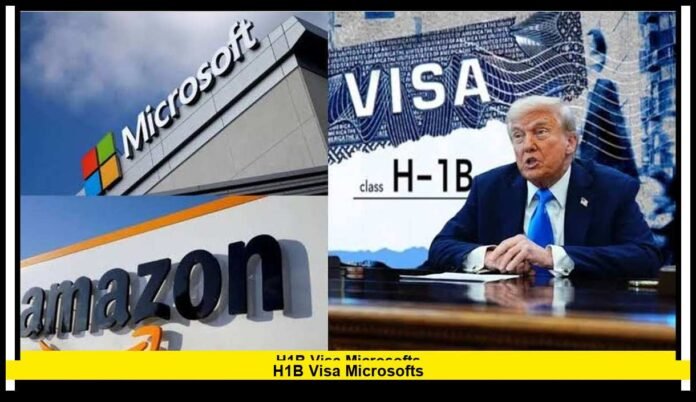

The latest h1b visa microsoft development has put thousands of foreign technology workers and prospective immigrants under renewed scrutiny after the Trump administration suspended Microsoft from a federal employment-based green card program. The action announced October 8, 2026, is part of a broader immigration enforcement campaign focused on alleged misuse of H-1B visas, employment practices and the protection of U.S. workers.
The government action is significant because Microsoft is one of the largest employers of highly skilled foreign professionals in the United States. While the announcement does not mean that every Microsoft employee with H-1B status has lost legal status, it could create serious uncertainty for workers whose long-term immigration plans depend on employer-sponsored permanent residency.
What Happened to Microsoft’s Green Card Program?
The Trump administration announced that Microsoft has been suspended from participating in the Department of Labor’s Permanent Labor Certification, or PERM, program.
PERM is an important stage in many employer-sponsored employment-based green card cases. It is designed to establish that an employer has tested the U.S. labor market and that hiring a foreign worker meets federal requirements.
Vice President JD Vance announced the Microsoft action as part of a wider federal crackdown involving companies accused of abusing immigration programs.
The administration has alleged that Microsoft used foreign-worker programs in a manner that disadvantaged American employees. Officials have pointed to Microsoft’s workforce reductions and its substantial use of H-1B workers as reasons for heightened scrutiny.
The government has also taken action involving other large technology and IT-services companies.
Importantly, the announcement concerns Microsoft’s participation in the PERM system. It is not the same as announcing the cancellation of all existing Microsoft H-1B visas.
Does the Microsoft Decision Cancel H-1B Visas?
No.
The latest government action does not automatically cancel the H-1B status of every foreign employee working at Microsoft.
H-1B status and PERM labor certification are separate components of the U.S. employment-based immigration system.
An H-1B visa allows an eligible foreign professional to work temporarily in a qualifying specialty occupation for a sponsoring employer. PERM, by contrast, can be part of the process an employer follows when seeking permanent residency for a foreign worker.
This means an employee who already has valid H-1B status should not automatically assume that the Microsoft PERM suspension terminates that status.
The practical consequences can nevertheless be significant for workers who were relying on Microsoft to move their cases toward permanent residency.
Why PERM Is So Important for Foreign Workers
For many employment-based green card applicants, PERM is one of the most important steps in the immigration process.
The employer generally must conduct required recruitment activities and demonstrate that there are not qualified U.S. workers available for the position under the applicable rules.
Once the labor certification is approved, the employer can generally proceed with the next stages of the employment-based immigration process.
For an H-1B worker, the green card process is particularly important because H-1B status is temporary.
Many foreign technology professionals spend years working in the United States while waiting for an employment-based green card. Delays or interruptions at an early stage can therefore have consequences much later in the immigration process.
The Microsoft suspension could make that timeline less predictable for affected employees.
Who Could Be Most Affected?
The people most likely to face immediate uncertainty are Microsoft workers whose green card cases depend on the PERM process and have not yet moved beyond that stage.
Potentially affected groups can include employees who:
- Are currently working for Microsoft in H-1B status
- Are waiting for Microsoft to begin the PERM process
- Have a PERM case pending
- Were preparing for labor certification
- Are planning a long-term employment-based immigration strategy
- Depend on Microsoft sponsorship to progress toward permanent residency
The impact will not necessarily be identical for everyone.
An employee whose PERM has already been approved and whose case has progressed to later immigration stages may be in a different position from someone whose PERM filing has not yet been completed.
The precise effect can also depend on the status of the individual worker, the timing of filings and future government guidance.
Microsoft Has Become a Major Focus of H-1B Enforcement
Microsoft’s position in the technology industry makes the development particularly notable.
The company employs a large number of professionals in software engineering, cloud computing, artificial intelligence, cybersecurity, data science and other specialized occupations.
The H-1B program has historically played an important role in helping major technology companies recruit international talent for specialized positions.
The Trump administration has increasingly argued that the program should be used primarily for highly skilled workers who complement, rather than replace, the American workforce.
Federal agencies have been directed to pay closer attention to employers that have conducted layoffs involving similarly situated U.S. workers.
That policy is particularly relevant to large technology companies that have simultaneously reduced portions of their workforce while continuing to seek specialized workers.
Why Microsoft’s Layoffs Are Part of the Debate
Microsoft’s workforce reductions have become an important part of the government’s argument.
Officials have questioned whether companies should continue relying on foreign-worker programs when American employees in comparable roles have recently been laid off.
The administration has characterized this as a worker-protection issue.
Microsoft’s position and the government’s allegations should be distinguished, however. Government accusations do not by themselves establish that a company has violated every immigration or employment rule mentioned in public statements.
The ongoing investigations and administrative actions could provide additional details about the government’s specific concerns.
For workers, the most important question is how those proceedings ultimately affect individual immigration cases.
Broader H-1B Restrictions Are Also in Effect
The Microsoft action comes at a time when the federal government is already imposing tighter restrictions on H-1B immigration.
In September 2026, President Donald Trump extended restrictions on the entry of certain H-1B workers through September 2027.
Under the current policy, certain H-1B workers who are outside the United States are subject to a $100,000 payment requirement associated with qualifying petitions, unless an applicable exception applies.
The administration says the policy is designed to discourage lower-paid or lower-skilled use of the H-1B system and encourage employers to prioritize highly skilled positions.
The government has also moved toward a wage-weighted H-1B selection system.
Under the newer system, higher-paid positions receive greater consideration than lower-paid positions in the selection process.
Together, these changes represent a major shift in how the administration approaches employment-based immigration.
How the New Rules Could Affect Microsoft Recruitment
Microsoft and other large technology companies may have to consider immigration costs and regulatory risks more carefully when recruiting foreign professionals.
For a company hiring someone already legally working in the United States, the immigration situation may be different from recruiting an employee who is outside the country and requires entry based on a new H-1B petition.
The distinction could influence hiring decisions, relocation plans and international recruitment.
Companies may also need to conduct more detailed reviews of their workforce practices before sponsoring foreign workers.
This could make immigration processing slower or more complicated for certain employees.
What Indian Professionals Should Know
The development is especially important for Indian technology professionals.
Indian nationals make up a substantial portion of the U.S. H-1B workforce, particularly in technology and engineering occupations.
Many Indian professionals working in the United States use the H-1B system as a temporary employment pathway while pursuing an employment-based green card.
Because employment-based immigration can involve long waiting periods, disruption at the PERM stage may have long-term consequences.
Indian workers at Microsoft should therefore pay attention to the exact stage of their immigration case rather than assuming that the suspension has the same effect on everyone.
The same caution applies to professionals considering Microsoft employment from outside the United States.
What Current Microsoft H-1B Employees Should Do
Employees with pending immigration cases should determine exactly what filings have already been submitted and approved.
Important documents and milestones may include:
- H-1B approval notices
- H-1B visa validity
- H-1B extension filings
- H-1B transfer filings
- PERM labor certification
- Employment-based immigrant petitions
- Adjustment-of-status applications
- Priority dates
- Employment authorization documents
Workers should also communicate with their employer’s immigration team to determine whether a particular case is affected by the latest federal action.
Because immigration law can vary significantly depending on individual circumstances, employees facing a major status decision should consider obtaining advice from a qualified U.S. immigration attorney.
Could Microsoft Challenge the Government’s Decision?
The latest action could potentially lead to further legal and administrative disputes.
The government has imposed the suspension as part of a broader enforcement initiative, while affected companies may seek clarification or challenge actions they believe are improper.
The ultimate outcome could depend on additional agency decisions, investigations, court proceedings and future immigration policies.
For now, the most important point is that the situation remains active rather than settled.
Additional guidance could determine how pending PERM applications are handled and whether affected employers can eventually regain access to the program.
What It Means for Future Microsoft Green Card Sponsorship
The biggest uncertainty is whether Microsoft will be able to resume normal PERM activity and how long any suspension will remain in place.
If the restriction continues, foreign employees could face delays in starting or advancing employer-sponsored green card cases.
For workers already deep into the employment-based immigration process, the effect may depend on whether their cases have moved beyond the labor-certification stage.
For new employees, the situation could influence whether and when an employer begins permanent-residency sponsorship.
Microsoft could also adjust its immigration policies in response to the changing regulatory environment.
The Bigger Picture for U.S. Technology Immigration
The Microsoft case is larger than one company.
The administration has made immigration program enforcement a central part of its labor-market policy, particularly in industries where employers rely heavily on international workers.
Technology companies are likely to remain under close scrutiny because of their substantial use of H-1B professionals and their recent workforce restructuring.
At the same time, U.S. technology companies argue that access to specialized international talent is important for maintaining competitiveness in areas such as artificial intelligence, cloud computing and advanced software development.
The debate is therefore likely to continue between companies seeking specialized talent and policymakers seeking stronger protections for U.S. workers.
What Comes Next?
The next stage will depend on the federal government’s investigations, additional Department of Labor guidance and Microsoft’s response.
Workers should watch for official announcements concerning PERM applications, pending green card cases and H-1B processing.
It is also important to distinguish confirmed policy changes from social media reports or speculation. Immigration rules can change quickly, and a headline about one company’s PERM status does not automatically establish a new rule for every H-1B employee in America.
For Microsoft workers, the key issue is the status of their individual case and whether the government action directly affects the immigration stage they are currently pursuing.
Final Takeaway
The latest h1b visa microsoft news highlights a major change in the U.S. employment-based immigration environment. The Trump administration has suspended Microsoft’s access to the PERM labor-certification program while accusing the company of improperly using foreign-worker programs and disadvantaging American employees.
The decision does not automatically cancel existing H-1B status, but it could complicate or delay green card sponsorship for affected foreign workers.
For Microsoft employees and prospective hires, understanding the difference between H-1B status, PERM labor certification and the later stages of the green card process is now more important than ever.
As federal immigration enforcement continues to evolve, future announcements could determine how Microsoft’s sponsorship programs operate and how affected employees move forward with permanent residency.
Stay tuned for the latest verified U.S. immigration developments, and share your thoughts on how the new Microsoft immigration restrictions could affect technology workers.