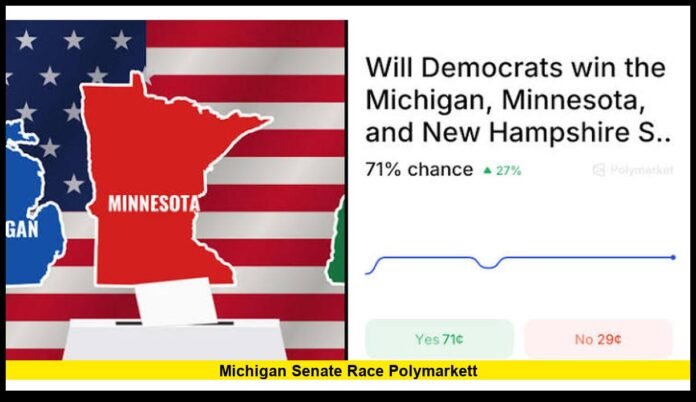

The Michigan Senate Race Polymarket market is drawing attention as voters prepare for the November 2026 election, with Democrat Abdul El-Sayed and Republican Mike Rogers competing for a seat that could influence the balance of power in the U.S. Senate. Prediction markets offer a real-time perspective on how traders assess political outcomes, but their prices must be considered alongside public opinion polls, candidate platforms, campaign developments, and the issues shaping Michigan’s electorate.
The contest has national significance because both parties are working to strengthen their positions in Congress during a consequential midterm election year. Michigan’s industrial economy, politically diverse electorate, and importance in presidential and congressional elections make the Senate contest a focal point for political observers. As Election Day approaches, voters and market participants will be watching for signs of momentum, changes in public sentiment, and developments that could alter the candidates’ prospects.
Why Michigan’s 2026 Senate Election Is Receiving National Attention
Michigan is one of the states where local concerns frequently intersect with national political debates. Manufacturing, international trade, healthcare costs, energy prices, employment, and federal spending all have the potential to influence how voters evaluate candidates.
The Senate seat is open following Democratic Senator Gary Peters’ decision not to seek reelection. An open-seat election creates a different political environment from a race in which an incumbent is defending a record in office. Both parties must persuade voters that their nominees offer the stronger direction for the state and the country.
The contest also matters because control of the Senate affects the confirmation of federal judges, consideration of legislation, oversight of the executive branch, and the broader legislative agenda. Even a single seat can become consequential when the chamber is closely divided.
For national party organizations, Michigan represents an opportunity to demonstrate that their economic and political messages can attract voters beyond their most loyal supporters. For residents, the immediate question is which candidate is best positioned to address their priorities.
Abdul El-Sayed: The Democratic Candidate’s Strategy
Abdul El-Sayed enters the general election with a background in public health and a political platform centered on healthcare affordability, economic fairness, and stronger protections for working Americans.
He previously served as Detroit’s health department director and became known nationally through his progressive policy positions. His experience in public health provides a foundation for his arguments about access to medical care, the cost of prescription drugs, and the relationship between household finances and public policy.
El-Sayed supports a Medicare for All approach, which would substantially change the way Americans obtain and finance health insurance. He has also emphasized the need to address economic inequality and challenge practices that he believes leave families struggling with rising expenses.
His victory in the Democratic primary over Representative Haley Stevens was an important milestone in his campaign. The result established him as the party’s nominee, but a competitive primary can leave candidates with the additional task of bringing together voters who supported different contenders.
In the general election, El-Sayed must communicate his progressive agenda to Democratic voters while making a persuasive case to independents and voters who may be dissatisfied with both parties. His ability to connect national policy proposals to everyday financial concerns could play a significant role in determining his performance.
The Opportunities and Challenges Facing El-Sayed
El-Sayed’s supporters may be attracted to his focus on healthcare reform, affordability, and economic inequality. His campaign can use these issues to argue that federal policy should respond more directly to the financial pressures facing households.
However, progressive proposals can also generate disagreement among voters who prefer more incremental reforms or are concerned about the cost and implementation of major policy changes.
The campaign therefore faces two related challenges: maintaining enthusiasm among its core supporters and demonstrating broader appeal. Strong voter engagement in urban areas, combined with sufficient support in suburban communities and other competitive parts of Michigan, could be important to his chances.
Mike Rogers: The Republican Candidate’s Approach
Mike Rogers brings a different political background to the election. A former U.S. representative, Rogers has experience in federal politics and is seeking to translate that experience into a statewide victory.
His campaign has emphasized economic conditions, manufacturing, energy costs, public safety, and policies intended to reduce financial pressure on American families. These issues have particular relevance in Michigan, where automotive production, suppliers, logistics, and international trade play important roles in the economy.
Rogers is also attempting to appeal to voters who want Republican leadership in Washington but have concerns about specific administration policies. His position on tariffs illustrates the potential complexity of that strategy.
Michigan’s businesses and workers can be affected by trade relationships with Canada, especially when tariffs increase costs or introduce uncertainty into cross-border supply chains. Rogers has called for an end to the U.S.-Canada tariff dispute, creating a point of disagreement with President Donald Trump’s trade approach.
He has also called for an end to the war with Iran, expressing concerns about the conflict and its economic consequences.
These positions could help Rogers distinguish himself from the administration on particular issues while maintaining his broader Republican identity. Whether that distinction attracts enough voters to change the direction of the race remains an important question.
What Rogers Needs to Demonstrate
Rogers must persuade voters that his economic proposals can improve conditions for Michigan families and businesses. He also needs to establish that his experience in Congress is an advantage and that he can represent the state’s interests effectively in Washington.
Winning over independents may be especially important. Voters concerned about manufacturing, energy prices, trade policy, and the cost of living may evaluate candidates according to practical outcomes rather than party loyalty alone.
His campaign’s challenge is to turn those concerns into a convincing case for Republican representation while responding to Democratic criticism of his positions and political alliances.
What Prediction-Market Odds Can Tell Voters
Prediction markets provide a different way to assess an election. Instead of asking a representative sample of voters whom they support, these platforms allow participants to trade contracts associated with specified outcomes.
The resulting prices can reflect participants’ collective expectations about the likelihood of a candidate winning. Prices may respond to polling releases, endorsements, campaign controversies, economic news, debate performances, and changes in trading activity.
A contract priced at 70 cents, for example, may be interpreted as indicating a market-implied probability of approximately 70%. However, that interpretation is not a guarantee and does not mean that 70% of voters support the candidate.
Market prices can also be affected by trading fees, liquidity, bid-ask spreads, and the specific rules governing a contract. Prices across different candidates may not add up to exactly 100%, depending on the market’s structure and trading conditions.
For election watchers, the principal value of a prediction market is its ability to show how expectations change over time. It can be useful to compare market movements with public polling and major campaign events, rather than treating a single price as a definitive forecast.
How to Read the Michigan Senate Race Polymarket Market
Anyone monitoring the Michigan Senate Race Polymarket market should distinguish between short-term fluctuations and meaningful changes in the broader election outlook.
A candidate’s price might rise after a strong debate performance or favorable news coverage. Yet the movement could also reflect a small number of trades or a temporary reaction that does not correspond to a lasting change in voter preferences.
Several indicators can help provide context:
- Price movements: Compare current prices with earlier levels to determine whether expectations are shifting consistently.
- Trading volume: Greater activity can help explain how much attention a market is receiving, although volume alone does not establish forecast accuracy.
- Polling averages: Multiple credible polls can offer a broader view than a single survey.
- Campaign developments: Endorsements, fundraising, advertising, and candidate appearances may influence both voters and traders.
- Market rules: Check how the contract defines a winning outcome and when it will be resolved.
Readers should also consider whether a market is sufficiently liquid. When relatively few participants are trading, prices can move sharply without representing a broad consensus.
Most importantly, a candidate who is favored by a prediction market can still lose. Election forecasts describe uncertainty; they do not remove it.
The First Debate and Its Potential Consequences
The candidates’ first televised debate on October 8 brought their differences into sharper focus. Both attacked the other’s political record and positions on major issues, producing a confrontational exchange.
Rogers challenged El-Sayed’s policy positions and sought to question whether his proposals would deliver practical results. El-Sayed criticized Rogers’ alignment with Trump and argued that Michigan needs a senator prepared to challenge federal policies that he considers harmful to working families.
Foreign policy also featured prominently, including disagreements over international conflicts and American support for Israel. The candidates presented contrasting views about the role the United States should play abroad and how federal decisions affect taxpayers.
Debates can influence elections in several ways. They may introduce candidates to viewers who have not followed the campaign closely, reinforce existing opinions, or raise concerns about a contender’s judgment and preparedness.
However, the immediate media reaction does not necessarily predict the final result. A widely discussed exchange may have little effect on voting preferences, while an apparently minor moment may resonate with particular groups of voters.
The most informative assessment will come from examining subsequent polling, campaign reactions, and sustained changes in market prices rather than assuming that one debate determines the contest.
Economic Issues Could Shape the Final Result
Manufacturing and Trade
Michigan’s manufacturing sector gives trade policy an unusually direct connection to employment and household finances. Automotive production depends on complex supply chains that cross national borders, and policy changes can affect costs for manufacturers, suppliers, and consumers.
Rogers’ criticism of the tariff dispute could appeal to voters concerned about uncertainty in cross-border commerce. El-Sayed can use the issue to question the economic direction associated with Republican leadership.
The broader question is which candidate offers the more convincing plan for supporting jobs, protecting workers, and maintaining Michigan’s competitiveness.
Healthcare and Prescription Drug Costs
Healthcare affordability is another major dividing line. El-Sayed advocates a fundamental restructuring of health insurance through Medicare for All, while Rogers emphasizes affordability measures and changes intended to help consumers navigate healthcare costs.
Voters may consider not only the goals of these proposals but also their potential costs, implementation, and effects on existing insurance arrangements.
Because healthcare spending can consume a substantial portion of household budgets, the candidates’ plans may be particularly relevant to families worried about medical bills and prescription prices.
Energy Prices and Household Expenses
Energy costs influence household budgets as well as manufacturing, transportation, and business operations. Higher fuel and electricity costs can affect how voters judge the performance of elected officials, even when some of the underlying factors originate outside state or federal control.
Both campaigns have an incentive to explain how their policy priorities would affect consumers and businesses. The persuasiveness of those explanations could matter as voters make their final decisions.
Turnout and the Road to Election Day
The general election is scheduled for November 3, 2026. With the campaign entering its final stretch, voter engagement and turnout will be essential factors to monitor.
Michigan’s electorate includes major urban centers, suburban communities, smaller cities, and rural areas with differing political priorities. A statewide victory requires a coalition broad enough to compete across this diverse landscape.
Absentee voting is underway, and the state’s early in-person voting period is scheduled for October 24 through November 1. These voting options give eligible residents additional opportunities to participate before Election Day.
Early voting figures must be interpreted carefully. The number of ballots cast does not, by itself, establish which candidate is leading because the political preferences of those voters may not be known. A reliable assessment requires appropriate data and context.
Campaign organization, voter registration efforts, and the ability to motivate supporters could become increasingly important as Election Day approaches.
What Could Change the Election Forecast?
Several developments could alter expectations during the final weeks of the campaign.
New polling could reveal a closer contest than previously indicated, while endorsements or campaign controversies might change perceptions of either candidate. Economic developments involving tariffs, energy costs, or employment could also affect which issues dominate public discussion.
Another important factor is the difference between national political sentiment and state-level voting behavior. Michigan voters may consider the president’s performance, but they will also evaluate the Senate candidates’ own records, proposals, and credibility.
For that reason, no single indicator should be treated as conclusive. Prediction-market prices, polling, turnout information, and campaign activity each offer a different perspective on the contest.
Final Outlook
Michigan’s Senate election is an important test of the political environment ahead of the 2026 midterms. Abdul El-Sayed is presenting a progressive agenda focused on healthcare and economic fairness, while Mike Rogers is emphasizing his federal experience, manufacturing, affordability, and public safety.
The debate, economic concerns, and national political divisions are likely to remain central to the campaign. Prediction markets can help observers follow changing expectations, but they cannot establish the eventual winner before votes are counted.
As November 3 approaches, the strongest analysis will combine current market prices with credible polling, verified campaign developments, and careful attention to Michigan’s diverse electorate.
Who do you think will win Michigan’s Senate race, and which issue will matter most to voters? Share your thoughts in the comments and follow the latest election developments.