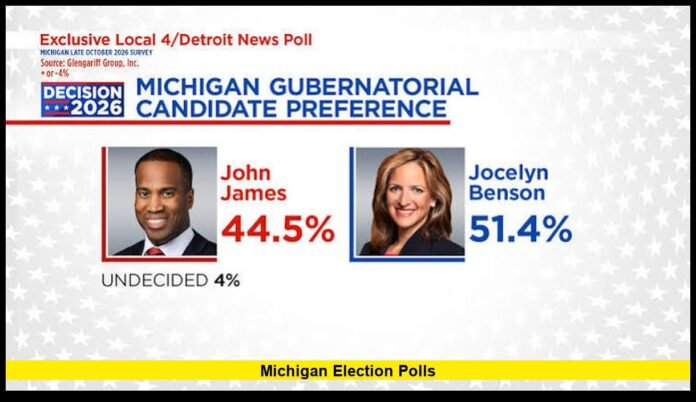

As Americans head to the polls on November 3, Michigan election polls are attracting national attention as voters decide two major statewide contests that could influence the political direction of the country. The open U.S. Senate seat and the race for governor have become important tests for Democrats and Republicans, with candidate support, voter turnout, and economic concerns shaping the final election landscape.
Michigan is among the states receiving considerable attention during the 2026 midterm elections. Its competitive political environment makes the outcome especially important for parties seeking to strengthen their positions at both the state and federal levels.
Democrat Abdul El-Sayed is competing against Republican Mike Rogers for the Senate seat, while Democrat Jocelyn Benson and Republican John James are contesting the governorship.
Although pre-election surveys have provided useful indications of voter preferences, the actual ballots will determine the winners. Election Day turnout and the distribution of votes across Michigan’s urban, suburban, and rural communities will be particularly important.
Michigan’s Senate Contest Draws National Attention
The U.S. Senate race is one of the most consequential contests on Michigan’s 2026 ballot. The seat became open after Democratic Sen. Gary Peters decided against seeking another term, creating an opportunity for both parties.
Abdul El-Sayed represents the Democratic side of the contest, while Republican Mike Rogers is seeking to secure the seat for his party.
The campaign has highlighted disagreements over economic policy, healthcare, federal spending, manufacturing, and national leadership. Both candidates are seeking support from voters who believe their priorities would better address Michigan’s challenges.
Pre-election surveys generally placed El-Sayed ahead in several polling averages, although the size of his advantage differed among polling organizations.
That distinction matters because a polling lead does not establish an election winner. The final outcome depends on the people who actually cast ballots, not simply those who participated in surveys.
Control of the Senate adds another layer of importance. A Michigan victory could influence the national balance of power and affect which party controls congressional committees, legislative priorities, and confirmation proceedings.
Benson and James Compete for Michigan’s Governorship
The gubernatorial election is another major political contest attracting attention across the state.
Jocelyn Benson, Michigan’s Democratic secretary of state, is seeking the governor’s office against Republican John James, a member of the U.S. House of Representatives.
The candidates have presented different approaches to state leadership, economic development, public services, education, and government priorities.
Benson entered Election Day with a favorable position in many published surveys. Several pre-election polls showed her ahead of James, although the margin varied depending on the polling organization.
James has sought to make the contest competitive by emphasizing economic performance, public safety, and concerns about the direction of state government.
The outcome will determine who leads Michigan’s executive branch and helps shape policy decisions affecting millions of residents.
For voters, the contest is not simply about party control. It also concerns the state’s budget, infrastructure, education system, business environment, and long-term economic development.
What the Final Polling Numbers Reveal
The final surveys published before Election Day suggest that Michigan’s Senate and governor contests have different levels of uncertainty.
In the Senate race, several late polls show El-Sayed leading Rogers, but the size of the advantage varies. One survey conducted from October 31 through November 1 placed El-Sayed at 51% and Rogers at 45%. Another late survey showed a much narrower gap, illustrating the differences between polling organizations.
The governor’s race presents a more consistent picture. Recent surveys generally put Benson ahead of James, with some showing a single-digit margin and others indicating a larger advantage.
These differences are important because polls are snapshots of voter preferences during specific periods. They should not be combined indiscriminately, particularly when surveys use different sampling methods or voter populations.
Turnout remains the decisive factor. Even a candidate with a measurable polling advantage must attract enough supporters to vote and maintain that advantage across the state’s diverse electorate.
Economic Concerns Could Shape Voter Decisions
Michigan’s economic conditions are likely to influence how voters evaluate the candidates. The cost of living, employment opportunities, manufacturing investment, and household financial security remain important concerns for many families.
The state’s connection to the automotive industry gives economic policy particular significance. Changes in vehicle production, trade, technology, and investment can affect workers and businesses throughout Michigan.
Candidates may offer different approaches to supporting employment, attracting investment, and managing public spending. Voters will decide which proposals they consider most credible and beneficial.
Healthcare affordability is another issue that can influence voting decisions. Insurance costs, prescription prices, and access to medical services affect households across income groups.
National political attitudes also matter. The Senate election is closely connected to federal policymaking, while the governor’s race focuses more directly on Michigan’s state government and its priorities.
These concerns may help explain why voters approach the two contests differently, even when both elections feature candidates from the same major parties.
Michigan Counties to Watch on Election Night
Regional results will help explain how the statewide contests develop.
Wayne County is a major Democratic stronghold, and turnout in Detroit and surrounding communities could influence the statewide margin.
Oakland County is important because suburban voters can affect the balance between Democratic and Republican support. Candidate performance in this area may offer clues about whether the polling trends hold.
Macomb County is another closely watched region where economic concerns, manufacturing employment, and political preferences could influence the result.
Kent County, which includes Grand Rapids, is significant in western Michigan. Its results may help show whether Republican candidates are performing strongly enough to narrow Democratic advantages elsewhere.
Genesee and Washtenaw counties also deserve attention because their voting patterns provide additional context for the statewide picture.
No individual county determines the result. Analysts must examine vote totals across Michigan, including smaller communities and rural areas, before reaching conclusions about either contest.
When Will Michigan Election Results Be Known?
Michigan voters cast their ballots on November 3, 2026. Polls generally close at 8 p.m. local time, with the applicable local time zone determining the clock time in each jurisdiction.
Initial results may become available after polls close, but reporting speed varies among counties and election offices. Some areas may report substantial portions of their votes before others have completed processing.
Absentee ballots and in-person votes can also appear in reporting updates at different times. As a result, an early lead does not necessarily indicate who will ultimately win.
Election officials must continue counting and verifying ballots, completing the required canvassing procedures, and certifying the results.
Media organizations may project winners before certification when the available evidence supports a conclusion. Such projections are not the same as official certified results.
Readers should therefore distinguish between preliminary vote totals, projected winners, and the final results confirmed through Michigan’s election procedures.
What the Michigan Election Means for National Politics
The Senate outcome could influence the balance of power in Washington, affecting legislation, committee leadership, and federal appointments. A Democratic victory would help the party pursue its effort to gain control of the chamber, while a Republican victory would support the party’s position.
The governor’s race has a different but equally important consequence for Michigan residents. The winner will oversee the executive branch and help set priorities involving the state budget, education, infrastructure, and economic development.
The results may also influence how both parties approach future campaigns in the Midwest. Strong performances among suburban voters, younger voters, or working-class communities could shape campaign strategies beyond Michigan.
However, the state’s results should be interpreted in their own context. Local candidates, regional concerns, and differences in turnout can produce outcomes that do not mirror national trends.
Final Outlook
The latest available Michigan election polls point to a competitive Senate contest and a governor’s race in which Benson holds an advantage in many surveys. El-Sayed has led Rogers in several final polling averages, while James faces the challenge of overcoming Benson’s consistent lead.
The final outcome will depend on actual voter participation, the distribution of support across the state, and the counting of ballots after polls close. Polling estimates provide useful context, but they cannot replace official election results.
Stay tuned to Michigan’s election developments, and share your prediction in the comments: which candidates do you think will win their statewide races?